
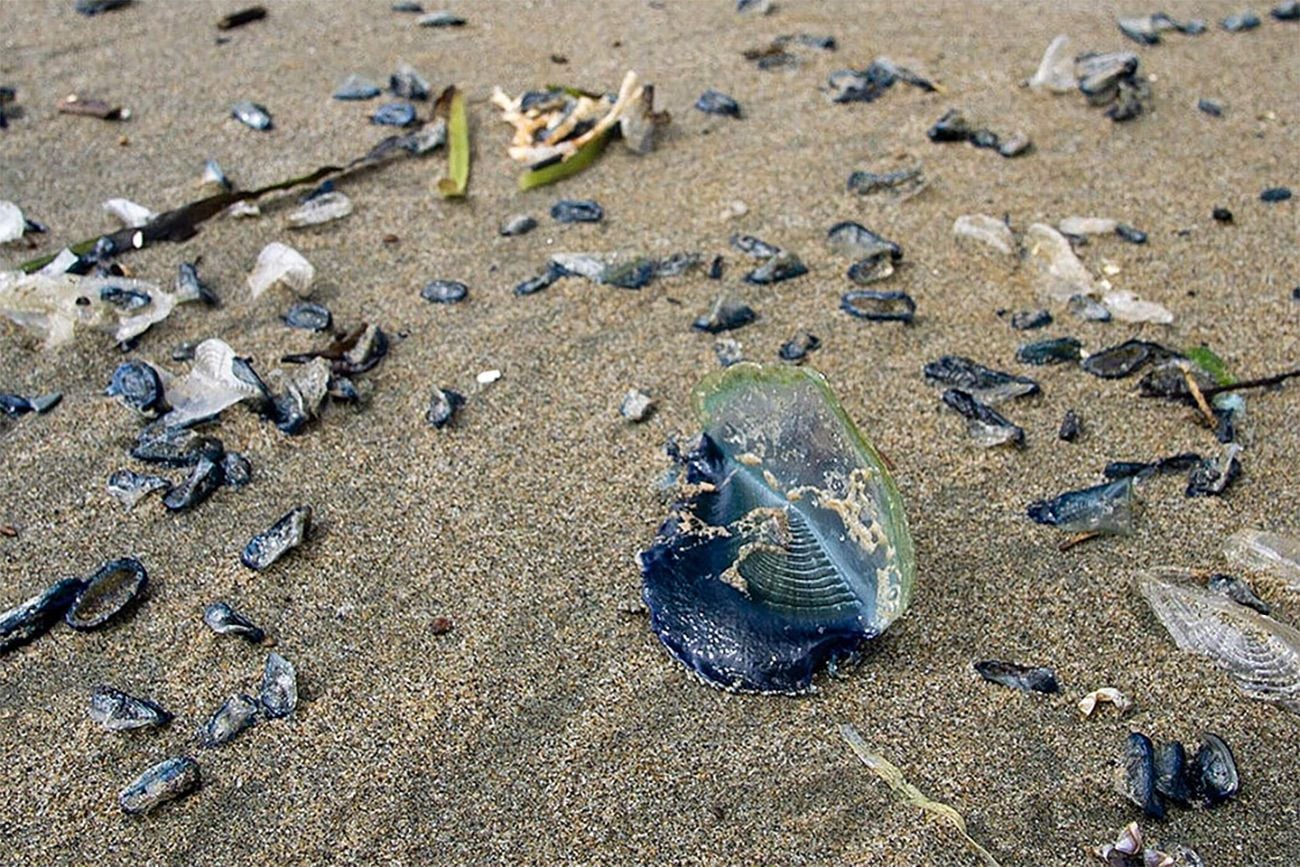
'Tis the season once more for Velella velella, also known as "by-the-wind sailors," which tend to wash up onshore en masse on NorCal beaches in the spring and sometimes summer.
There was a mass beaching of the little blue guys with their distinctive jelly "sails" on Baker Beach, Crissy Field, and Ocean Beach (and likely elsewhere) on Monday, as the Chronicle reports. And it is a natural phenomenon for this time of year — onshore winds catch the creatures, which use wind currents to sail over the surface of the ocean, and can push them toward the shoreline, particularly after storms.
And being free-floating hydrozoans without any means of steering or sight, they just end up beached.
Velella velella do have stinging tentacles that reach down into the water to catch food, however these don't tend to harm humans, as the National Park Service explains.
"Velella are not true jellyfish, but are related to jellyfish, as well as to sea anemones, corals, and hydroids," says the Park Service. "The Velella is a flat, oval-shaped creature, bluish to purple in color and three to four inches long. The body is relatively firm and has a flexible two-inch-high triangular 'sail' attached to it."
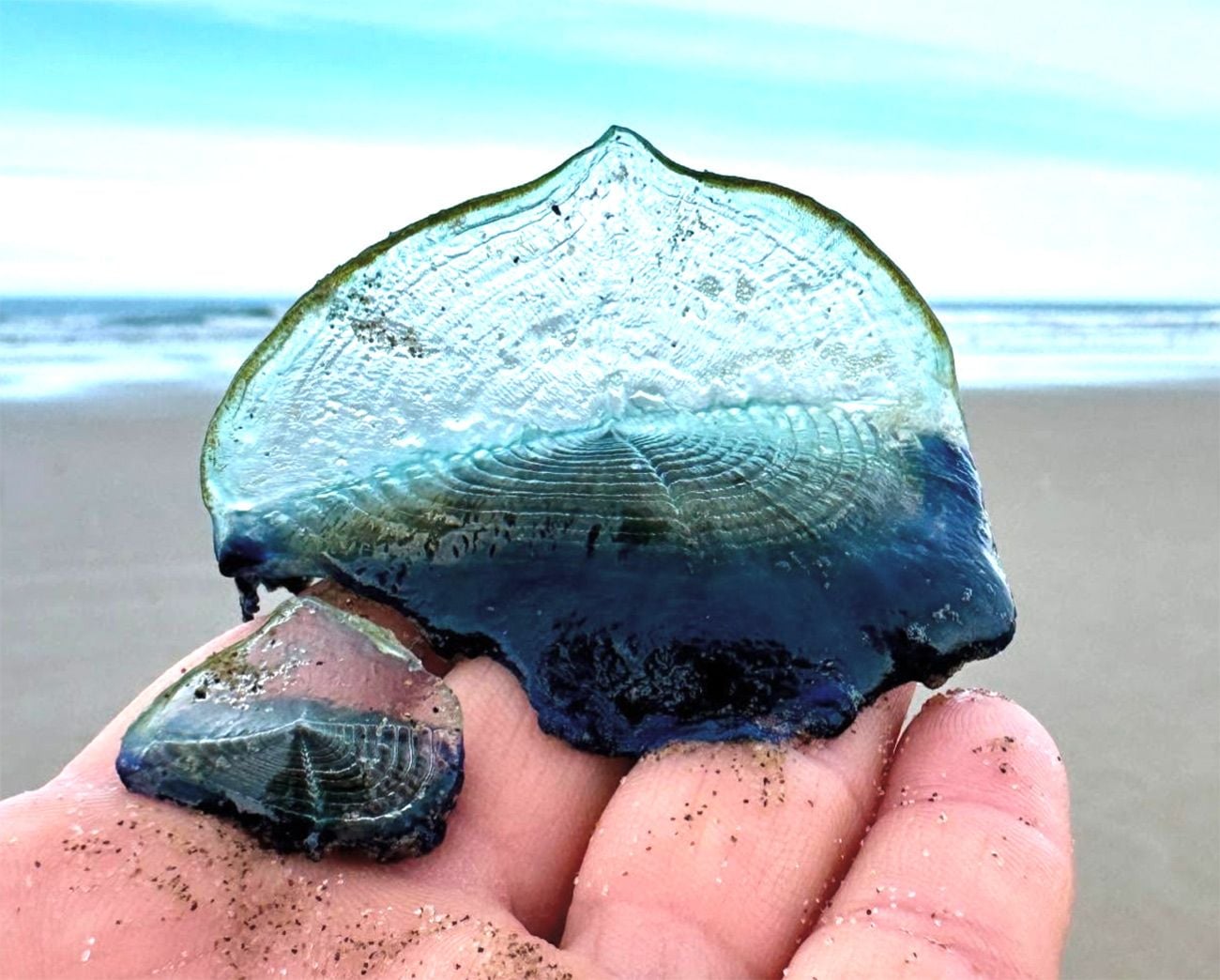
The Velella "feeds on planktonic crustaceans, primarily copepods" as it sails over the ocean surface, and it has few known predators.
These mass beachings have been fairly regular occurrances on local beaches, happening in late March 2025, late April 2024, and mid-April 2023, and social media documentation of these events started ramping up around 2014.
One fascinating fact about these small, semi-transparant hydrozoans: some lean left, and some lean right.
Per the National Park Service:
Some sails on Velella angle to the left and propel the animal left of downwind; others angle to the right and propel the animal right of downwind. Due to the prevailing winds in different parts of the world, left-handed Velella are usually found·in the Northern Hemisphere, while right-handed ones are usually found in the Southern Hemisphere.
Also, their remains don't linger long after these beachings. Per the Park Service, they dry into something that resembles "a cellophane candy wrapper," become brittle, and typically just blow right back into the ocean or get caught in the next high tide.
Previously: Jelly Creatures Stranded En Masse on North Bay Beach
Top image via National Park Service

Join the conversation
Comments
Comments load automatically as this section approaches.