
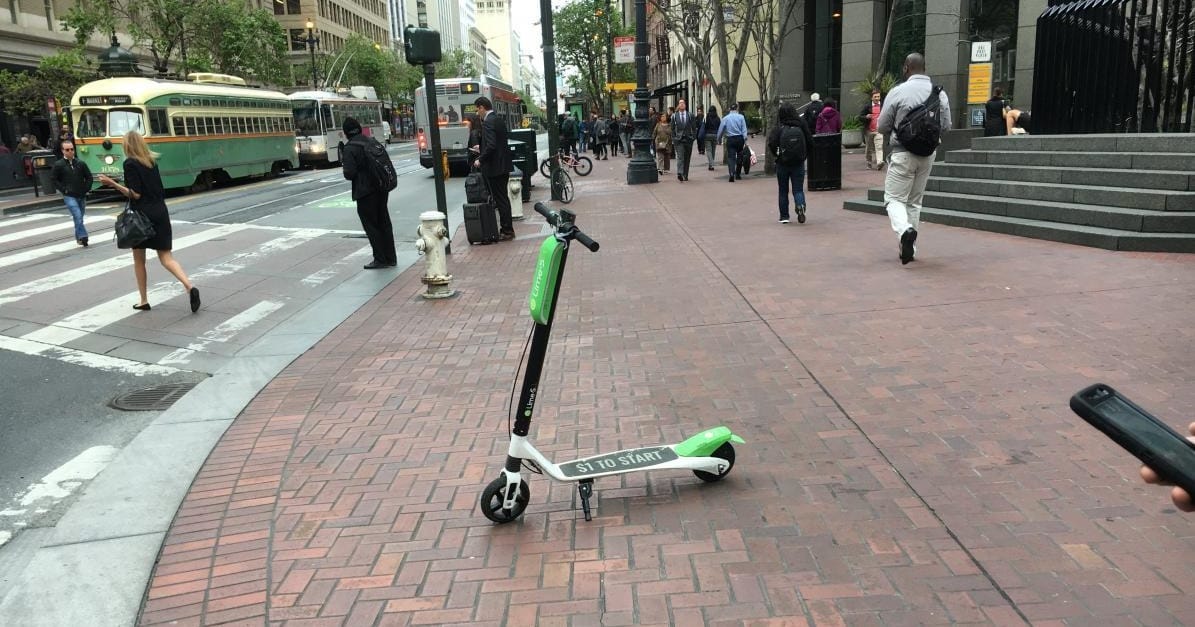
Lime is adding AI-powered cameras to its SF scooters to deter sidewalk riding amid rising injuries and complaints about reckless riders, though questions remain about how the data is stored and used beyond safety.
About 30% of Lime's San Francisco scooter fleet currently has the cameras installed, with the company expecting to outfit its entire fleet by next year, as KRON4 reports.
According to GeekWire, Lime Vision uses artificial intelligence to determine whether a scooter is traveling on a street, bike lane, or sidewalk. When the system detects sidewalk riding, it emits an audible alert and sends a notification through the Lime app telling the rider to move to a permitted area. The alerts continue until the scooter leaves the sidewalk or the rider ends the trip.
The technology comes as injuries involving electric scooters and e-bikes continue to raise concerns. According to the San Francisco Municipal Transportation Agency (SFMTA), there were 210 severe injuries involving e-scooters last year, and another 116 during just the first six months of this year, per KRON4. Meanwhile, 311 reports of sidewalk riding have also surged since 2024.
Lime's rollout in SF follows an earlier deployment in Seattle, which was the first city to receive the technology. The Seattle Times reported in May that the company began testing Lime Vision there ahead of the rollout, with plans to equip approximately 3,500 scooters, or half its Seattle fleet, by June and the entire fleet by the end of the year.
Parker Dawson, Lime's senior regional lead of government relations for the Pacific Northwest, described the audible alerts as a way to make both riders and pedestrians aware when a scooter is being used somewhere it shouldn't be.
“The audible alert very clearly makes you and others around you aware that the vehicle is not where it's supposed to be,” Dawson said, speaking to GeekWire.
Lime, which is based in SF, began developing the camera-based system in 2022, initially planning pilot programs involving nearly 400 scooters in San Francisco and Chicago, as TechCrunch reported at the time. Before investing in its own technology, the company tested systems developed by third-party providers that use computer vision to identify sidewalk riding.
The original camera units were reportedly designed to be retrofitted onto existing scooters, with Lime also developing a version that would be integrated directly into the vehicle.
[Update] After publishing, Lime contacted SFist with additional details about the current version of Lime Vision, including how its cameras operate, how images are processed, and what information is retained.
Lime has previously discussed using the technology for more than detecting sidewalk riding, including identifying improperly parked scooters and pinpointing areas where riders frequently travel on sidewalks. The company also discussed eventually extending Lime Vision to its e-bike fleet. However, Lime says the technology currently being introduced in San Francisco is a new version of Lime Vision and that it has no current plans to expand the technology beyond its e-scooter fleet.
There are also questions about the technology's privacy implications. Lime says the current version of Lime Vision uses a forward- and downward-facing, purpose-built low-resolution camera to understand the riding environment. Images are processed by onboard artificial intelligence during normal operation and discarded before the next trip.
According to Lime, the imagery may show people as indistinct shapes but captures only enough visual detail to classify the scene as sidewalk or not sidewalk. The system is not designed or used to determine anyone's identity, and does not identify people, use facial recognition, or function as a general-purpose video system.
The privacy policy previously cited in this article is not related to Lime Vision, the company said.
In a 2022 interview with Auto Futures, Lime's Alan Clarke said visual data collected through an earlier version of Lime Vision would be stored on US cloud servers to train city-specific algorithms and deleted once that training was complete. That description concerned an earlier iteration of the technology, rather than the current version being rolled out in San Francisco.
Per KRON4, SF Supervisor Danny Sauter has voiced support for the technology but says Lime, Lyft, and other companies operating shared bikes and scooters need to coordinate on pedestrian safety. He also emphasized that camera technology alone won't address the underlying infrastructure problems.
“We need more protected bike lanes. We need more dedicated bike and scooter parking so they aren’t cluttering sidewalks,” Sauter said.
Sauter noted that privately owned e-bikes and scooters are more difficult for the city to regulate and encouraged residents to report sidewalk riding through the city's 311 app, including submitting photographs when possible.
Correction: This article was updated to clarify that the San Francisco rollout involves a new version of Lime Vision, distinguish its current privacy and data-handling practices from those of earlier versions, and correct information about the company's privacy policy and potential expansion to e-bikes. The article has also been updated to reflect Lime's explanation of how the technology processes and discards camera images.
Related: City Extends Lime, Spin Permits But Doesn’t Address Widespread Scooter-Related Complaints

Join the conversation
Comments
Comments load automatically as this section approaches.