
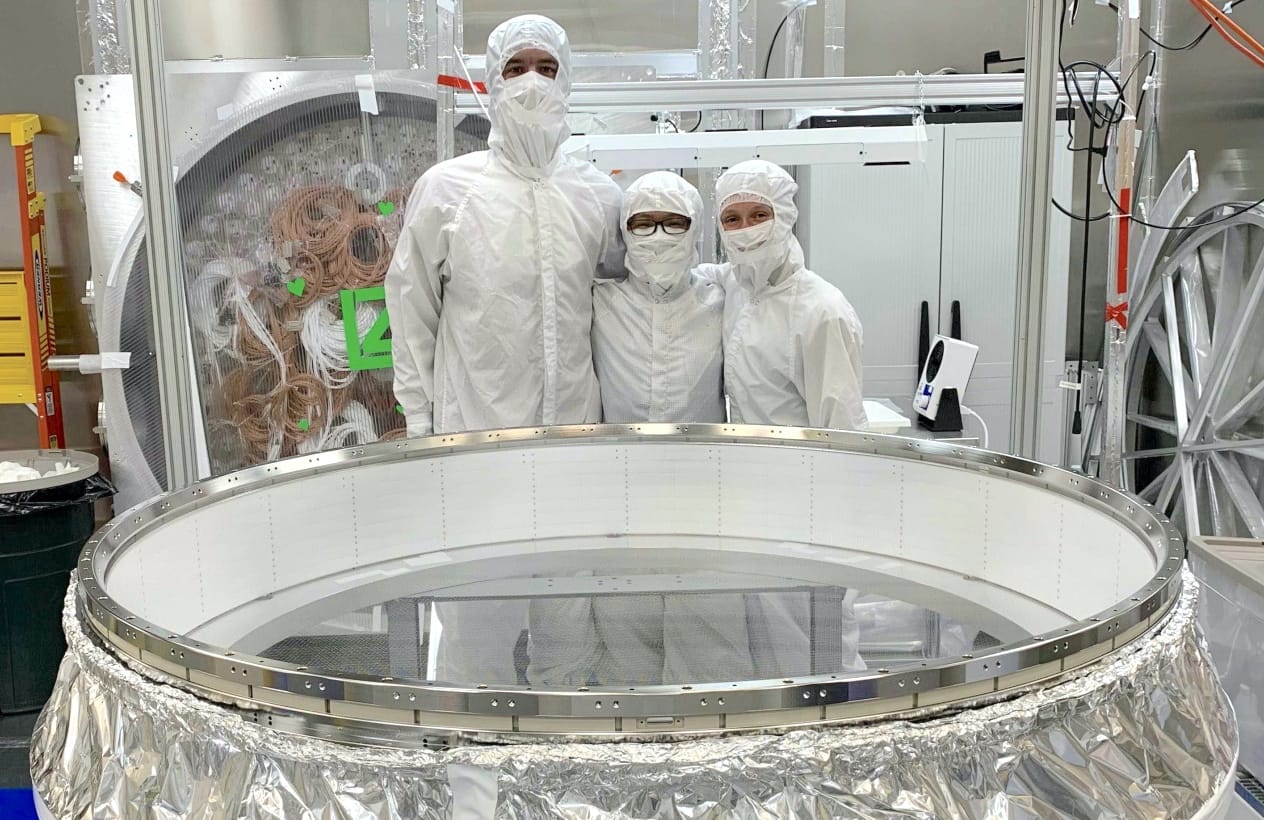
Scientists from Berkeley and Livermore national laboratories are part of a research team investigating what could be the first recorded observation of dark matter, a substance believed to make up most of the universe’s mass.
Researchers with the LZ Project, including physicists from Lawrence Berkeley National Laboratory and Lawrence Livermore National Laboratory, presented their latest findings at a particle astrophysics conference in Japan this month. As Bay Area News Group reports, the project was met with widespread excitement over what could be the first direct observation of dark matter, the invisible substance believed to make up about 85% of the universe’s mass.
The LZ team’s data reportedly included a single unusual interaction that could not be readily explained by known particles. The signal came from a massive detector buried about a mile underground in a former South Dakota gold mine, where 10 metric tons of liquid xenon are shielded from cosmic rays and other interference.
Per the News Group, the experiment is designed to detect the tiny signals produced when a dark matter particle collides with a xenon atom. Researchers analyzing 220 days of data found an interaction in which a xenon nucleus recoiled, producing the type of light and electron signals they were looking for.
The LZ Experiment reportedly launched in 2021 through the Department of Energy, with researchers from Lawrence Berkeley National Laboratory, Lawrence Livermore National Laboratory, and SLAC National Accelerator Laboratory, and the collaboration includes 250 scientists and engineers from institutions around the world.
The finding was especially intriguing because dark matter has reportedly never been directly detected, despite decades of evidence that some unseen form of matter is affecting the movement of galaxies and galaxy clusters. Dark matter also can't be explained by the Standard Model, the framework physicists use to describe known subatomic particles.
Additionally, the possible signal reportedly resembles what physicists would expect from a hypothetical weakly interacting massive particle, or WIMP, one of the leading theories for what dark matter might be.
“The holy grail of particle physics is to search and find things that disagree with the Standard Model,” said Aaron Manalaysay, a Lawrence Berkeley National Laboratory scientist on the project, speaking to the News Group. “And dark matter is one of those, and that motivates everyone.”
The analysis currently stands at 2.6 sigma, well below the five-sigma threshold conventionally required to claim a discovery in particle physics. According to CNN, at that level, there is reportedly a roughly 1-in-200 chance that the result is a statistical fluke.
After months of analysis, researchers estimated there is only a 0.5% chance that a known source of interference produced the event, reportedly making it the most compelling dark matter signal the detector has recorded.
Researchers are continuing to analyze the data in hopes of determining whether the signal becomes more significant.
Alvine Kamaha, a UCLA assistant professor of physics and member of the LZ collaboration, told CNN that researchers need to see additional events and determine whether the signal becomes statistically stronger as more data are collected.
“One event, by itself, is not enough,” Kamaha said.
Lawrence Livermore National Laboratory scientist Jingke Xu stressed the need to avoid interpreting ambiguous data according to what researchers hope to find.
“It’s like mining for gold. The majority of the things you see are rock, things you are not interested in,” Xu said, speaking to the News Group.
Similar experiments at PandaX in China and XENONnT in Italy are reportedly working on related searches that could help determine whether the LZ result can be reproduced.
Benjamin Safdi, a UC Berkeley physicist on the project, told the News Group confirmation could take anywhere from several months to several years. For now, the researchers are treating the result as an unexplained anomaly while they work to rule out other possibilities.
“Whatever it ends up being, it will hint at a deeper structure of nature that is totally unknown,” said Safdi.
Related: Lawrence Livermore Lab Successfully Shoots Mega-Laser That Could Kill Us All

Join the conversation
Comments
Comments load automatically as this section approaches.