
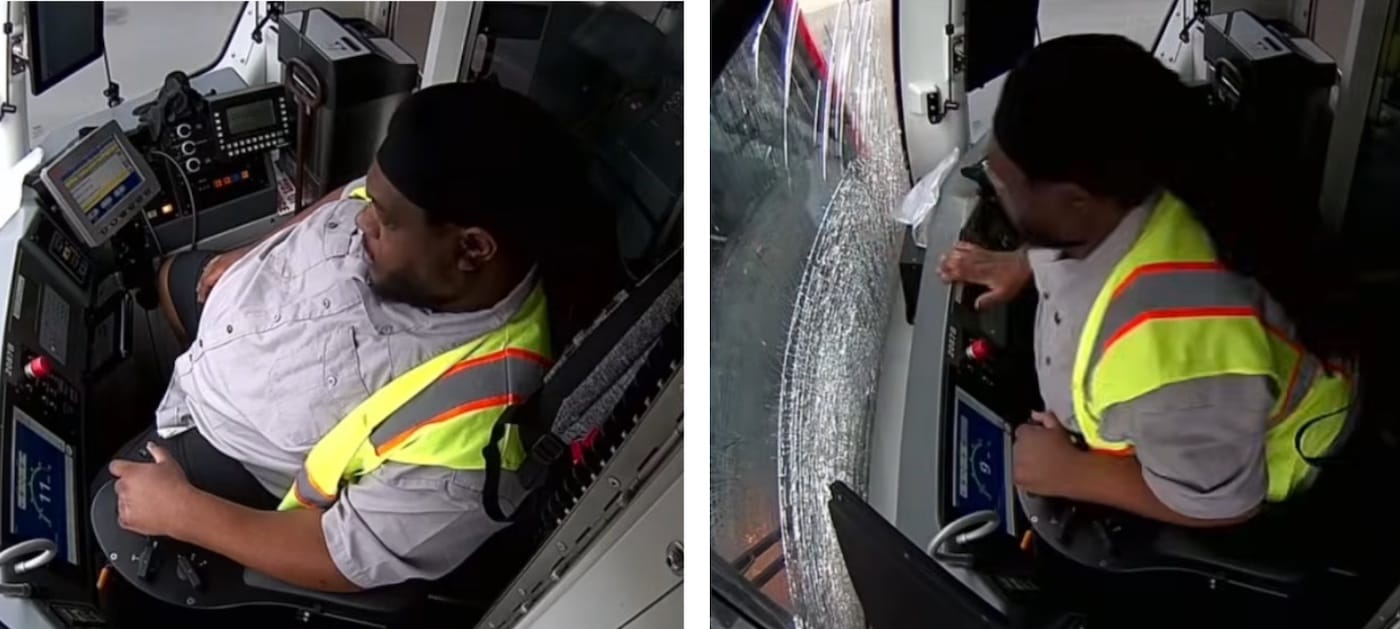
A Muni driver operating an empty L train was filmed crashing into another empty train after he appeared to fall asleep at the controls, which Muni determined was caused by driver fatigue.
The footage, obtained by NorCal Bodycam, shows the Muni operator apparently asleep shortly before the L train reaches the second train, which was stopped on the tracks near the San Francisco Zoo, as ABC 7 reports.
The crash reportedly happened on the morning of July 31 near 47th Avenue and Wawona Street, causing the the L train's windshield glass to shatter. Fortunately both trains were empty, and no one was injured.
The agency said vehicle and infrastructure problems have been ruled out as part of its ongoing investigation, leaving operator fatigue as the initial cause.
“This type of incident is simply unacceptable,” said the agency in a statement.
The July collision follows another incident last September in which a Muni operator was captured appearing to doze off while the crowded N-Judah train she was operating accelerated to 50 mph coming out of the East Portal tunnel at Duboce Avenue. The operator was jolted awake, while several passengers were thrown forward or out of their seats. The SFMTA also determined that incident was caused by “operator fatigue” and subsequently launched a fatigue-awareness education campaign.
The incidents have renewed questions about the safeguards available when operators lose alertness on Muni’s surface-running tracks. According to Hoodline, while Muni Metro uses automated train control to manage speed and spacing underground, surface segments such as the L Taraval require operators to manually control the train and use physical deadman switches, according to SFMTA operating guidelines.
Chronic operator shortages and high absenteeism were reportedly flagged in a 2013 municipal audit of SFMTA transit operations, which found that the agency relied heavily on unscheduled overtime to keep service running, while raising concerns about driver fatigue. California Public Utilities Commission rules now limit light rail operators in safety-sensitive roles to 12 consecutive hours, or 12 hours within a 16-hour period, with at least eight consecutive hours off before a shift.
After last September’s N-Judah incident, the CPUC opened a formal review of SFMTA’s fatigue-management policies to determine whether scheduling problems were systemic.
The issue of operator fatigue also intersects with the long commutes many Muni employees face. A 2019 San Francisco Examiner report found that only about 42% of the agency’s roughly 2,000 operators lived in San Francisco, with many commuting from other parts of the Bay Area after being priced out of the city.
Several operators told the Examiner at the time that they regularly slept in their cars rather than drive home after a shift because they were too exhausted to safely make the trip. The drivers' union argued that higher pay, places for operators to sleep, or a city employee shuttle could help address the problem. The SFMTA said at the time it planned to build facilities where operators could rest during downtime.
Related: Onboard Video Shows Muni Driver Likely Asleep at the Wheel During Terrifying Incident By Duboce Park

Join the conversation
Comments
Comments load automatically as this section approaches.