
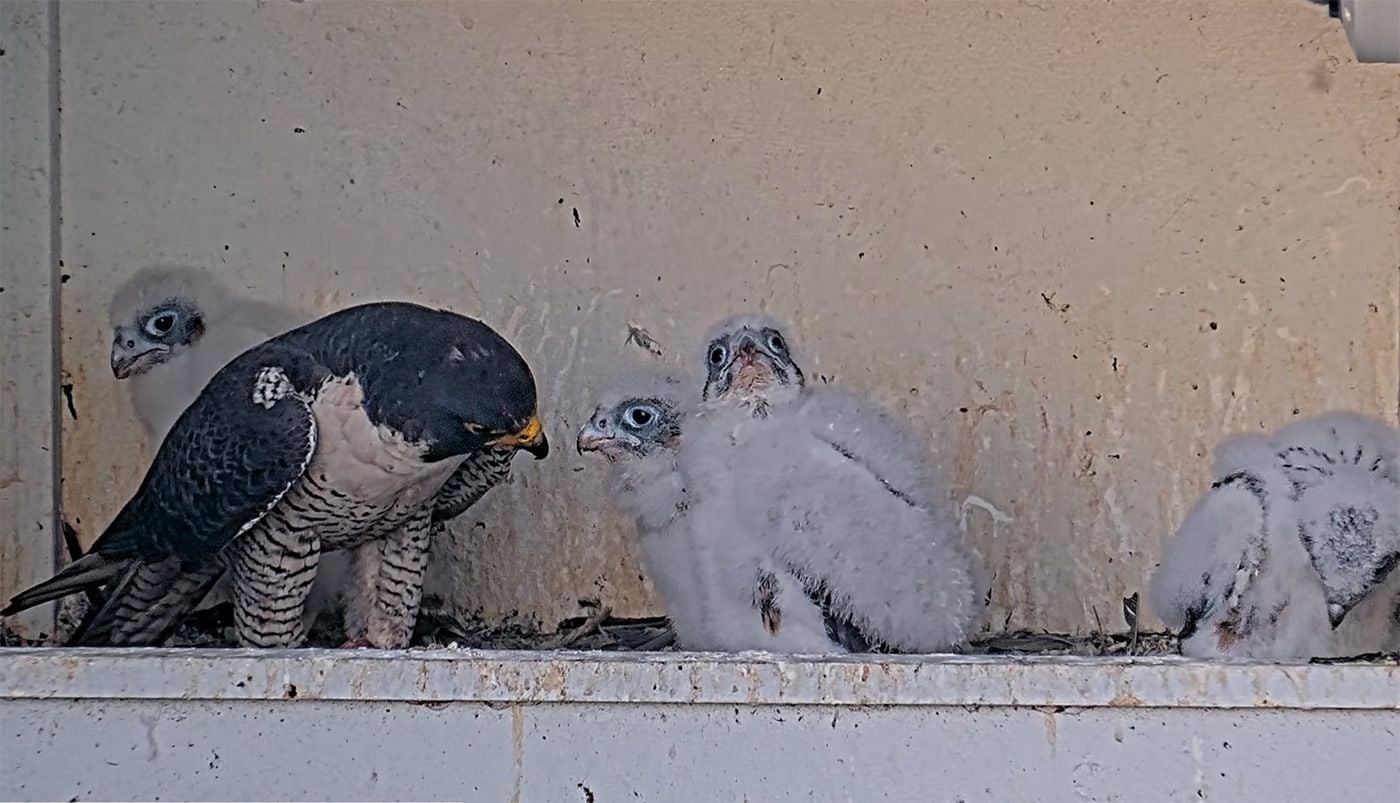
There's some good news on the local raptor front, which we all could use after a rough few years for Bay Area peregrine falcons: Four chicks have hatched this spring in the nest box atop San Jose City Hall, and biologists from UC Santa Cruz have given them a clean bill of health.
Avian flu has decimated the peregrine falcon population here and elsewhere, leaving the falcon nest atop UC Berkeley's Campanile tower — and many others — sadly empty the past nesting seasons. But at least one publicly watched nest has been occupied this breeding season.
NBC Bay Area reports that researchers from the Santa Cruz Predatory Bird Research Group paid a visit to the 18th-floor nest at San Jose City Hall this week to tag the four newest additions, and they determined that all four chicks are male. And in a first for the program, each bird will be fitted with a radio transmitter in addition to the usual identifying leg bands, allowing researchers to track their movements remotely as they eventually disperse across the region.
The chicks are expected to fledge and make their first flights in about six weeks, at which point a small army of volunteers will be stationed outside City Hall to make sure none of them come down before they're ready.
The San Jose City Hall nest has been among a small group of closely watched and webcam-equipped peregrine falcon nesting sites in the Bay Area ever since a pair of birds first showed up to scope out the ledge of the then-new building back in 2006.
The Santa Cruz Predatory Bird Research Group subequently installed a nest box in 2007, and the falcons have been nesting there — and captivating webcam viewers around the world — ever since. The resident female for most of that run was a bird named Clara, who cycled through a series of mates with names like José, Carlos, and Fernando before she was replaced in the 2019 season by Grace, a bird who, in a nice bit of local bird lore, had been born herself in the famous PG&E building nest atop 77 Beale Street in downtown San Francisco back in 2016.
Since early 2023, the resident falcons in San Jose have been Hartley and Monty.
We've covered the SF falcon beat extensively over the years — including many seasons of the PG&E nest and the long-running soap opera atop the Campanile, where beloved falcon Annie reigned for years before going missing in early 2025 along with her mate Archie. As we reported last March, avian flu was the suspected culprit, with a new bird having briefly appeared on the Campanile cams to survey the vacancy before themselves moving on.
And that's the shadow hanging over what would otherwise be happy hatching story in San Jose. A preprint study published in February out of UC Santa Cruz documents a dramatic collapse in the Bay Area peregrine population tied directly to the H5N1 outbreak first detected in California in mid-2022. Of 47 nests that were occupied in 2020, only 11 now have healthy breeding pairs — a staggering decline for a species that had only just finished its remarkable comeback from the DDT era, when California's peregrine population fell to perhaps five breeding pairs statewide.
In normal nesting seasons, most or all available nests, including the no-longer-surveilled 77 Beale Street nest and the Campanile nest, would be occupied by returning birds or "floaters" without established mates.
Seventeen confirmed peregrine fatalities in our region alone have been attributed to H5N1, which the birds contract by eating infected prey — their diet being the thing makes them most likely to be exposed to to the virus. And as experts told SFGate earlier this year, the virus does not appear to have run its course, and more falcon deaths are likely in the near term.
San Jose's last resident female Shasta died of avian flu back in February 2023; her mate Sequoia disappeared shortly after.
Which makes this spring's clutch of four healthy chicks at San Jose City Hall all the more significant. ABC7 notes that scientists now consider the San Jose City Hall nest especially important to rebuilding the region's peregrine population, which is why the radio transmitter upgrade matters — researchers need to know where these birds go, and whether they survive long enough to establish territories of their own.
So here's to the four new boys on the 18th floor. May they grow strong, learn to fly, and stay well clear of infected prey. We'll be watching the cams, and hoping that a bird finds their way to that choice real estate in Berkeley soon too.

Join the conversation
Comments
Comments load automatically as this section approaches.