Over the next ten years, there will be a fair amount of construction activity happening on the main span of the iconic Golden Gate Bridge, as a project to protect it from significant damage in an earthquake gets underway.
As you're likely aware, the Golden Gate Bridge did not suffer any real damage during the Loma Prieta earthquake in 1989 — the Bay Bridge wasn't so fortunate. That is because the bridge is designed to withstand a fair amount of ground shaking, and likely would not collapse even in a very strong quake. It could, however, suffer significant damage in the event of a major earthquake with an epicenter closer than Loma Prieta, and that damage could put the bridge out of commission for months or even years, which would have major economic impacts for the Bay Area at large.
So, as far back as 1990, the Golden Gate Bridge Highway and Transportation District has been working on a major seismic retrofit project, the first two phases of which are already complete. Those phases involved shoring up the viaducts at either end of the bridge, which connect the suspension span to the roadways in Marin County and San Francisco.
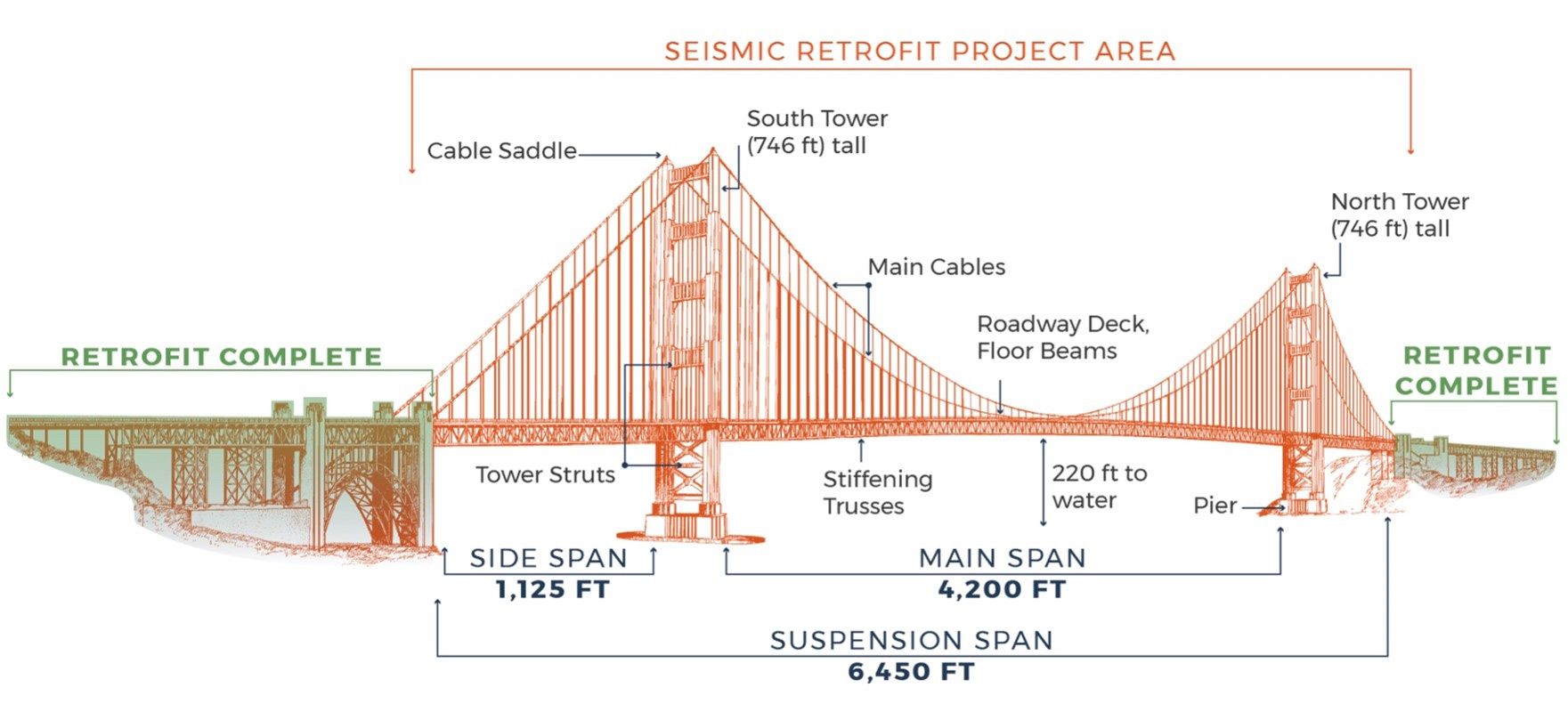
But the largest piece of the project involves retrofitting the two 746-foot towers of the bridge, and the 6,450 feet of main roadway on the bridge itself.
As the Chronicle explains, via bridge engineer John Eberle, while the steel parts of the bridge are designed to swing side to side as much as 27 feet in the event of an earthquake, the concrete supports of the bridge and the roadway might not move the same way.
In the event of a major quake, on the level of the estimated 8.3M of the 1906 earthquake, "They won’t be moving in sync, and they’ll be banging into each other," Eberle tells the Chronicle. And pieces of the bridge could then "pop out of alignment," causing damage that renders the bridge impassable for a long period of repairs.
Retrofit elements include 40-foot-tall steel plates that will be affixed to the bases of both bridge towers, and a stronger steel lattice support will be added beneath the entire span. The bridge is also set to get 38 giant shock absorbers installed.
Per the Chronicle, most of this work won't be visible to drivers on the bridge, but starting in January or after, you will see a "white-sheathed temporary platform" running underneath the entire bridge, where most of the work will be done. And there will be some overnight lane closures starting likely next summer.
This is unrelated to the road maintenance work that is ongoing through this November, and for which the center two lanes have been closed between the hours of 10 am and 1 pm on Wednesdays only.
This final phase is being broken up into two sub-phases, only the first of which is funded. The second phase, dealing with main span between the two towers, is expected to cost $900 million, for which officials plan to apply for federal and state grant funding. That work won't begin for another five years.
One of the most visible improvements will come as the South Tower of the bridge gets a new coat of International Orange paint. This painting was scheduled as part of the retrofit work occurs on the tower.
As the Chronicle explains, the North Tower isn't quite as battered by the wind and weather, and isn't yet scheduled for a new paint job.
Photo by Varun Yadav

