
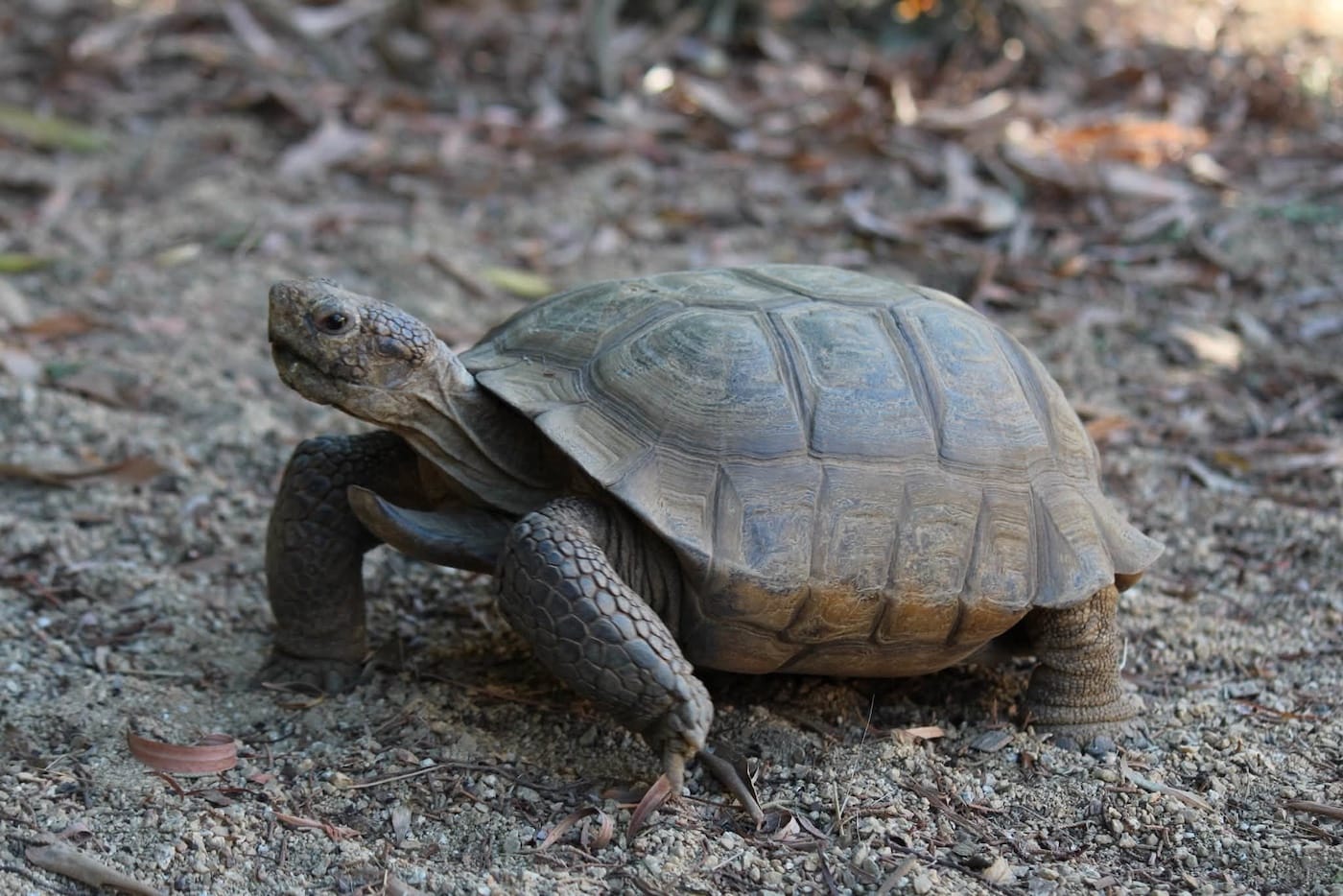
Thousands of SF Zoo visitors got to know desert tortoises through Mojave, the Zoo's 79-year-old resident who spent nearly three decades serving as an ambassador for his increasingly threatened species.
Mojave had been living at the Zoo's Koret Animal Rescue and Conservation Center since 1997, where he became one of its longtime animal ambassadors. Through the Zoo's Wildlife Theater and Nature Trail programs, the tortoise introduced thousands of visitors, staff members, and volunteers to desert tortoises and their place in the ecosystem.
The zoo shared on social media that earlier this year, a CT scan revealed that Mojave had developed a spinal condition. Keepers and veterinary hospital staff monitored him over the following months, but when the condition began affecting his quality of life, they decided to humanely euthanize him. Zoo staff were able to spend time with him and say goodbye.
Mojave desert tortoises are a threatened keystone species that play an important role in California's desert ecosystems. They are also the official state reptile.
According to the Los Angeles Times, the Mojave Desert supported hundreds of tortoises per square mile 80 years ago, with the animals found throughout nearly every part of the desert below 3,000 feet in elevation. Today, most populations in California outside designated recovery areas have reportedly dwindled to just two or three adults per square mile, making it increasingly difficult for males and females to find one another to reproduce.
Despite receiving state and federal threatened-species protections in 1989 and 1990, respectively, the tortoise's numbers have continued to fall. In 2022, Defenders of Wildlife, the Desert Tortoise Council, and the Desert Tortoise Preserve Committee petitioned the California Fish and Game Commission to upgrade its status to endangered. The commission approved the change last year, as NPR reported.
The designation could help direct additional resources toward conservation efforts, according to state agency spokesperson Krysten Kellum, who told NPR the change "highlights the urgency of tortoise conservation needs."
But federal staffing cuts and funding freezes under the Trump administration have reportedly raised concerns about the future of those efforts. Kristina Drake, former head of the US Fish and Wildlife Service's Desert Tortoise Recovery Office, left the agency through its deferred resignation program and said she doesn't anticipate additional federal funding for the species.
There have been some encouraging developments. In 2024, 70 Mojave desert tortoises were released into their native habitat at Edwards Air Force Base in Southern California through a collaborative program involving San Diego Zoo Wildlife Alliance, The Living Desert Zoo and Gardens, the USFWS, and the US Geological Survey. The young tortoises were raised using a combination of indoor and outdoor techniques intended to improve their survival rates.
Researchers have continued monitoring the group, tracking their health and behavior, including their ability to establish and modify burrows for shelter.
Related: Four-Month-Old Capybara Siblings Arrive at San Francisco Zoo

Join the conversation
Comments
Comments load automatically as this section approaches.