
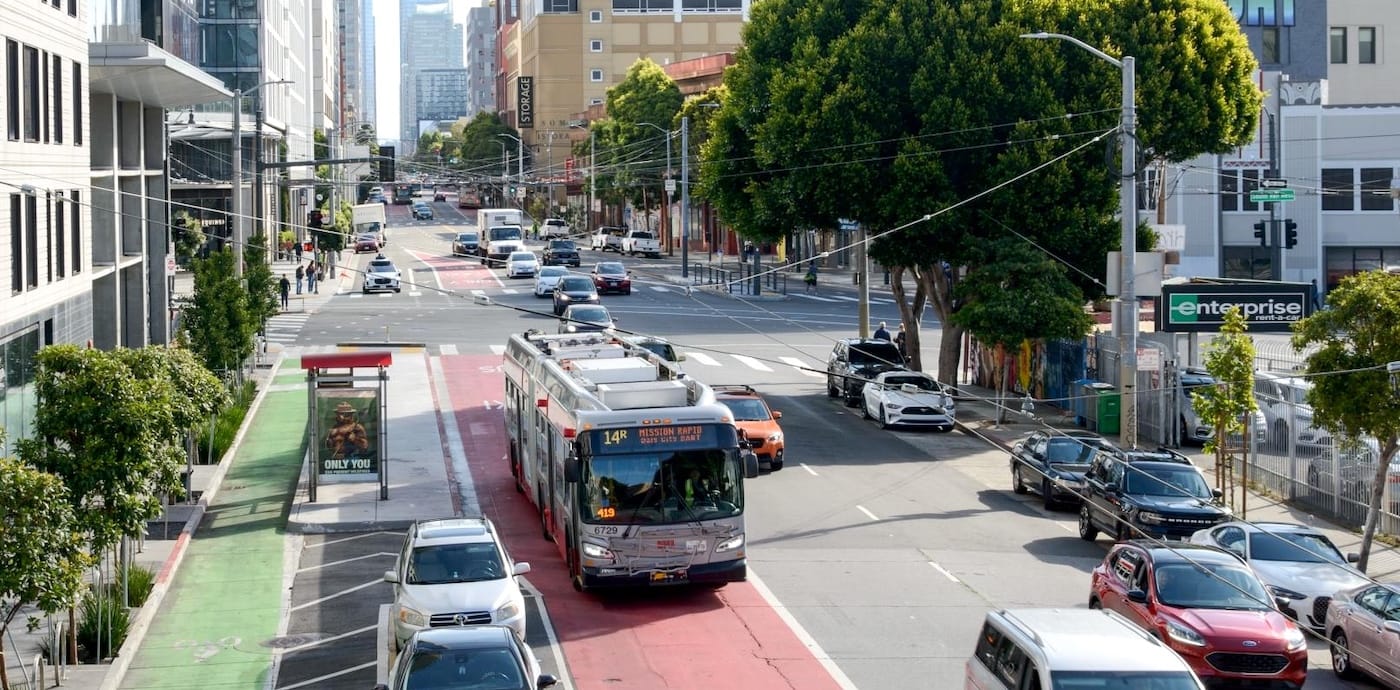
Muni buses will soon be equipped with AI-powered cameras designed to automatically detect drivers blocking bus lanes and stops, with the new system expected to help the SFMTA process up to five times as many citations as it currently does.
The San Francisco Municipal Transportation Agency board recently approved a contract worth up to $55 million with San Francisco-based Hayden AI, which will provide the camera systems, as KQED reports. The initial agreement covers 212 Muni vehicles over three years, with the option to extend the contract for three additional one-year periods.
According to ABC 7, the agency plans to begin rolling out the technology over the next seven to eight months.
The cameras will be mounted inside buses, behind the windshield, where they can capture a wider view of the street as vehicles travel their routes. Rather than continuously recording footage, as the current system does, the new equipment will reportedly use onboard processing to identify potential violations and save only short video clips when something is flagged.
Hayden AI Chief Growth Officer Charley Territo told KQED the system is designed to recognize different types of parking violations that obstruct transit lanes and bus stops.
SFMTA first introduced bus-mounted cameras for transit lane enforcement in 2008, becoming the first transit agency in the country to use the technology. But the existing system requires parking control officers to manually review footage.
As SFist reported last year, just two designated parking control officers are responsible for reviewing footage and issuing roughly 20 citations a day.
The new system is expected to increase that capacity to around 100 citations daily, or as many as five times the 6,000 to 8,000 violations currently processed each year, per KQED. Rather than having officers watch hours of recordings to locate potential violations, the AI will flag incidents and generate digital evidence packages for review.
Viktoriya Wise, director of the SFMTA's Streets Division, explained that the technology will help officers identify violations without having to search through entire recordings.
The agency told KQED the cameras will automatically blur pedestrians, drivers, and unrelated license plates, and will not use facial recognition or biometric identification. Footage that does not show a violation will reportedly be deleted after 15 days. SFMTA will retain ownership and control of the collected data, rather than Hayden AI, and parking control officers will still review every potential citation before it is issued.
Wise said the agency had taken “a lot of safety precautions” to address privacy concerns surrounding the technology.
The system is already in use at 12 other transit agencies or municipalities nationwide, including AC Transit and New York City's Metropolitan Transportation Authority, as KQED reports.
SFist reported last year that the SFMTA was also considering eventually expanding the program to its fleet of approximately 600 new New Flyer buses, pending city approval.
The initial three-year contract was estimated last year to cost approximately $15.6 million, and a $2.5 million Caltrans grant would be covering installation costs. The agency expected revenue from citations to pay for the remaining expenses.
The proposal still requires final approval from the SF Board of Supervisors, which is expected to consider it in February 2027. According to KQED, the SFMTA is tentatively planning a 60-day warning period and public education campaign beginning in May 2027, with citations expected to start in July.
The current fine for blocking a transit lane is $108, while blocking a bus stop carries a $443 fine. SFMTA says it will review the fine schedule and propose potential reductions before enforcement begins.
The agency says the enforcement program has helped improve Muni travel times and reduce street injuries by keeping transit lanes clear. SFMTA also anticipates that increased enforcement will eventually discourage repeat violations as drivers become more aware of the rules.
Previously: SFMTA to Upgrade Bus Lane Ticketing System, Expects to Raise Number of Fines by 500%

Join the conversation
Comments
Comments load automatically as this section approaches.