
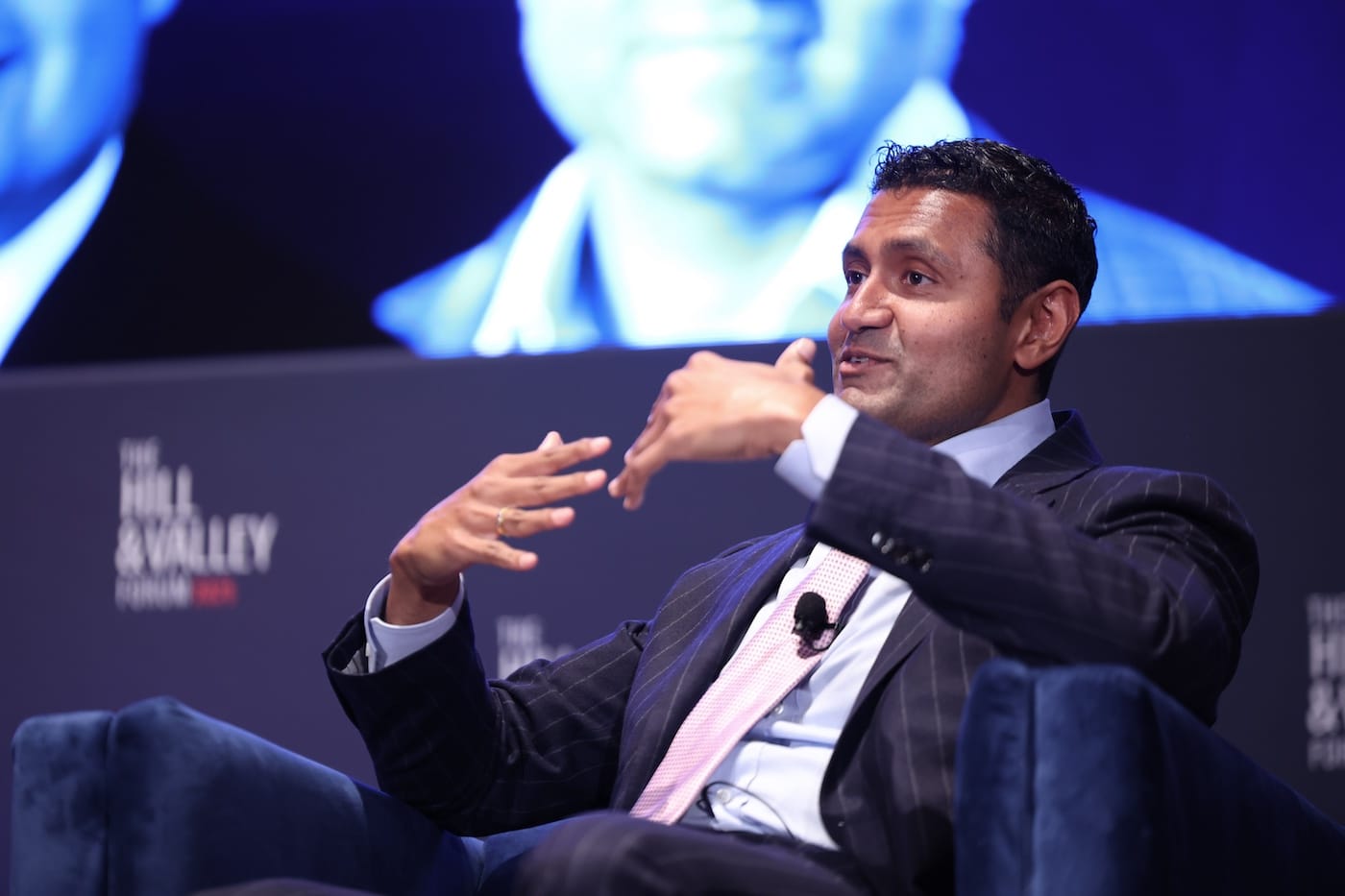
As smoking makes a comeback among Silicon Valley founders and engineers, Palantir CTO Shyam Sankar says some AI researchers are lighting up to signal their belief that the technology will cure cancer, calling it a form of “mass psychosis.”
Speaking with Face the Nation’s Margaret Brennan Sunday, Sankar argued that some people building artificial general intelligence (AGI) have developed an almost religious faith in the technology, while others’ warnings about its dangers are driven by their own ideological beliefs.
The X account Fireside Alpha shared a clip.
Palantir CTO reveals AI researchers are taking up smoking to signal to other researchers that they believe AI will cure cancer--and calls it a “mass psychosis” Shyam Sankar (CTO): “But if you understand that it’s actually a theological critique, then you can kind of weigh it against the empirical facts of what is actually happening out there. “I think there’s a profound truth to Pascal’s saying that every human has a God-shaped hole in their heart. And it’s important to understand that many of these folks in Silicon Valley who are building this technology have filled that hole with the machine god of AGI. “And I mean, there’s so many interesting stories around this. For example, so many AI researchers have started smoking as a way of signaling to other researchers how much they believe in AI.” Margaret Brennan: “What? That makes no sense. What do you think?” Shyam Sankar: “I believe so much in AI that it’s going to cure cancer. So I’m showing you my chips are all in. So there is kind of this mass psychosis, social delusion around it.”
— Fireside Alpha (@firesidealpha) October 11, 2026
“I think there’s a profound truth to Pascal’s saying that every human has a God-shaped hole in their heart,” Sankar told Brennan. “And it’s important to understand that many of these folks in Silicon Valley who are building this technology have filled that hole with the machine god of AGI.”
Sankar claimed that some AI researchers have taken up smoking to demonstrate how strongly they believe the technology will eventually cure cancer, arguing the practice has become a “social delusion,” though he offered no evidence of how widespread the practice is.
The comments come amid reports of a general return to nicotine use in the tech industry, where some founders and investors have embraced cigarettes as a way to stand out in a culture long associated with health optimization and productivity hacks.
Business Insider reported last month that some startup founders have also started smoking partly for the networking opportunities. Cigarette breaks can offer a more relaxed setting for conversations between entrepreneurs and investors, potentially helping founders build relationships that might otherwise take place in more formal settings.
Jake Jolis, a general partner at Los Angeles-based Zeno Ventures, told the outlet that founders who smoke can appear less concerned with pleasing venture capitalists, which may make them more appealing to investors. Jolis said he had invested in two founders who smoke and that both had performed well, although he does not actively seek out smokers.
Other founders have been more direct about the perceived benefits of betting on AI. Avi Schiffmann, CEO of AI wearable startup Friend, told Fortune, “By the time you do get lung cancer, our AI robots are supposed to have cured that.”
Nicotine products are also reportedly being kept in stock at some tech workplaces, as some say it helps them code faster. Fortune reported in March that Palantir stocked vending machines at its Washington, DC, office with free nicotine pouches for employees aged 21 and older.
Business Insider noted that smoking has remained relatively common in Europe and Asia, and some workers from those regions have moved to Silicon Valley for tech jobs, potentially contributing to the trend.
Sankar also used Sunday’s interview to criticize “effective altruism,” a movement focused on using evidence and reason to maximize the good people can do, which he said has influenced the debate over AI safety, as Fortune notes. He described the movement as a “millenarian doomsday cult” and claimed, without providing evidence, that the vast majority of the roughly 2,000 AI researchers in the United States subscribe to its worldview.
Effective altruism has reportedly influenced some researchers and employees at major AI companies, including Anthropic and OpenAI, particularly those working on AI safety who argue that safeguards are needed to prevent increasingly capable systems from escaping human control and threatening humanity.
Sankar dismissed the focus on existential AI risks associated with effective altruism, arguing that the industry should prioritize economic growth, national security, and engineering safe products. He called on companies to take responsibility for building AI safely while leaving regulation of its use in fields like medicine and defense to existing government agencies.
But he also ridiculed the idea that AI will eventually cure cancer, calling it “mass psychosis” and suggesting that some tech workers are choosing to smoke on the dangerous assumption that future AI breakthroughs will spare them from the consequences.

Join the conversation
Comments
Comments load automatically as this section approaches.