
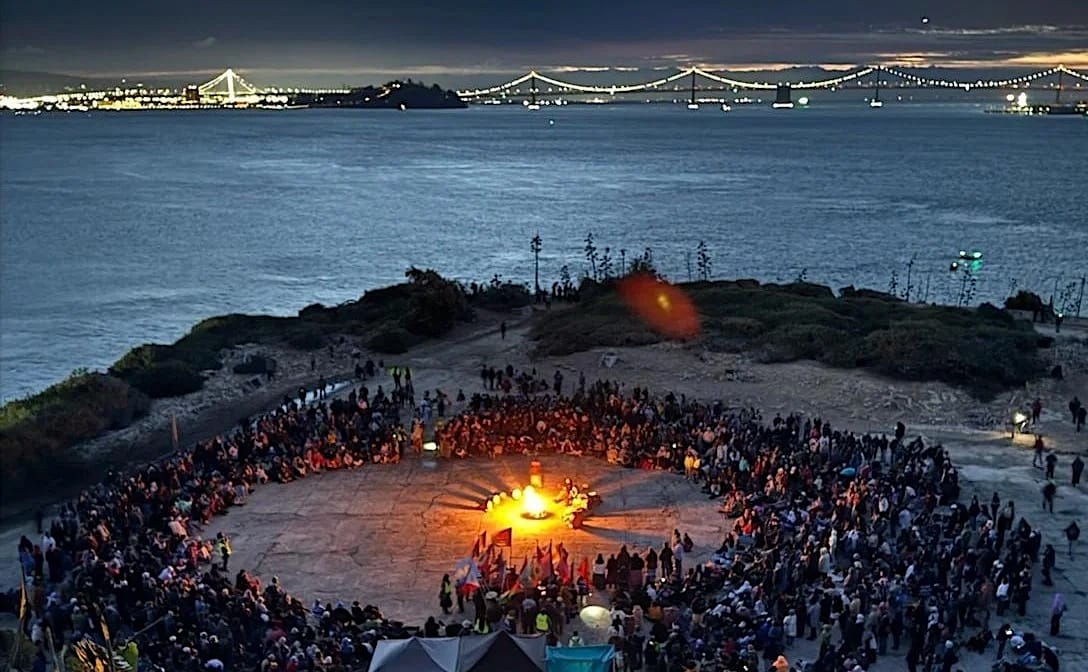
Ahead of Monday’s Sunrise Gathering on Alcatraz Island, event organizers criticized the governor for vetoing bills that would have expanded Indigenous protections just days after declaring September 30 a Day of Remembrance for Indian Boarding Schools.
Thousands gathered on Alcatraz Island before sunrise Monday for the annual Indigenous Peoples’ Day Sunrise Gathering, which honors the 19-month occupation of the island by Native American activists that ended in 1971, as the SF Examiner reports. The gathering was organized by the International Indian Treaty Council and other Indigenous advocates.
Attendees reportedly formed a circle around a bonfire on the island’s parade ground, where San Francisco Supervisor Jackie Fielder, the first Native American to serve on the Board of Supervisors, urged younger generations to continue advocating for their communities.
“You belong here, and you are your ancestors’ dreams come true,” Fielder said. “So rise up, keep resisting.”
According to CalMatters/Indian Country Today (ICT), the gathering comes less than two weeks after Newsom vetoed Assembly Bill 1881, which would have strengthened protections for tribal religious practices and sacred sites, and Assembly Bill 2218, which would have established a mediation process for disputes between tribes and state water agencies over projects in ancestral territories. The latter measure also sought to address water shortages affecting tribal communities.
The International Indian Treaty Council reportedly called the vetoes a “shocking action.” Organizers also criticized Newsom for signing legislation establishing September 30 as a Day of Remembrance for Indian Boarding Schools shortly before rejecting the two bills.
The new law recognizes the history of 13 California boarding schools that held Indigenous children from tribes across the country, as CalMatters/ICT reports. Children at the schools were subjected to harsh conditions as part of efforts to forcibly assimilate Native Americans, and some who died were buried in unmarked graves.
Morning Star Gali, executive director of Indigenous Justice and a citizen of the Pit River Tribe, told CalMatters/ICT the fight to protect Indigenous religious practices remains ongoing. She described being removed from state parks while attempting to gather traditional medicines and pray at sacred waters.
“I’ve gone into state parks with all of our relatives to go in to be able to gather medicine and to be able to pray, to be able to pray at the sacred waters — I’ve been kicked out of those spaces,” Gali said.
A representative for California State Parks told the outlet the department was not aware of any such incidents in recent years. Meanwhile, 62 California tribes lack federal recognition, which can limit their ability to secure protections for ancestral lands and sacred sites.
Fielder also stressed the importance of protecting Indigenous communities’ access to clean water, per the Examiner.
“We know water is life,” she said. “It must be protected.”
Attendees also called attention to Newsom’s veto of Senate Bill 891, which would have created a Missing and Murdered Indigenous Persons Justice Program within the California Department of Justice. CalMatters/ICT reports that the proposed program would have expanded funding and data collection and provided additional victim advocates to support Indigenous families.
Newsom argued in his veto message that existing efforts made the legislation “unnecessary.” Indigenous advocates countered that Native American women continue to face disproportionate rates of violence, including homicide, while families seeking answers about missing and murdered relatives remain underserved.
“Who else is going to stand up and be visible for our sisters? No one,” said Teyana Viscarra, a Piro-Tewa Pueblo, Apache, and Kumiai woman and co-founder of Way Of The Sacred Mountain, an advocacy group focused on missing and murdered Indigenous women, per CalMatters/ICT. “It’s ridiculous, our sisters continue to be ignored even as they go missing and die.”
Viscarra’s organization operates the Red Tipi Healing Project, which places red tipis bearing white handprints at gatherings across the country to raise awareness of missing and murdered Indigenous women and offer spaces for healing and prayer. After the Alcatraz gathering, organizers set up a tipi at Yerba Buena Gardens for another celebration.
The Sunrise Gathering, which takes place annually on Indigenous Peoples’ Day as well as Thanksgiving, commemorates the occupation of Alcatraz by the Indians of All Tribes, which began in November 1969, six years after the federal prison closed. Activists sought to reclaim the island for Indigenous people and establish a university, cultural center, and museum. At its height, the occupation included hundreds of residents and became a defining moment in the Native American rights movement.
Federal authorities removed the remaining occupants in June 1971, but the gathering continues to honor their demands for Indigenous sovereignty and self-determination.
Video Journalist Emma Garcia captured stunning footage of Monday’s gathering.
The island’s future is also a concern for some attendees. President Donald Trump has repeatedly called for reopening the former prison and requested $152 million for Alcatraz in his fiscal 2027 budget, which Congress has yet to finalize.
“It’s a scary world we live in — scary president,” said Irvin Whekins, a Shawnee youth counselor who brought nine Native American youths from Chico to the gathering. “He’s still trying to get rid of us.”
Related: Alcatraz Island’s Indigenous Thanksgiving Sunrise Gathering Has Its 50th Anniversary Thursday

Join the conversation
Comments
Comments load automatically as this section approaches.