
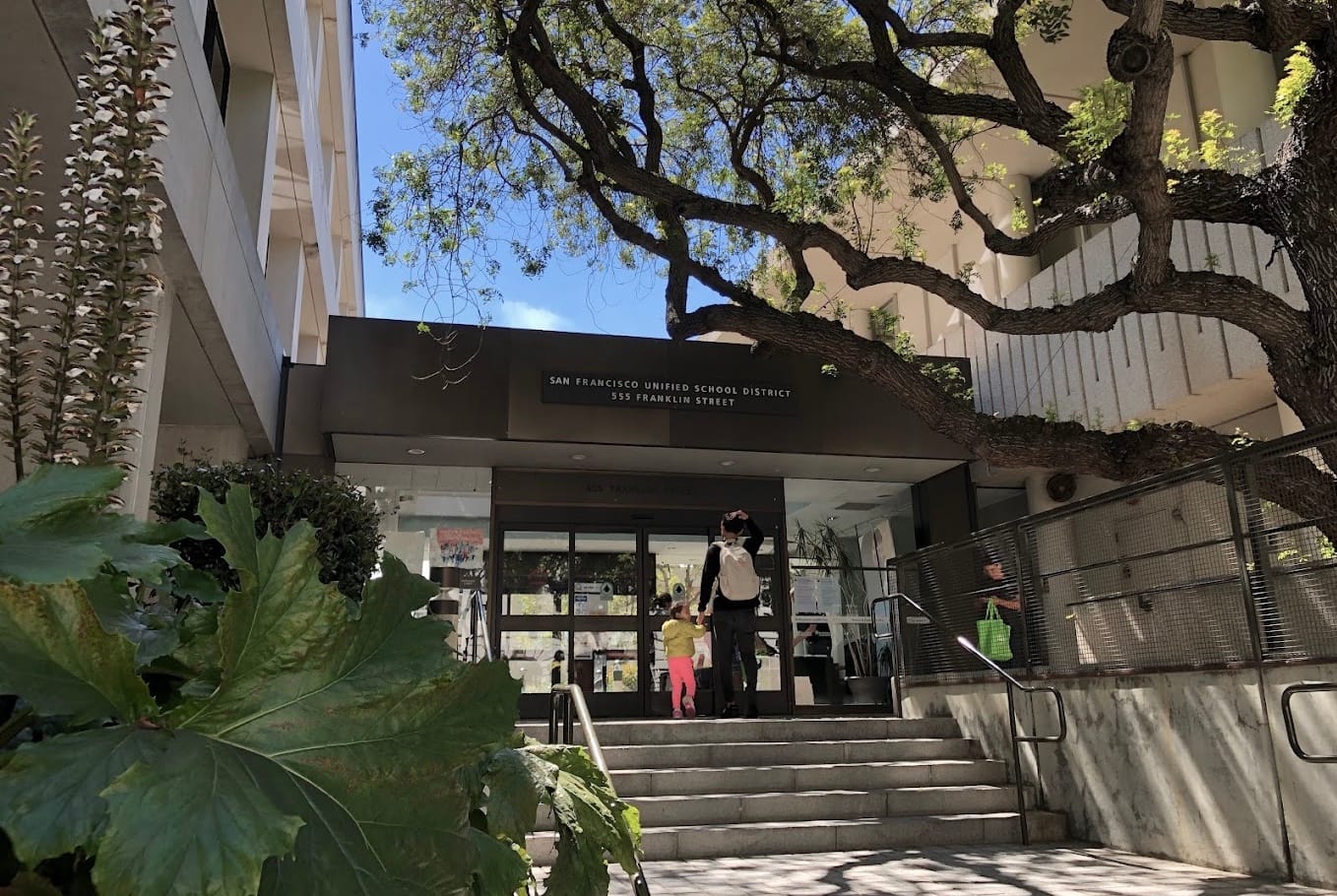
The SF school board will vote Tuesday on a neighborhood-based enrollment plan to replace its old lottery system by the fall of 2028, but families are urging the district to slow down, warning that the options don't addresses inequities in underserved neighborhoods.
The San Francisco Unified School District is weighing two options for assigning students to schools closer to home, with both plans allowing some degree of choice beyond neighborhood boundaries, as the Chronicle reports. The school board is scheduled to vote on the options Tuesday evening.
“The direction is neighborhood schools,” school board President Phil Kim said.
Under Option B, families who apply by the deadline would be guaranteed a seat at their neighborhood school while remaining eligible to apply to other schools citywide,per EdSource. Option C would guarantee a neighborhood placement even for families who miss the deadline, but limit additional applications to citywide programs such as K-8 schools and language immersion programs.
According to the SF Standard, the board previously dropped a third option, Option A, which would have grouped nearby schools into small zones, guaranteeing families a seat at one of them, while keeping the two neighborhood-school proposals under consideration.
A district survey of 2,725 families found that 71% favored Option B, compared with 48% who supported Option C.
The Chronicle reports that the district plans to adopt the policy in April, with the new enrollment system scheduled to launch for the 2028–2029 school year. Incoming kindergarten students in fall 2028 would be the first to use the new system.
The district will also reportedly redraw school attendance boundaries, determining which neighborhood school is assigned to each address. Officials expect to spend the coming months working out those boundaries, evaluating enrollment capacity, and potentially adding programs at some schools or relocating existing ones to accommodate changing student populations. Families are not expected to learn which schools serve their neighborhoods until spring.
The proposal would mark a significant shift away from the city’s longstanding school choice system, under which incoming kindergarten families rank schools across San Francisco and assignments are determined by an algorithm that considers factors including siblings and home addresses, as EdSource notes. The current system also gives priority to students from the 20% of the city with historically low test scores at any school on their application list.
The district voted to eliminate the lottery in 2018 after data showed it had not reduced socioeconomic segregation as intended, but officials reportedly never implemented a replacement. A separate zone-based plan approved by an earlier school board in 2020 was delayed by the pandemic, administrative problems, and budget deficits before being dropped from consideration this time around.
Supporters of neighborhood assignments say the change could make enrollment more predictable, keep students closer to home, and help stabilize school populations. According to the Chronicle, some schools currently receive hundreds of applications for a limited number of kindergarten seats, while others struggle to fill a single classroom. Board Vice President Jaime Huling argued that the existing process creates uncertainty for families and contributes to uneven enrollment.
“The complexity and lack of predictability of the lottery is driving families away and creates unnecessary anxiety,” Huling said, speaking to the Chronicle. “We need to have predictably staffed schools that are fully enrolled.”
But parents and advocates warned that assigning students to their nearest school won't resolve the disparities that lead families to seek alternatives, particularly in southeastern neighborhoods where many families bypass nearby schools.
At a school board informational meeting, parents urged officials to slow the process, arguing that students in underserved communities could end up assigned to schools that lack the programs, staffing, and other resources available elsewhere, as the Chronicle reports.
Roberto Guzman Rivera, a parent at Guadalupe Elementary, said families' decisions to seek schools outside their neighborhoods reflect persistent problems with educational outcomes and services.
“Chronic absenteeism, the excessive suspension of our communities, literacy levels. Black and brown communities, they don't read up to level,” Guzman Rivera told the Chronicle. “Why we're not focusing on that? Focusing on fully staffing?”
Board member Alida Fisher acknowledged that enrollment changes alone would not make the plan successful without investments in schools that have struggled to attract and retain students.
“For any of these systems to be successful, we've got to address the resources,” Fisher said, speaking to KALW.
Blanca Catalan, a parent organizer at Coleman Advocates, which advocates for children in San Francisco, told the Chronicle that neighborhood schools can provide stability for families, but school choice must remain an option.
“But also we know that location alone does not guarantee equity,” Catalan said. “Families need schools where their children feel seen, supported and have access to the programs and services they need.”
As 48Hills Tim Redmond reports, Mfalme Mashairi, executive director of Coleman Advocates, called on the board to reconsider the proposals and hold community town halls to learn what families need — beyond the survey that SFUSD sent out to families. Redmond argues that without addressing unequal funding and access to programs, the new system could restrict choices for families in the southeast while wealthier neighborhoods continue to benefit from better-resourced schools.
Parent-teacher associations play a longstanding role in the disparity, Redmond notes, as schools attended by wealthier families have the ability to raise hundreds of thousands of dollars to pay for enrichment programs and help offset budget cuts. Schools serving families with fewer financial resources generally cannot raise comparable amounts, leaving students with unequal opportunities even within the same public school system.
Language immersion programs present another challenge, with demand reportedly exceeding the number of available seats. Officials say the district will need to determine how to distribute programs and services as attendance boundaries change, while persuading families to enroll at their neighborhood schools.
Kim acknowledged the stakes, describing the decision as one that would shape the district for years to come.
“This is a monumental and consequential decision that’s going to impact our district for a generation,” Kim said. “We have to get it right.”
Related: Black Leaders Demand Action From SFUSD Following Recent Racist Incidents

Join the conversation
Comments
Comments load automatically as this section approaches.