
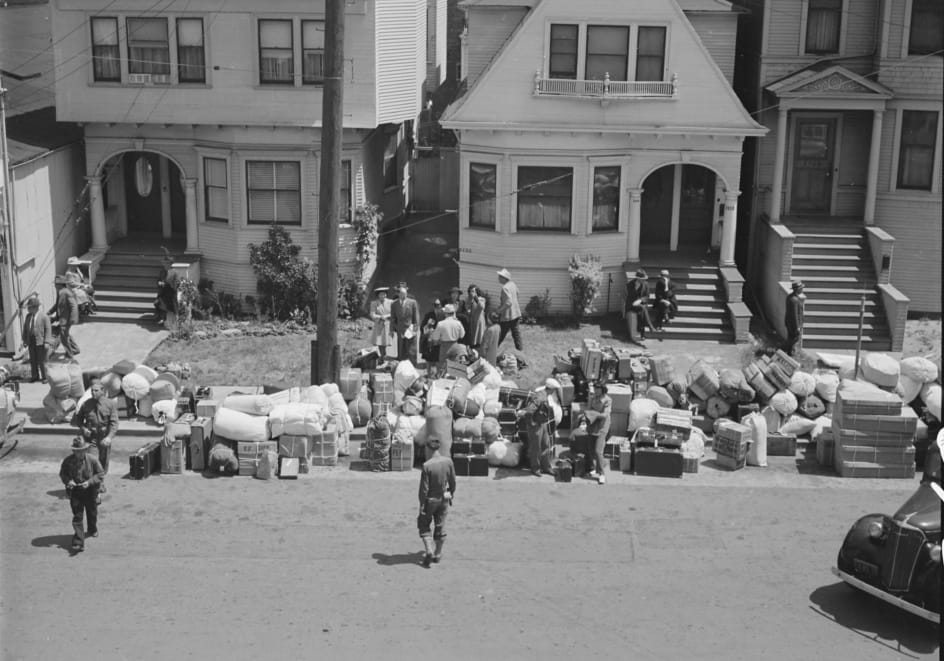
A new exhibit at Oakland Museum uses augmented reality to bring visitors into Dorothea Lange’s photographs of Japanese American families facing forced removal from the East Bay in 1942.
At the Oakland Museum of California, visitors can now step into a recreation of the streets where Japanese American families gathered with their belongings before being taken away during World War II. As Berkeleyside reports, the exhibit, BeHere / 1942: A New Lens on the Japanese American Incarceration by Tokyo-based artist Masaki Fujihata, uses augmented reality to place those moments back into the Oakland landscape, drawing heavily from photographs taken by Dorothea Lange, who was a longtime Berkeley resident. Work by Lange's colleague in Los Angeles, Russell Lee, is also featured in the exhibit.
Lange and Lee were working under the War Relocation Authority, the federal agency overseeing the forced removal, when they photographed Japanese American residents in 1942. Several of Lange’s photographs were taken in Oakland, including images of people preparing to leave their homes before being taken to the Tanforan detention center in San Bruno.
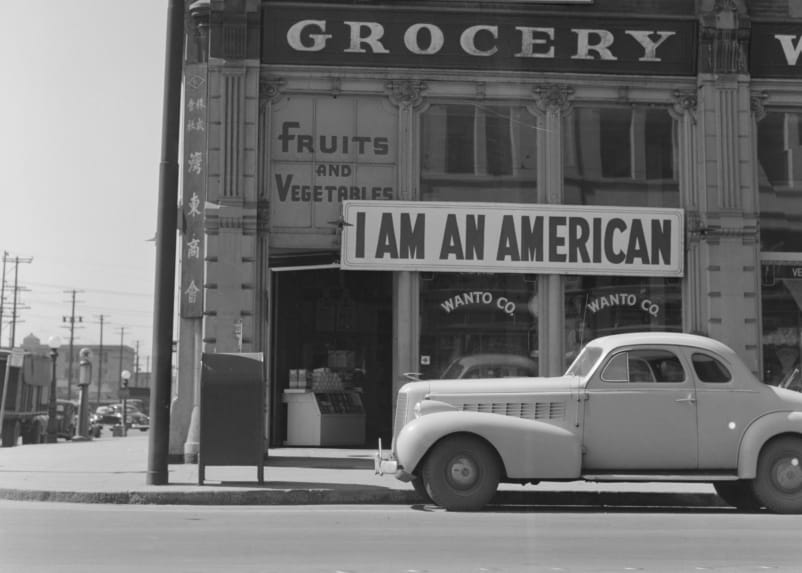
According to Berkeleyside, Oakland’s Japanese American community was one of the largest in California at the time, numbering 1,790 people in 1940, with many living around Chinatown and West Oakland. Lange photographed a Japanese American-owned storefront at 8th and Franklin streets displaying an “I AM AN AMERICAN” sign.
In Berkeley, about 1,300 people were reportedly ordered to report to the First Congregational Church of Berkeley before being sent to the camps. From Tanforan, many were eventually sent to Topaz, Utah. Across the country, roughly 120,000 people of Japanese ancestry were incarcerated in 10 major camps.
Many families remained incarcerated for about three and a half years.
Berkeleyside reports that the artist, Tokyo-based Masaki Fujihata, has spent decades exploring the intersection of art and technology, often using digital tools to blur the line between physical spaces and historical events. His AR work has previously examined the Japanese American incarceration experience in Los Angeles.
Fujihata previously created a version of the exhibit in Los Angeles in 2022 after studying Lange’s archives through UCLA’s Yanai Initiative, as Berkeleyside reports. For Oakland, he focuses on the period when families were gathering with their belongings and waiting to be taken away.
Inside OMCA, visitors can handle a replica of Lange’s Graflex camera and use its viewfinder to enter an AR recreation of Japanese Americans waiting to board a train. Outside, an iPad lets visitors see people with suitcases seemingly occupying the museum’s Oak Street Plaza.
Per Berkeleyside, the figures are played by real people, including descendants of those who were incarcerated and elders who experienced the camps. Fujihata filmed them in Tokyo and Los Angeles, with period clothing used to recreate the scene.
“When the public comes here to experience it, they will see it as something that happened in this space,” Fujihata said, speaking to Berkeleyside.
The exhibit also features Russell Lee’s photographs of Japanese Americans waiting at a Los Angeles train station, including government officials and news photographers.
Lange’s photographs of the forced removal were suppressed by the government during the war. OMCA holds her archives, and some of her photographs are featured in the museum’s permanent Sent Away history exhibit on Japanese American incarceration.
Related: Bay Area Japanese-Americans Warn About Trump Using Racist Law For Mass Deportations

Join the conversation
Comments
Comments load automatically as this section approaches.