
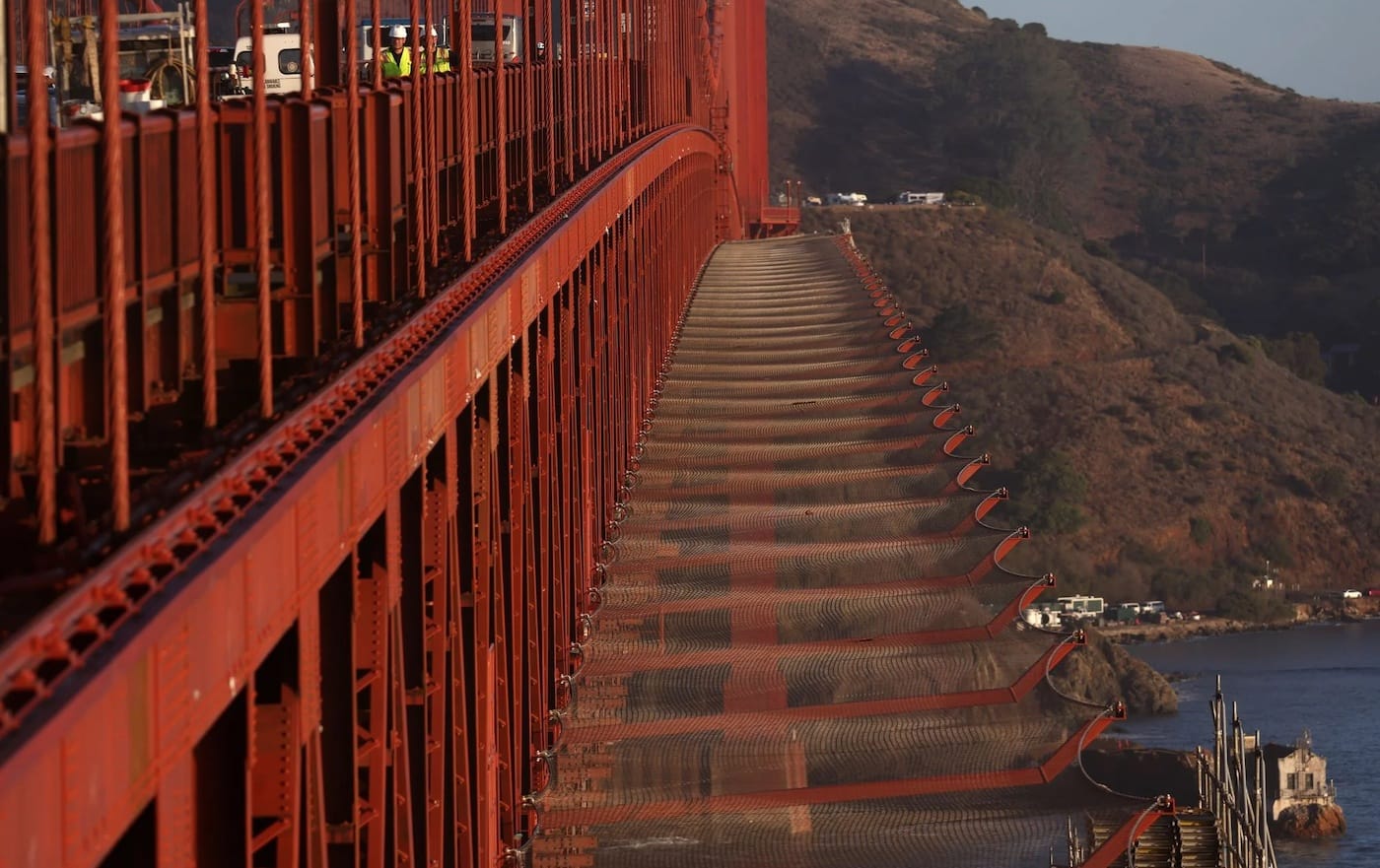
Following the success of the Golden Gate Bridge suicide net, Senator Alex Padilla and a colleague introduced a bill to help state and local governments install similar barriers on bridges and other high-risk structures.
The sharp drop in suicides since the Golden Gate Bridge’s suicide net was installed is now being cited as a model for suicide prevention infrastructure elsewhere. US Senators Alex Padilla (D-California) and Thom Tillis (R-North Carolina) have introduced a bill that would help state and local governments install similar barriers at high-risk locations.
The Barriers to Suicide Act would create grants for nets and other barriers at bridges, buildings, parking garages, highway-rail crossings, train stations, and other structures where people are at risk of dying by suicide. The bill would also fund research into which structures are most frequently used in suicide attempts and which prevention measures are most effective.
“The Barriers to Suicide Act is commonsense, life-saving legislation that will help enhance safety standards and make our public infrastructure safer,” said Padilla in a news release.
The Golden Gate Bridge's steel net, which hangs about 20 feet below the bridge’s walkways, was installed two years ago after five years of construction at a cost of nearly $225 million.
Deaths have dropped sharply since the net was installed. Four people died by suicide at the bridge in 2025, compared with about 30 in a typical year before the net was installed. There were no deaths from June through December 2025.
“California has seen firsthand at the Golden Gate Bridge that nets and barriers work,” Padilla said. “As we continue to confront the suicide crisis, we must do more to help state and local governments install nets and barriers on bridges and other high structures.”
Padilla and Tillis are co-chairs of the bipartisan Senate Mental Health Caucus. The bill is also cosponsored by Senator Jeff Merkley (D-Ore.) and has been endorsed by the National Alliance on Mental Illness (NAMI), Suicide Awareness Voices of Education (SAVE), and the American Foundation for Suicide Prevention (AFSP).
If approved, the grant program would be run through the National Highway Performance Program.
Previously: Two Years In, Golden Gate Bridge Suicide Prevention Nets Have Almost Completely Eliminated Bridge Suicides

Join the conversation
Comments
Comments load automatically as this section approaches.