
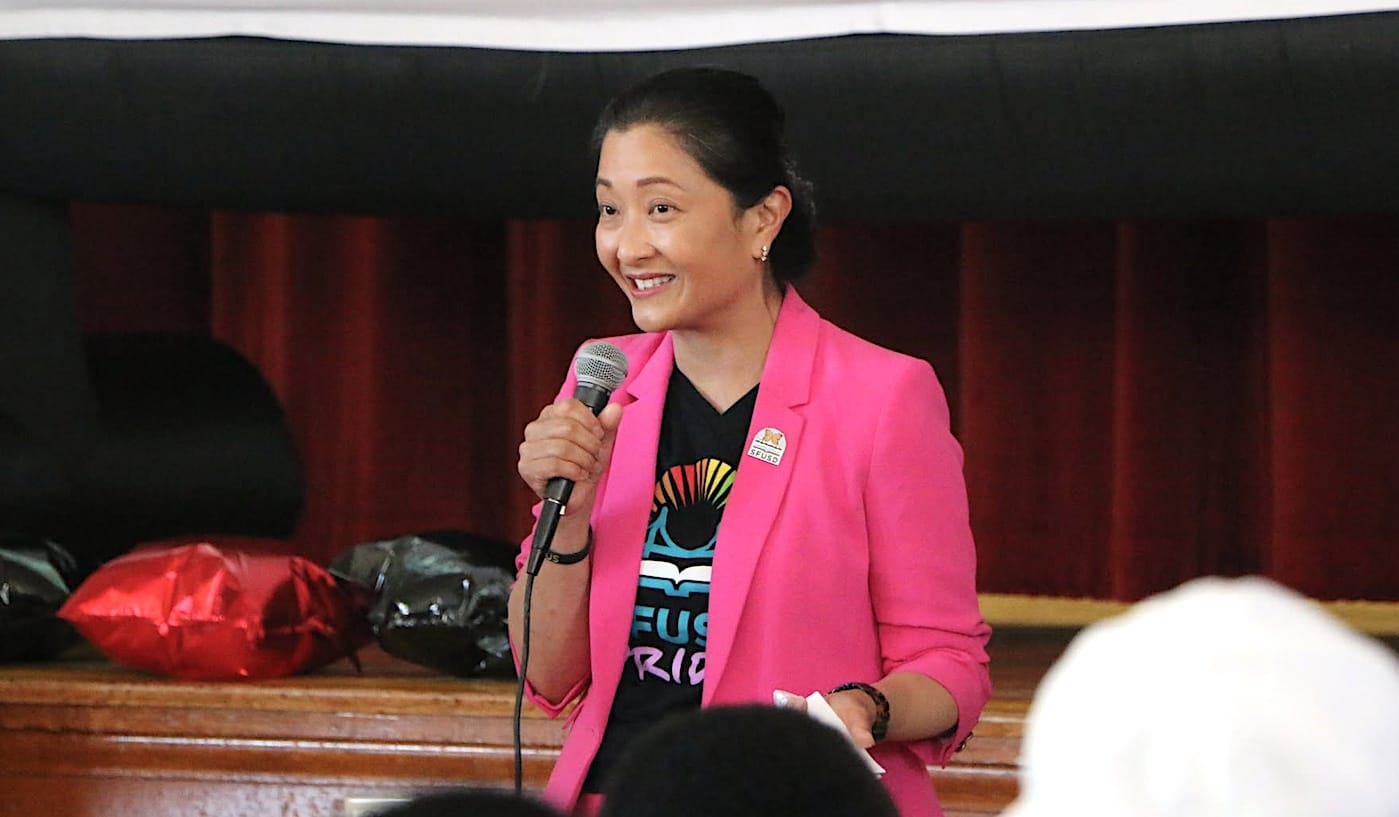
SFUSD Superintendent Maria Su discussed classroom technology at Dreamforce last week, emphasizing tech equity and human relationships while leaving the greater community's concerns about AI accuracy, privacy, and effects on children largely unaddressed.
At a discussion during Dreamforce last week, SFUSD Superintendent Maria Su emphasized the importance of supporting and investing in educators while pointing to SFUSD’s nearly 14-year partnership with Salesforce, as SFGate reports. Su focused much of her discussion on the technology gap that became particularly apparent during the pandemic, when some San Francisco students had Chromebooks but no reliable wi-fi.
She said simply handing students technology does not close the equity gap, and that schools need to invest in educators and communities so students can actually use the tools effectively, arguing that Salesforce’s philanthropic support has helped expand access to STEM classes for girls and provided professional development and other resources for educators.
Despite the discussion's title, “Real Talk on Public Schools & AI,” SFGate notes that Su never used the word “AI” during her remarks, instead referring to technology broadly as “tools.” She argued that schools cannot predict which technologies will still exist in the coming years, comparing the uncertainty around new tools with the introduction of calculators in math classes.
“A lot of people are trying to tell school districts and superintendents like myself what the future is going to look like. We can't really predict the future, right?” said Su. “We don't even know what tools are going to still be around in the next five years, let alone five months. I still remember a time when everyone was saying having a calculator in the classroom was going to ruin math for everybody.”
Su's comments came as SFUSD is developing a broader technology and AI policy, with the school board scheduled to vote on it in March 2027. The district also recently signed a contract with OpenAI to provide ChatGPT Edu to 12,000 teachers and staff.
Additionally, Salesforce announced $18 million in new education grants this month, with $6 million going to SFUSD. According to ABC 7, the company has donated more than $156 million to Bay Area public schools and other organizations since 2013. SFUSD's partnership with the company has spanned nearly 14 years.
While Su spoke repeatedly about using technology to support teachers and preserve human connection, she did not address the community’s ongoing concerns about the accuracy of AI products, student data privacy, or the broader effects of increasing technology use on children. Per SFGate, she also did not discuss whether teachers and parents want these tools or how their feedback would factor into the district’s technology policies.
That omission is notable given that some SFUSD educators say classroom technology has actually added to their workload and reduced opportunities for direct interaction with students. United Educators of San Francisco President Cassondra Curiel said the district has yet to show that its AI tools are improving student learning, while parent advocates have called for greater transparency and more input from families.
“After making students and teachers lab mice, there has not been any data to show those tools advance the learning of students,” said Curiel, speaking to SFGate.
Curiel and former teacher Adlah Chisti cited the district’s use of the AI reading program Amira, which Curiel said was introduced without consulting the union. She said the program can increase teachers’ workload and has problems with students who have accents or speech impediments, while Chisti questioned whether the district has provided evidence that its AI products improve student outcomes.
The concerns come as more than 1,000 San Francisco parents and teachers have signed a petition calling for limits on AI tools and student screen time. According to the Chronicle, the debate now centers on how much technology belongs in classrooms, which tools provide a meaningful benefit, and which may come at the expense of teacher-student interaction.
SFUSD is directing families to its existing recommendations until it determines a final policy in March.
Related: Congress to Grill SFUSD’s Maria Su, Two Others on Parental Rights ‘Abuses’ In Schools

Join the conversation
Comments
Comments load automatically as this section approaches.