
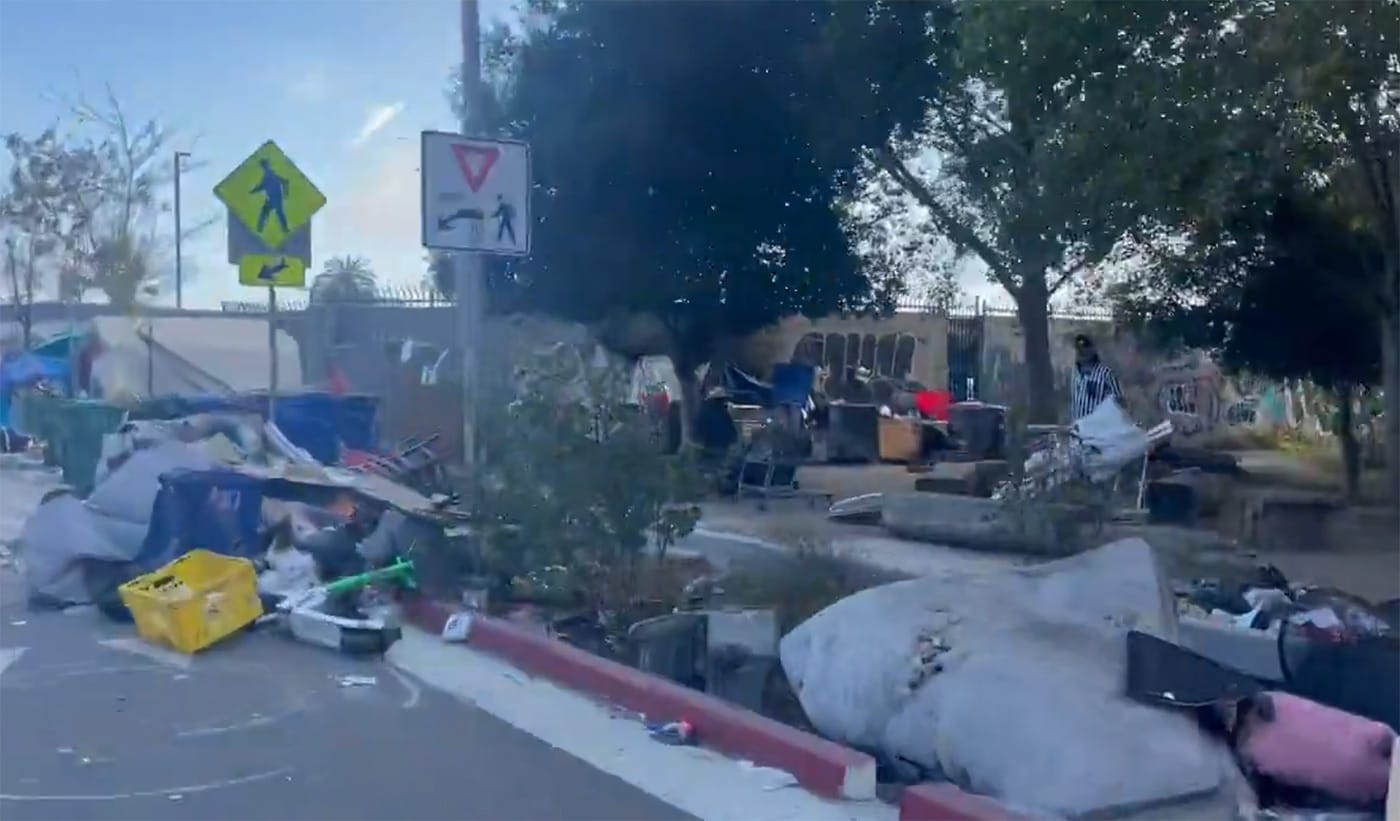
The seemingly permanent homeless encampment at Eighth and Harrison streets in Berkeley, which had been the subject of an extended court fight between the city and homeless advocates, began being cleared out Tuesday.
After a federal judge ruled that the City of Berkeley could move forward with the clearing of the approximately ten-year-old encampment at Eighth and Harrison, so long as special accommodations were provided to residents with disabilities, notices were posted Friday of the coming encampment clearing. As KTVU reports, city workers had orders to destroy and remove all structures and tents at the encampment so that rodent abatement could take place.
This follows an ongoing outbreak of leptospirosis, a bacterial infection which was being spread through the urine of infected rats and dogs, which made two people sick this summer, and one of them died. (Those individuals, as Berkeleyside noted, were living in an RV about a mile from the encampment and were allegedly breeding rats. But two dogs at the encampment tested positive for the disease last year.)
Per KTVU, "dozens of rats" were visible at the encampment site Tuesday.
Last month, ABC 7 Eyewitness News reporter Lyanne Melendez posted a video to X that went viral showing the sprawling encampment, which she filmed the day she was dropping her son off at college at Cal. "Shame on [the city of Berkeley]," she said for allowing this continue.
But in the case of this encampment, it hasn't been for lack of trying on the part of the city. The Berkeley Homeless Union has been battling the city in court over this site for years, and last year got a federal judge to halt the effort for at least the second time — a similar court-ordered halt occurred in December 2023. The federal judge who gave the OK to the city in April to move forward with a clearing process, US District Judge Edward Chen, gave the restriction about providing special accommodation to seven people with disabilities.
As the Daily Californian reported in late July, Chen again granted a temporary restraining order to the Berkeley Homeless Union, halting the clearing process that was about to begin, because they called out ways in which the city was not complying with some of the conditions laid out in Chen's April order — which included providing replacement tents and sleeping bags to the residents.
BHU president Yesica Prado was on the scene Tuesday and telling KTVU that she did not see any replacement tents being given out. But it's unclear if this had already occurred or was set to occur.
Prado also told the station that no one should be surprised if people return to the same block to camp after the city clears out.
"I’ve been brainstorming with them and driving around the whole city trying to find places for them to relocate. And I can tell you right now, very few people know where they can go next," Prado tells KTVU. "A lot of them are planning to stay on the sidewalk until the city leaves and try to re-camp again because they have no idea where they can go."
The situation is reminiscent of the yearslong battle over the Wood Street encampment in West Oakland, where at one point an estimated 300 people may have lived. Following a five-year saga involving multiple court orders, Oakland cleared the encampment in 2023, though the area may not remain entirely clear to this day.
Up until a 2024 Supreme Court ruling, many federal judges had relied on a lower-court precedent from 2018, Martin v. Boise, that had declared encampment-clearing and anti-camping laws to be cruel and unusual punishment under the constitution. That ruling was overturned in Johnson v. Grants Pass, in June 2024, which paved the way for all municipalities to undertake whatever measures they needed to in order to enforce local laws against blocking public rights of way, camping in parks, etc., in the name of the greater public good.
The court's three liberal justices dissented in that decision, with Justice Sonia Sotomayor delivering a dissent from the bench and saying, "Sleep is a biological necessity, not a crime. For some people, sleeping outside is their only option. Punishing people for their status is 'cruel and unusual' under the Eighth Amendment."
Previously: Berkeley Encampment Sparks Fresh Outrage

Join the conversation
Comments
Comments load automatically as this section approaches.