
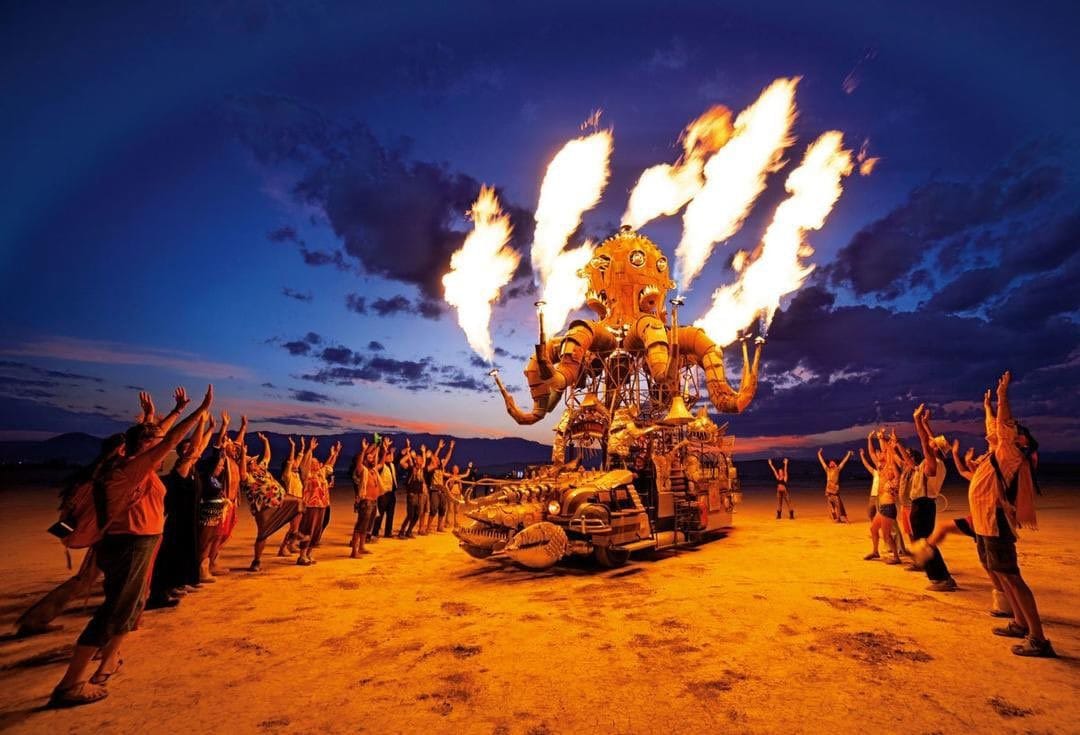
The annual release of the Burning Man census has arrived, and we have a picture of how the demographics of Black Rock City may be changing, at least as of the 2025 burn.
Back in 2024, the headline was that Burning Man was getting more queer, wealthier in 2023 — news that the event was majority female for the first time appears to have been fake, or was later corrected, and Burning Man remains consistently majority male, around 56%. The annual census saw Burning Man get more diverse in 2024, going from being 81% white in 2023 to 66% white the following year, with the number of people checking the "other" box, possibly indicating multiracial identity, ticking up more than twofold. But the percentage of white attendees went up again in 2025 to 74.7%.
This year the headline, regarding the census data from 2025, is that fewer people in their 20s are attending Burning Man, and the population as a whole at the festival seems to be aging. The median age of a 2025 Burner was 35, and the percentage of people on the playa in their 20s was down around 12% — less than half of what that figure was a decade ago.
This has actually been the case since Burning Man resumed post-pandemic in 2022, with a significant drop in people in their 20s seen after the 2019 burn.
Still, the New York Times seized on that headline, noting today that the "decline has been so pronounced that attendees in their 40s and 50s, part of a generation that helped establish Burning Man as a cultural phenomenon, have overtaken 20-somethings in attendance."
That kind of makes sense, given that the population for whom annual attendance at Burning Man is just a given is probably much older these days, and given how expensive an undertaking it now is.
The share of Burning Man attendees who make over $150,000 a year has gone way up the past couple of years. As of 2025, a full 30.2% said they made between $150,000 and $300,000 a year, and another 29% of Burners said they made over $300,000 a year — meaning that about 60% of people on the playa are wealthier than the vast majority of Americans. (Nationally, about 26% of households have annual incomes over $150,000.)
The Times also quoted John Law, one of the event's founders, who wrote an op-ed this year for the SF Standard bemoaning how Burning Man had "lost its anarchist soul."
"Today’s event is a massive, kaleidoscopic extravaganza for the senses — a phantasmagoric, immersive spectacle built for the consumption of Western elites and the middle-class creatives who service them," Law writes, adding that the place felt like Disneyland, or a "commercialized escape hatch" for the rich.
The 2025 census found that 25% of people attending Burning Man cited the cost as their primary challenge in attending, well above those who cited the difficulty of taking time off from work (16.4%).
63% of Burners in 2025 identified as Progressive or Liberal, with only 4.7% calling themselves Conservative.
And in 2025, the percentage of Burners identifying as heterosexual went up from the previous year, from 61.7% in 2024 to 62.1%. The number of bisexual or bi-curious people remained flat, while the number of people identifying as gay or lesbian went up slightly, from 9% to 9.7%.
The census also found, after a couple of difficult and stormy years on the playa, about 13% of attendees said they would absolutely or probably not attend Burning Man again in 2026, with another 17% on the fence. When attendees were asked if they would attend again in two or more years, those numbers went down, and about 52% said they absolutely would be back.
Previously: Burning Man Admits to $14 Million Deficit, Says Ticket Price Hikes May Be in the Works

Join the conversation
Comments
Comments load automatically as this section approaches.