

A tropical disturbance that is forming off the tip of the Baja peninsula has a chance of becoming a hurricane, which in turn has a chance of impacting California — a rarity that might gain fuel from the super El Niño cycle in the Pacific.
The unnamed tropical disturbance, seen as a red X on the map below from the National Hurricane Center, has not yet formed into a tropical depression. But National Weather Service Meteorologist Bryan Lewis tells KTLA that meteorologists have their eye on it, and this has a chance of becoming a tropical storm within a day or so, and forming into a hurricane by Thursday or Friday.
"Once the depression forms, the National Hurricane Center will then likely write a discussion about it and include probabilities of tropical storm or even hurricane formation, so stay tuned for that," Lewis tells KTLA.
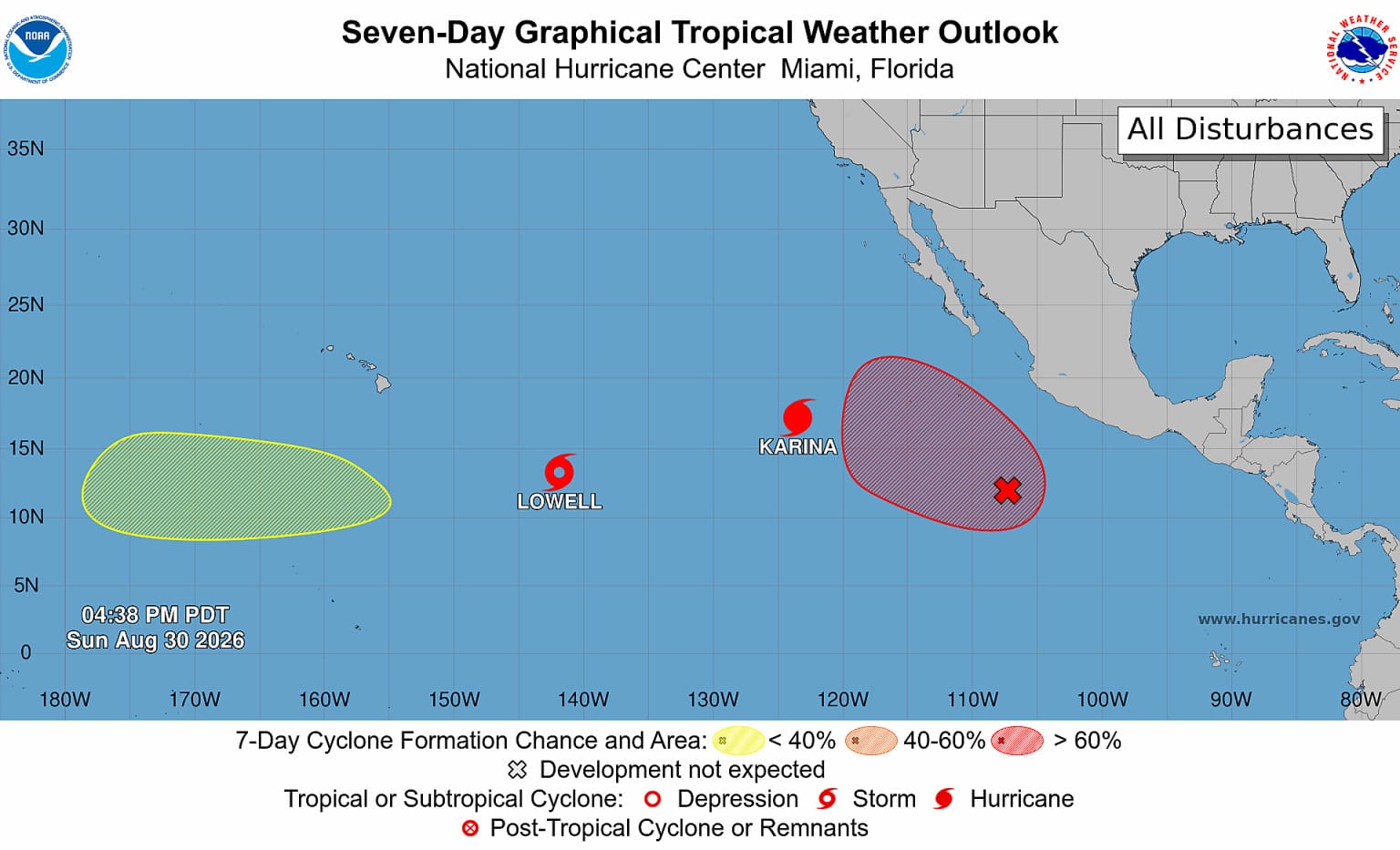
Already spinning in the Pacific are Hurricane Karina and Tropical Storm Lowell, with latter in the open ocean about 700 miles to the southeast of Hawaii. As the Honolulu Star Advertiser reports, Lowell is expected to become a hurricane by Wednesday, and will likely pass to the south of Hawaii over the weekend.
Hurricane Karina, which became a Category 4 storm after rapidly intensifying over the weekend, is reportedly causing increased swells along the SoCal coast.
As the Chronicle explains, the likelihood of any of these storms reaching the California coast as hurricanes is very low, because hurricanes need ocean surface temperatures around 80 degrees to sustain themselves — something that exists out in the far Pacific not along the Cali coast. We could still see impacts from these storms and the moisture that their remnants bring after it blows our way.
This year's super El Niño is reportedly off the charts in terms the ocean temperature rise that has been recorded in the deep Pacific, and its effects on global weather patterns in the coming months are anyone's guess — but are likely to be dramatic.
Longtime Bay Area residents often recall the super El Niño winter of '97/'98, which brought an onslaught of rain that lasted months — and a particular onslaught in February 1998 that dumped the equivalent of about a year's worth of rain on California in a single month.
The average year sees around eight tropical cyclones in the Pacific, while that 1997 El Niño season saw a total of 16, with 10 so-called super typhoons reaching Category 5 intensity in the West Pacific basin. There were also two Category 5 hurricanes in the Pacific that season, Hurricane Guillermo and Hurricane Linda, which struck in August and September, respectively.

Join the conversation
Comments
Comments load automatically as this section approaches.