
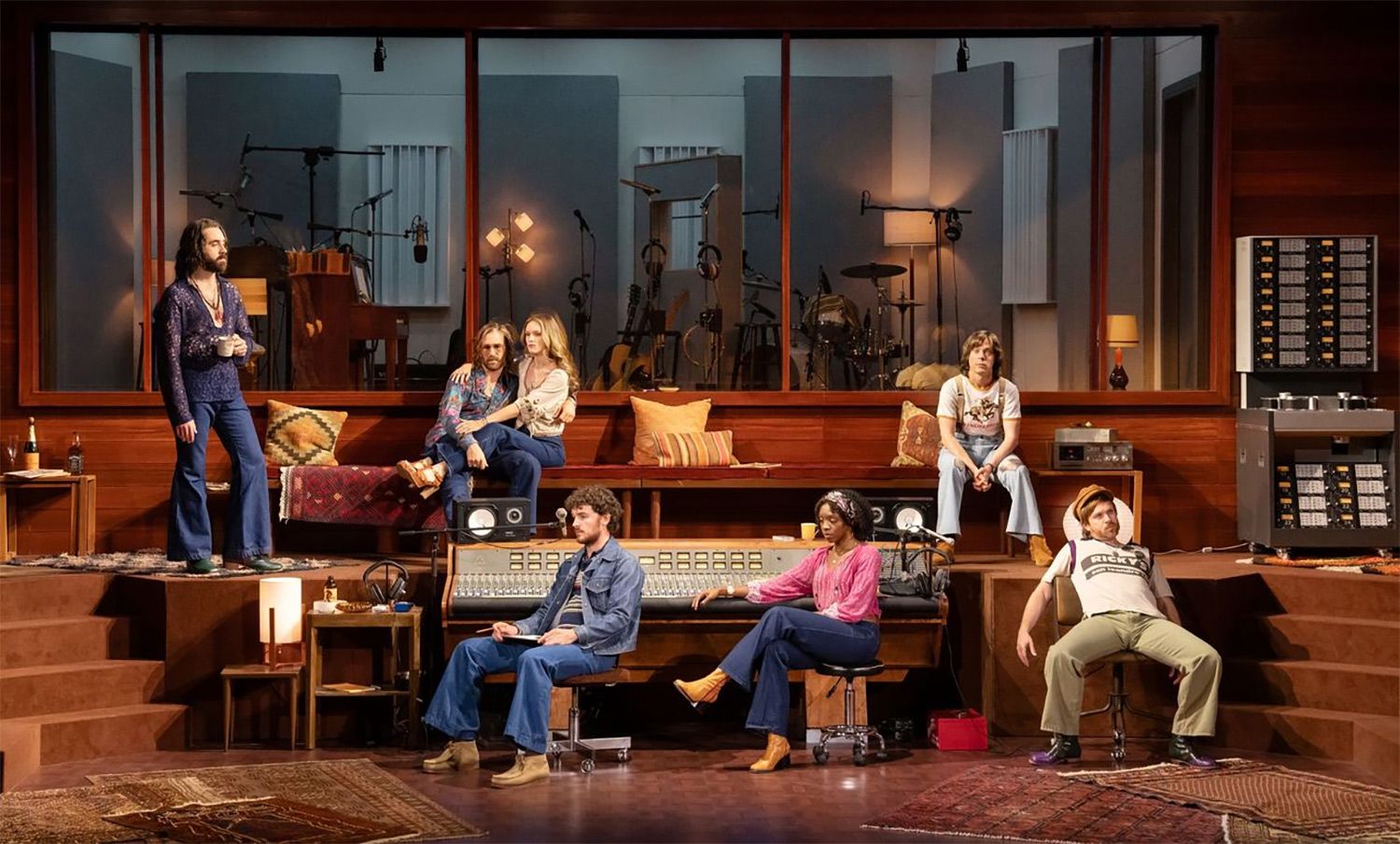
Tony-winning play Stereophonic blew into town this week with the bravado of the legendary rock band that it sorta kinda imagines the story of, pulsing with 1970s recording studio vibes, and using fiction to fill in the missing pieces of an iconic moment in American music history.
If you ask playwright David Adjmi, he was merely inspired by Fleetwood Mac and the story of the band's emotionally fraught and drug-fueled experience recording Rumours at the legendary Record Plant in Sausalito in 1976. But his play, Stereophonic, is not about the five specific members of that band, just about fictional members of a band who happen to look and sound a lot like Fleetwood Mac, having a tumultous, fictionalized experience in Sausalito in 1976.
Like Rumours-era Fleetwood Mac, the unnamed band in Stereophonic consists of three men and two women, with three of them British including a pair who were married but getting divorced at the time, and two young Americans who were also romantically involved.
There is Peter (played on this tour by Denver Milord), a swaggering, handsome, wildly talented, wildly arrogant stand-in for Lindsay Buckingham, who exerts enough control over his bandmates to become ersatz producer of the album they spend months working on. There is Diana (Claire DeJean), the stand-in for Stevie Nicks whose song from the band's previous album was still climbing the charts a year after it came out, and whose songwriting talent leads to an outsized representation on the record — all while she struggles to forge an identity separate from Peter's.
Adjmi certainly could have fictionalized his characters more than he did, if he wanted to avoid Fleetwood Mac comparisons — Peter mentions that he has a brother swimming in the Summer Olympics while the band is in the studio recording, and Buckingham's real-life brother was also an Olympic swimmer.
There is Holly (Emilie Kouatchou), a keyboardist and also talented songwriter in the vein of Christine McVie, who is in the process of divorcing Reg (the terrific Christopher Mowod, in the role that won a Tony for Bay Area native Will Brill), who opens the show in the throes of a cocaine and booze hangover that he quickly treats with more cocaine and booze. And there is Simon (Cornelius McMoyler), drummer and founding member of the band along with Reg and Holly, who much like Mick Fleetwood is dealing with his own family drama and divorce as the show unfolds.
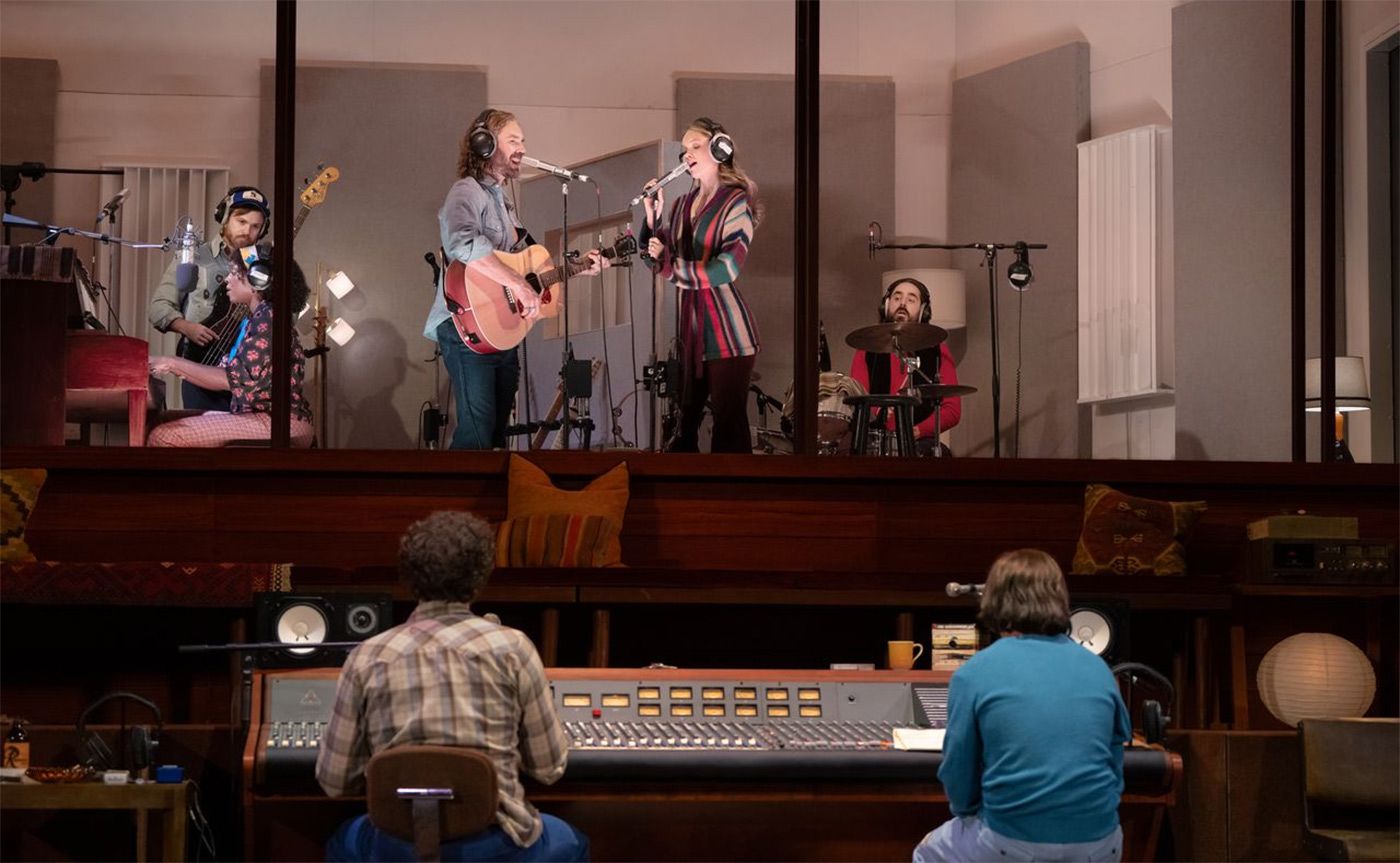
The other two members of the cast are Grover (Jack Barrett), the 27-year-old sound engineer who ends up with a producing credit despite meager previous experience; and Charlie (Steven Lee Johnson), the young, reticent assistant engineer whose name no one ever seems to remember.
What unfolds over nearly three hours — the touring version of the show, which Adjmi refers to in the program as the "radio edit," was slightly shortened from the version seen on Broadway — is an evocative, sometimes painful, often inspiring piece of theater that feels at turns like both a documentary and a fictional film. It only reminds us it's a play in its emotional intimacy, and by the fact of its static recording-studio set, lined in diagonal wood panels just like the Record Plant, the massive mixing board at downstage center. (The Tony-winning set design by David Zinn is spot-on 70s down to the floor cushions.)
Adjmi previously wrote a play, 3C, inspired by the television show Three's Company, and in the cases of both shows, he and the producers were taken to court on plagiarism charges. The 3C case ended in acquittal on fair-use grounds, but the producers of Stereophonic chose to settle a lawsuit brought last year by Rumours producer and sound engineer Ken Caillat claiming that Adjmi had lifted too liberally from his memoir Making Rumours, and "copied the heart and soul" of the book in order to write the play.
Irrespective of how much Adjmi might have borrowed from Caillat's book, Stereophonic nonetheless plays a kind of cultural proxy role in the lore of Fleetwood Mac for fans, inventing and dramatizing a version of the real-life interpersonal story of the creation of their seminal album — on which many of the members' emotions toward each other trickled out through iconic song lyrics. In that way, the play fills in a gap in documented history for fans — for lack of any documentary cameras in the studio in 1976 — and it's an emotionally resonant one, at that.

Adjmi says he wanted to avoid writing a musical, but the songs written by Arcade Fire's Will Butler still play an outsized role in the success of Stereophonic — the play had a clear edge at the Tonys in the Best Play category by virtue of having this memorable soundtrack.
The catchiest of the bunch, "Masquerade," serves as the triumphant closer to the first half — which includes Acts 1 and 2 — much as an Act 1 closer would in a traditional musical. Except here, we don't just hear it once. We hear five or six false starts as the engineer and different band members try to get each element right, until finally they pull off that one perfect take.
Anyone who loves fly-on-a-wall documentaries about how music gets made will no doubt love the show, as will anyone interested in music — with some special shoutouts to Sausalito in the 70s that mean more in the Bay Area than anywhere. The cast is, across the board, stellar, and made all the more impressive by their singing abilities and live instrument playing. It's quite the tight-rope act, being able to convincingly play these characters, who are all rock stars, and convincingly be rock stars at the same time, playing music live on stage and nailing it.
The play's first act takes an awkward few scenes to get off the ground — at one point the band calls for "a break" when we haven't seen them playing or singing anything yet, in what feels like a flub from the "radio edit" cuts. And the direction by Daniel Aukin at times feels ponderous in all the wrong places. But it's a play that takes its time and gives every character ample moments to say their piece. By the time we reach the show's denouement, as the band is licking their wounds, polishing the record in LA, and preparing to take it on tour, we viscerally sense the exhaustion — as Grover, who put in the most all-nighters of the bunch, puts it, "This was kind of a nightmare."
But the audience leaves feeling like it's been privy to something private and heretofore unknown about some famous and talented people, even if it plays fast and loose with the truth. What's hard to question is the beauty of that talent.
'Stereophonic' plays through November 23 at the Curran. Find tickets here.

Join the conversation
Comments
Comments load automatically as this section approaches.