A mother and son who had set out to attend a Boy Scouts camp in Calaveras County got quickly lost thanks to a questionable GPS unit, and then got stuck on a remote logging road deep in the Sierra woods with no cell signal.
The 49-year-old mother and her 9-year-old son left the Sacramento area Friday headed for Camp Wolfeboro, a picturesque campground owned by the Boy Scouts of America located near Highway 4 in Calaveras County. According to the Calaveras County Sheriff's Office, the mother was utilizing "a GPS unit that supplemented common routes with additional remote roads," which led her onto "a complex network of interconnecting, labyrinth-like roads" through the woods, where they promptly got lost.
As ABC 7 reports, via sheriff's office spokesperson Lt. Greg Stark, the mother and son "got stuck about 10 miles from the nearest paved road" and lost their GPS and cell signal.
When they did not show up as expected at the scout camp, a search effort was launched, and they were thankfully found by Saturday evening. A last location shared via a location-sharing app — probably "Find My" — also aided in the search.
The mother left a handwritten note, weighted down by rocks, by one of the larger roads a couple miles away from their car saying, "HELP. Me and my son are stranded with no service and can't call 911. We are ahead, up the road to the right. Please call 911 to get help for us. Thank you!"
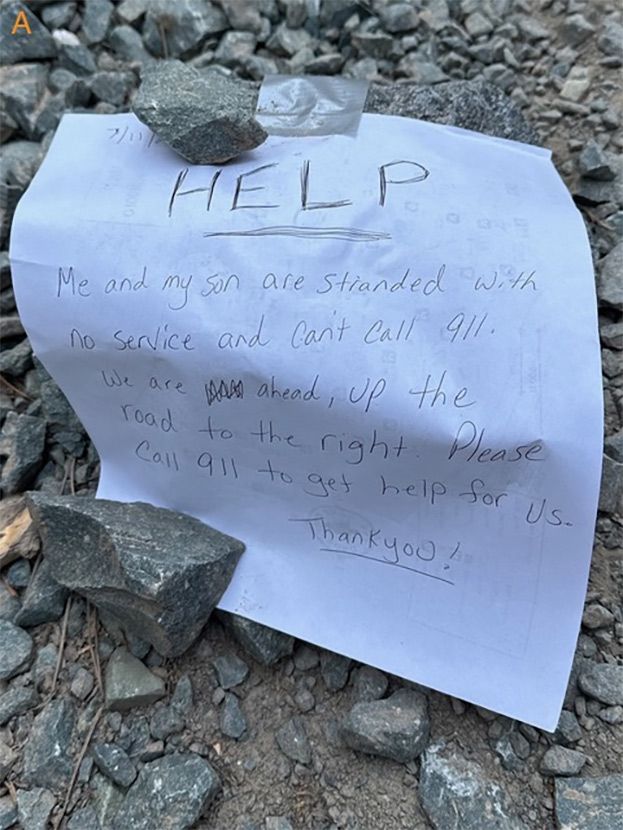
Rescuers say they found a second note up the road, and then found the mother and son about a mile further than that.
The son, being a Boy Scout, had tried several methods for getting them found, including using a whistle to blow three short bursts at a time, which is an international distress signal. They had also reportedly left their hazard lights on overnight as they slept in the car.
Luckily they had a cooler full of a food supplies, which they were taking camping with them.
Once found, the search team used vehicle recovery equipment to free the mother's vehicle from where it became stuck.
"They did everything right," Stark tells ABC 7. "They put themselves in the best position to be found."
Just to give a sense of the remoteness of the location, search and rescue personnel were not even able to communicate that they had located the pair using conventional radio signals, "due to the isolated location, which included dense forest and canopy," the sheriff's office said.
"They utilized an amateur radio frequency, commonly known as HAM radio, to establish communication. After broadcasting 'emergency traffic' on the HAM radio, their call was immediately answered by a retired El Dorado County Communications Supervisor who was a HAM Operator monitoring frequencies from his home," the sheriff's office said.

