
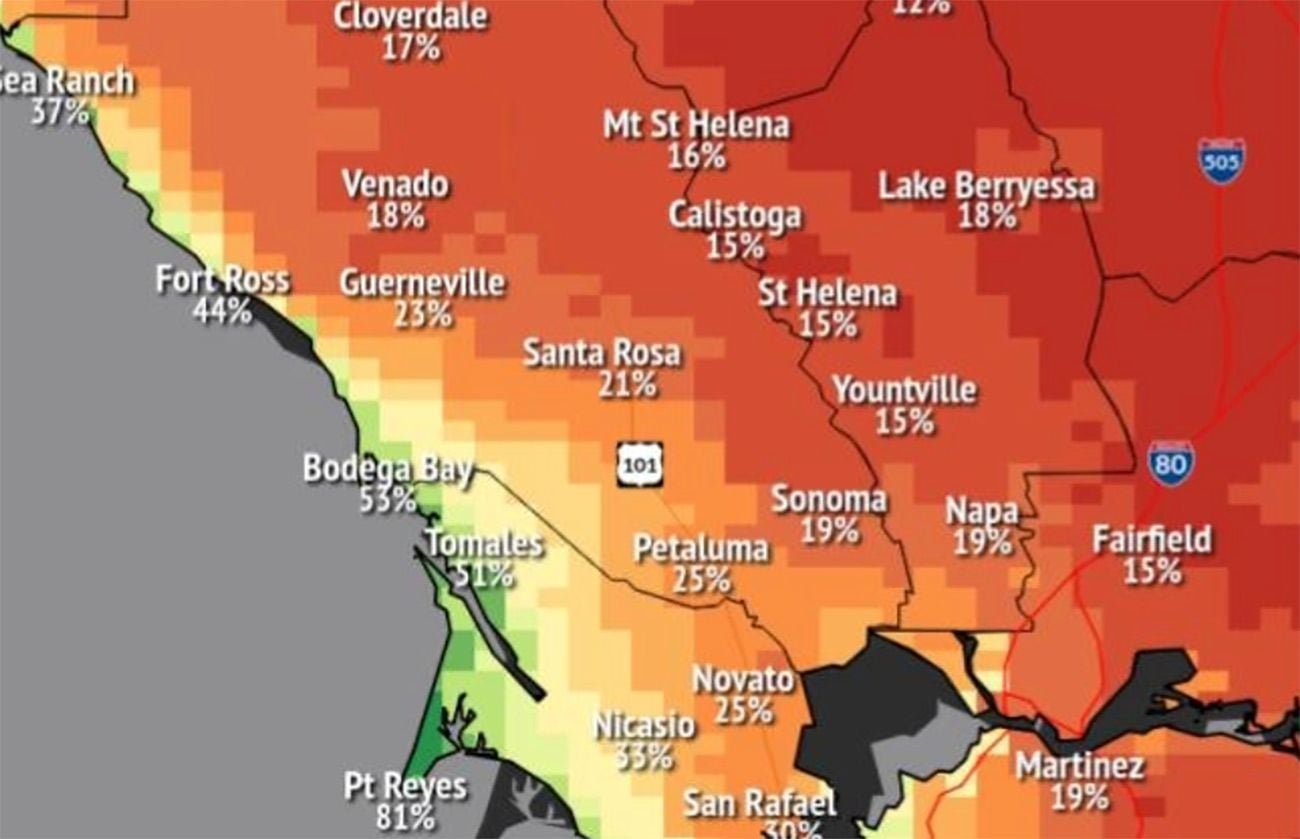
We're having an early kickoff to fire season this year and/or there is no distinct fire "season" anymore, with an offshore wind event expected to raise wildfire risks across Northern California this week.
The National Weather Service has issued a Red Flag Warning for the Sacramento Valley starting Wednesday morning, and they are warning of elevated fire risks in much of the North Bay as well due to an incoming wind event.
Winds are expected to be blowing out of the north and northeast Wednesday evening into Thursday, with low humidity expected particularly in the Napa Valley and Sacramento region. Gusts of 30 to 45 miles per hour are expected in parts of Northern California, leading to the elevated wildfire risk.
Wind gusts in Sonoma and Napa counties are expected to peak around 25 miles per hour, but could be stronger at higher elevations.
Fire weather concerns increase midweek across the North Bay Interior Mountains due to gusty northerly winds and critically dry conditions.
— NWS Bay Area 🌉 (@NWSBayArea) June 7, 2026
Remember one less spark, one less wildfire! #CAwx pic.twitter.com/LNWQ7mB4ME
PG&E has not yet announced any public safety power shutoffs (PSPS), but the utility is warning that some shutoffs may occur on Wednesday, as the Chronicle reports.
Exact addresses that can expect power shutoffs will receive notifications perhaps later today or on Tuesday.
In its seven-day PSPS forecast, PG&E says that shutoffs are possible Wednesday, Thursday, and Friday across eight NorCal counties: Colusa, Glenn, Lake, Napa, Sonoma, Sutter, Tehama, and Yolo.
PG&E has routinely performed these targeted shutoffs since 2019, when the PSPS protocal began in the wake of the deadly Camp Fire in November 2018. In 2021, after PG&E faced criminal charges stemming from the fire, a federal judge imposed strict guidance over when power shutoffs must occur, in order to decrease wildfire risk from sparking power lines.
This year has already seen one PSPS event in mid-May, when power was cut for pockets of PG&E customers in 15 counties, with 4,700 customers affected in all.
Typically these shutoffs, which often coincide with offshore wind events like the Diablo winds, tend to occur later in the summer and in the fall, when wildfire risk tends to be greatest from dry ground conditions as well.

Join the conversation
Comments
Comments load automatically as this section approaches.