
As part of the San Francisco Arts Commission's Mellon-funded Shaping Legacy Project, five artists will create temporary installations honoring communities and histories that have often been overlooked in the city's public monuments.*
The San Francisco Arts Commission launched its Mellon-funded Shaping Legacy Project in 2023 to examine the city's collection of public monuments and identify gaps in representation, as SFist reported. The project's audit phase concluded with the release of a final report in May 2025, and the initiative has since shifted into a public engagement phase focused on new installations, education, and community programming, as ABC 7 reports.
In recent years, the city removed the Christopher Columbus statue outside Coit Tower and the controversial “Early Days” monument in Civic Center, both of which drew criticism for their depictions of colonialism and the treatment of Indigenous people.
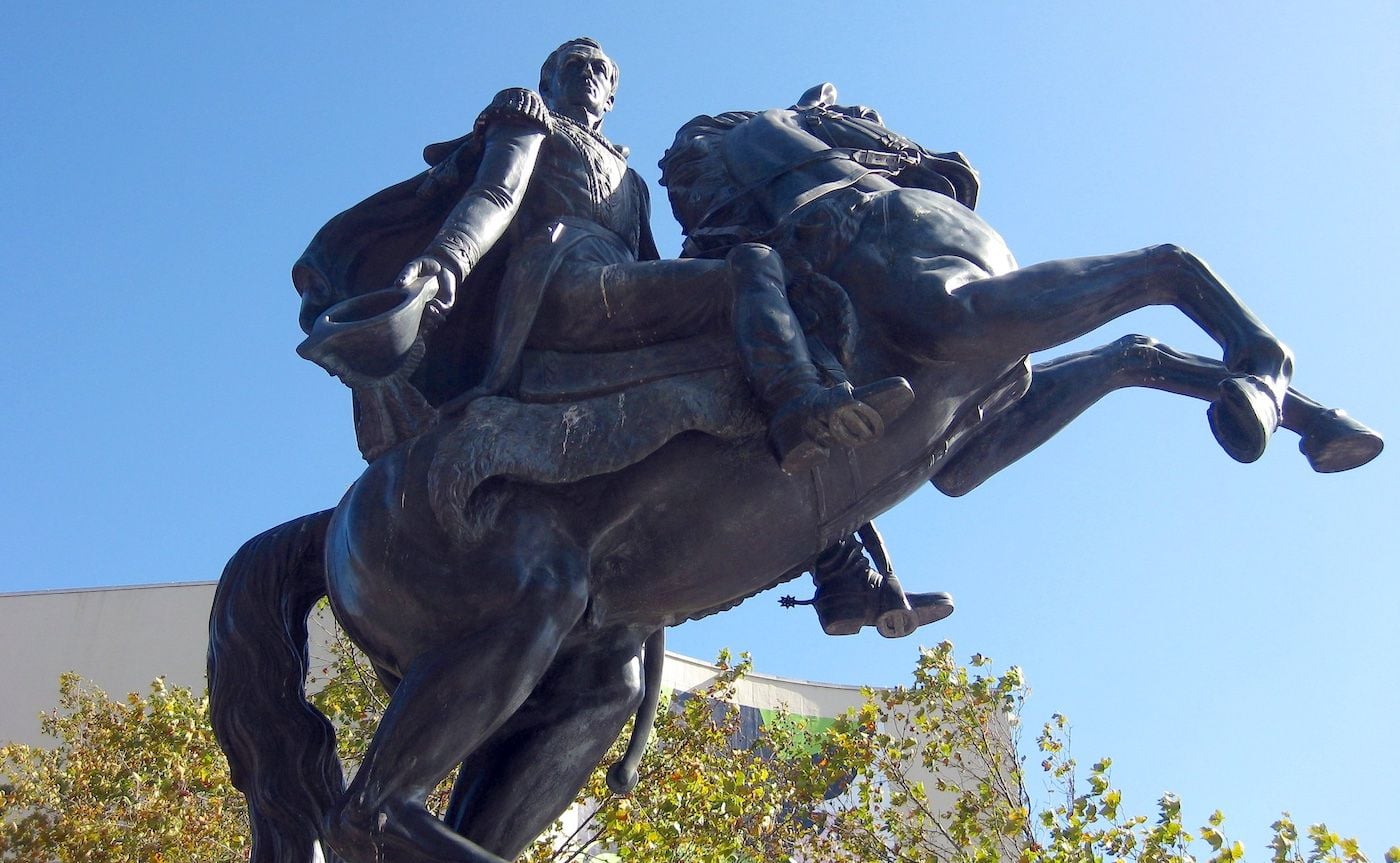
The report also cited monuments honoring figures with limited connections to San Francisco, including Robert Emmet, Simón Bolívar, and Miguel Hidalgo y Costilla, which ABC7 notes have been raised in discussions about representation in the city’s public art landscape.
Arts Commissioner Charles Collins told the outlet that the goal is to provide greater context for existing monuments while expanding representation in future public art.
“San Francisco is the epicenter of a really wonderful set of histories that we now can begin to open up more, explore and bring others in their own way into the dialog as opposed to, we with authority say what it should be," said Collins, speaking to ABC 7.
In April, the Arts Commission announced the next phase of the Shaping Legacy Project, which will feature five artists' temporary installations throughout the city. The installations are scheduled to launch sequentially between May and October 2026 and use media such as light, textiles, performance, and augmented reality to highlight histories of labor, migration, displacement, and other stories often absent from traditional monuments.
The commission also points to more recent efforts to broaden representation in public art, including Portrait of a Phenomenal Woman, which honors Maya Angelou. According to ABC 7, officials and community members have also called for greater recognition of figures such as William Leidesdorff, one of San Francisco's earliest Black civic leaders, and for more acknowledgment of the role Chinese Americans played in building the city's infrastructure, agriculture, and labor history.
In a column for the Chronicle last month, Collins argues that the city should distinguish between memorials, which reflect on historical events and losses, and monuments, which celebrate civic values.
“In Washington, DC, for example, the Lincoln Memorial stands as a solemn reflection on the Civil War’s human tragedy,” writes Collins, “while the Washington Monument celebrates the enduring idea of democracy embodied in a new nation.”
Collins writes that San Francisco should memorialize the genocide of the Ramaytush Ohlone and other Indigenous people while creating new monuments that reflect contemporary values and a broader range of community experiences.
The temporary installations selected through the Shaping Legacy Project initiative will reportedly honor Black workers at Hunters Point Shipyard as well as Chinese American and Central American garment workers.
Collins says he hopes the works spark discussion and encourage residents to think more critically about how the city represents its history in public spaces.
*This story has been updated to clarify that the Shaping Legacy Project is focused on expanding representation in public art rather than evaluating monuments for removal, as well as to reflect the project's current phase and installation timeline and to clarify the attribution of comments regarding existing monuments.
Previously: SF Performing an Audit of City’s 98 Statues to Determine If Any Should Be Removed for Being Racist or Sexist
Image: A statue of Irish nationalist Robert Emmett, by Victor Hugo Barrenchea-Villegas, a gift from the Venezuelan government in 1981; Wally Gobetz/Flickr

Join the conversation
Comments
Comments load automatically as this section approaches.