
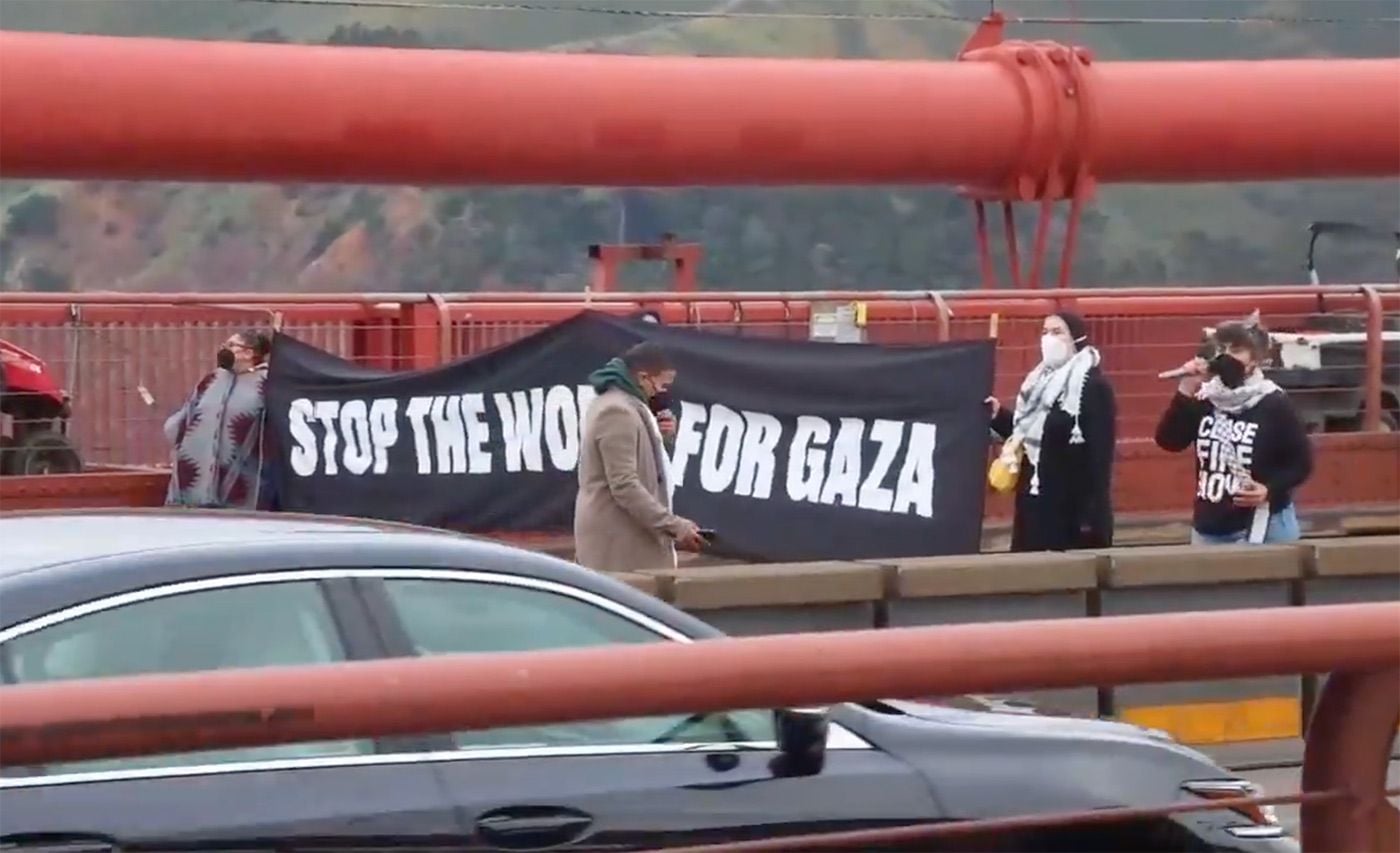
Seven individuals who face a raft of felony and misdemeanor charges stemming from a Tax Day demonstration in 2024 that shut down the Golden Gate Bridge for several hours are facing trial starting this week.
The trial of the Golden Gate Seven, who used to be the Golden Gate 26, kicked off Wednesday in San Francisco Superior Court, and it will be a battle between the perception of need for protest action, and the real-time impacts such actions can have on innocent bystanders whose lives are disrupted — as well as the need for a major piece of infrastructure to remain unobstructed.
The San Francisco District Attorney’s office has charged these seven individuals with felony conspiracy, along with multiple counts of false imprisonment, unlawful assembly, and willful restriction of free movement, the latter three of which are misdemeanors. If convicted, they could face up to 14 years in prison.
The group was part of a larger group who shut down the southbound lanes of the Golden Gate Bridge on April 15, 2024, 26 of whom were arrested and initially charged with felony false imprisonment and a slew of other charges — many of which were subseqently dismissed by a judge that November.
The entire bridge ended up remaining closed for about four hours, after CHP officers shutdown the northbound lanes as they worked to address the protest on the southbound side.
The group became known as the Golden Gate 26, or GG26, but as KQED explains, 18 of them had their charges reduced to misdemeanors and ultimately dismissed, and one other individual who faced felony charges saw those charges dismissed for lack of evidence.
A judge in the case ultimately declined to reduce the charges for the final seven in the group, partly in light of the $160,000 in restitution of toll money that was being sought by the Golden Gate Bridge, Highway and Transportation District. That sum has since been reduced to $5,300 for all 26 involved, or about $330 apiece.
As the trial begins, attorneys for the Golden Gate Seven are laying out arguments for why their clients believed that shutting down bridge traffic that day was necessary to stop the ongoing genocide and war in Gaza. Their protest action was part of a nationwide, coordinated effort on Tax Day 2024 to shut down major freeways which also included a similar human-chain protest on I-880 in Oakland.
In both the SF and Oakland protests, a tactic known as "sleeping dragon" was employed, which makes a human chain harder to break apart by law enforcement. In the Oakland protest, concrete was poured into buckets over the protesters' interlocked hands, and in the Golden Gate protest, demonstrators locked hands inside of metal tubes.
Per the Chronicle, "Many of the defense attorneys — each representing a separate defendant — said their clients had already tried more conventional calls to action. They had written to Congress, called their representatives, marched in permitted protests and attended events where politicians were speaking."
But, as Deputy Public Defender Nuha Abusamra said in court, "nothing changed. The death toll was increasing because of our tax dollars funding the genocide... It was time for civil disobedience."
Another attorney, trying to argue for why jurors should set aside harms that were done to commuters and those trying to travel across the bridge into San Francisco, reportedly made the analogy of a good Samaritan pushing a child out of the way of an oncoming car, which causes the child to be minorly injured.
"Technically, your act of shoving that kid out of the way is what caused him the injury, but at the time you dove into the street, you didn't have the criminal intent to hurt him, you had the intent to save his life," said attorney Jac Lyons, per the Chronicle.
As Mission Local reports, defense attorneys also highlighted their clients media consumption as a reason for their actions. Attorney EmilyRose Johns, who represents defendant Rocky Chau, told the jury, "The information that they were ingesting day to day was relentless. What is someone like Mr. Chau supposed to do, when no one will listen, and when the news is relentless and when the suffering is relentless?"
Meanwhile, the prosecution presented an opening argument centered on the significant delays and inconveniences that were caused to hundreds of drivers on the bridge that day. Those included a surgeon who was forced to cancel all of their operations that day, and a person with a brain tumor who was forced to miss a medical appointment.
"People missed doctors’ appointments, nurses were missing from their jobs, children were forced to defecate in bags, people had little to no water,” said Assistant District Attorney Angela Roze. “Because these seven individuals decided that their cause, their message, was more important."
"While you may agree with their cause, and it may be an important one, it does not excuse breaking the law," Roze added.
The trial is expected to last until late July.
Related: Protesters Gather at SF Hall of Justice as Golden Gate Bridge Gaza Protesters Appear In Court
Top image via CommonSenseiSF/X

Join the conversation
Comments
Comments load automatically as this section approaches.