Berkeley residents are now going to have to learn about a deadly bacterial disease called leptospirosis, which has broken out at an encampment there and already killed two dogs, and it could also spread to and kill humans.
There has long been a persistent and potentially dangerous homeless encampment at Harrison and Eighth streets in Berkeley, one which occupies about three whole city blocks. But the level of potential danger there has just escalated to DEFCON One, as the Chronicle reports that encampment is now the site of an outbreak of a deadly disease called leptospirosis, a tropical disease that is not common in the US, which has killed two dogs at the encampment, and could potentially spread to and kill humans as well.
Leptospirosis (casually known as “lepto”) is a bacterial disease that the CDC says “can lead to kidney damage, meningitis (inflammation of the membrane around the brain and spinal cord), liver failure, trouble breathing, and even death.” The Chronicle says that two dogs at that encampment have been confirmed to have been killed by the disease, and their testing has confirmed it has spread among rats in the area — with rats being the disease's main transmission vector. Now that the disease is there, it could potentially spread to and kill a person or multiple people.
"The absence of confirmed human cases is reassuring but does not remove the risk of undiagnosed cases or future cases," Berkeley Public Health Officer Noemi Doohan said in a court filing and subsequent public health alert. "If a human case were confirmed, that would elevate the urgency of the recommended response to protect human life and other animal life in the city of Berkeley."
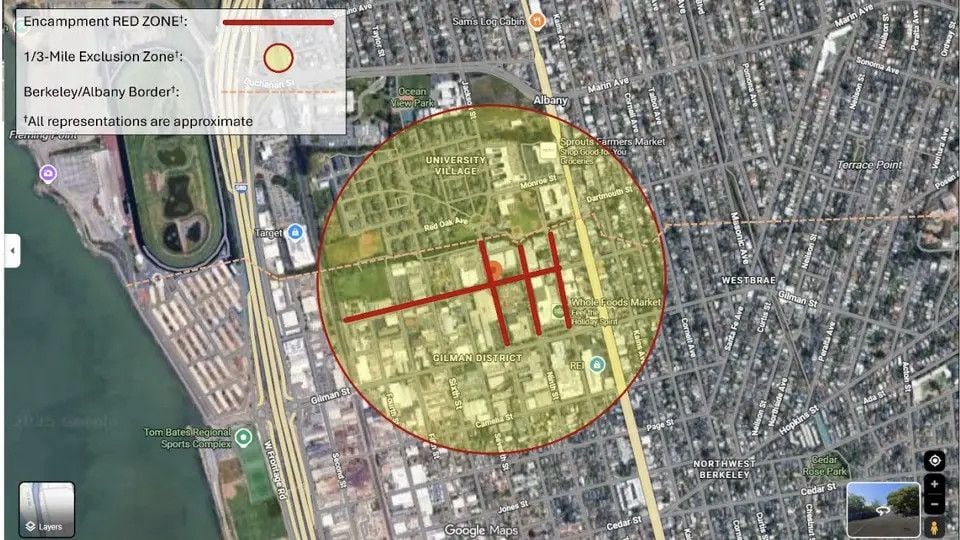
And so the City of Berkeley is recommending that all encampment residents clear the “red zone” shown in the map above, allowing public health officials to clean and disinfect the area. KTVU reports they’re also urging pet owners to vaccinate their dogs and cats for leptospirosis, noting that pets suffering from lepto can suffer from "excessive thirst, vomiting, shivering, and lethargy, and can progress to liver failure if untreated. Lepto can also be fatal to dogs."
KTVU also adds that for humans, leptospirosis can cause sudden fevers, headaches, severe calf or leg pain, kidney or liver failure, meningitis, liver failure, and possibly even death.
So people are being ordered to move out of the encampment, something Berkeley has been unable to get them to do for years. That is going to be hard enough, but then you have the issue that any infected RVs must also be fully destroyed. You try explaining to a homeless person living in an RV that they have to destroy their vehicle, for absolutely nothing in return.
Eighth and Harrison is already a particularly complicated encampment situation, where the residents currently have the legal upper hand to stay put. Berkeley has been trying to sweep this encampment for more than nine months, even before the deadly disease outbreak. But a federal judge ruled last June that they must halt all encampment sweeps at the site, in response to a lawsuit brought by the Berkeley Homeless Union.
That judge, US District Judge Edward Chen, just had an emergency hearing on the matter Tuesday, in response to the outbreak. Chen still kept the restraining order against forced clearing of the encampment in place. That is a legal win for the encampment residents.
“The city has only exacerbated health and safety issues,” the Berkeley Homeless Union’s attorney Anthony Prince told the Chronicle. “The city itself has created this health crisis.”
You also have the very thorny issue of how to notify encampment residents that they must leave, even though the City of Berkeley cannot force them to leave. The Berkeley Scanner reports that “On Monday, UC Berkeley sent the city's health alert to residents of University Village on the Albany-Berkeley border on the north side of the creek.” Okay that’s great, but how many unhoused people received such notification?
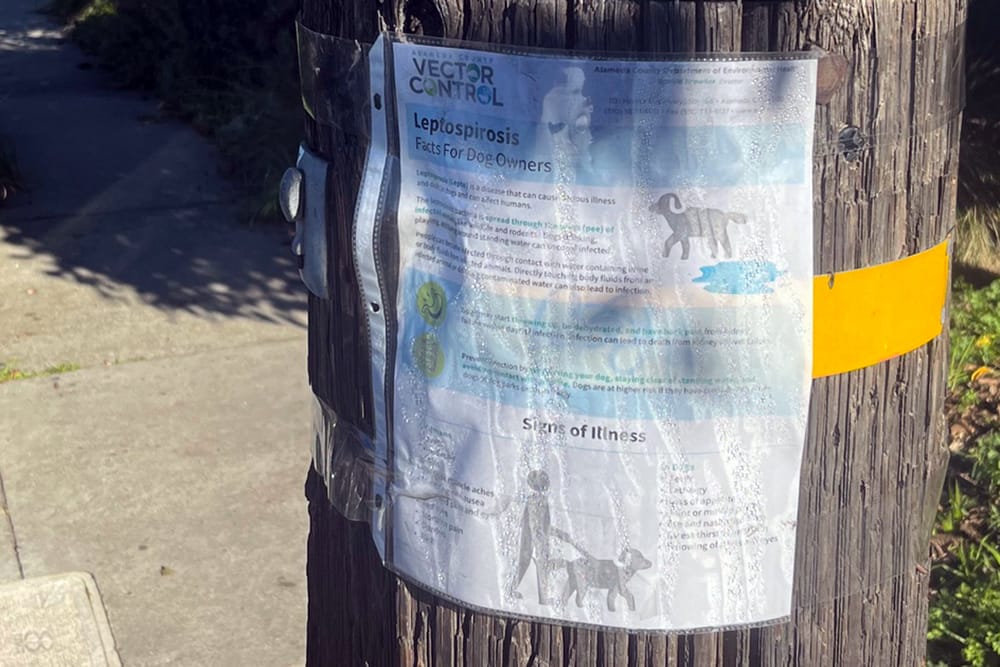
The Berkeley Scanner also points out that these flyers have been posted around North Berkeley, which I suppose is helpful, but seems nowhere near urgent enough a strategy for the situation at hand.
Clearly the City of Berkeley is between a rock and a hard place, racing against deadly infectious disease, but with their hands tied at clearing the disease from the geographic area where it is most concentrated. It sure seems like putting people up in hotels might be a good accommodation, to give encampment residents some/any motivation to leave the area when they legally do not have to?
That may sound like an expensive solution. But if a non-homeless person with access to good lawyers were to die because this disease spread from an encampment, the City of Berkeley could be on the hook for a settlement of tens of millions of dollars. So a few dozen hotel rooms for a month might be the vastly more cost-effective option here.
Related: Omicron Outbreaks Hit Multiple Bay Area Homeless Shelters, Including Two In SF [SFist]
Image: Google Street View