As we've heard multiple times in recent years, Muni has a major fare-evasion problem even though ridership has rebounded somewhat since the pandemic. But the actual numbers are pretty startling.
Buried in a new report from SPUR, titled "Taking Muni's Vitals," and tucked behind the good news that Muni has largely been a nimble and efficient agency in recent years, is the bad news that Muni fare revenue remains way, way down. Fare revenue is actually less than half of what it was a decade ago — $97 million in 2024 compared to $283 million in 2015 — even though ridership is now above 70% of pre-pandemic levels.
What does that mean? In part, it means that most people are back to using Muni trains and buses, but a good chunk of them aren't paying their fares. While ridership was down about 27% in 2024 (it's reportedly improved in the last year), fare revenue was down by 66% that year.
"Stated another way, independent of changes in total ridership, Muni experienced a 53% drop in per-passenger fares between 2015 and 2024, resulting in a significant loss of revenue for the system," the report says — though it goes on to explain that this revenue drop can also be attributed to expanded discounted and free fare programs for the elderly, students, and the homeless.
Still, anecdotally, we have all seen scores of people hop on Muni buses without tagging a phone or card at the fare box, and the state has taken notice of the discrepancy. A 2023 bailout package from the state came with the stipulation that both BART and Muni had to address their fare evasion problems. And a June 2023 report from ABC 7 cited the drop in fare revenue and quoted a Muni bus driver saying that "on a good day" maybe 40% of passengers pay their fares. (Muni's official number of fare-evading passengers, as of 2024, was 20.8%.)
The uptick in fare evasion seems tied to the pandemic, when the SFMTA laid off or furloughed many fare inspectors, and issued almost no fines for two years. The agency has since beefed up its fare enforcement, but clearly there are still far too many scofflaws and opportunities for free rides, and a few dozen fare inspectors have not been enough of a deterrant.
The Chronicle picked up the story about the SPUR report, and got a statement from SFMTA spokesperson Parisa Safarzadeh, who said, "We appreciate how this deep analysis shows that Muni service performance compares favorably with our peers, but we also know there is more work to do. Operating Muni as efficiently as possible is essential as we face unprecedented budget challenges."
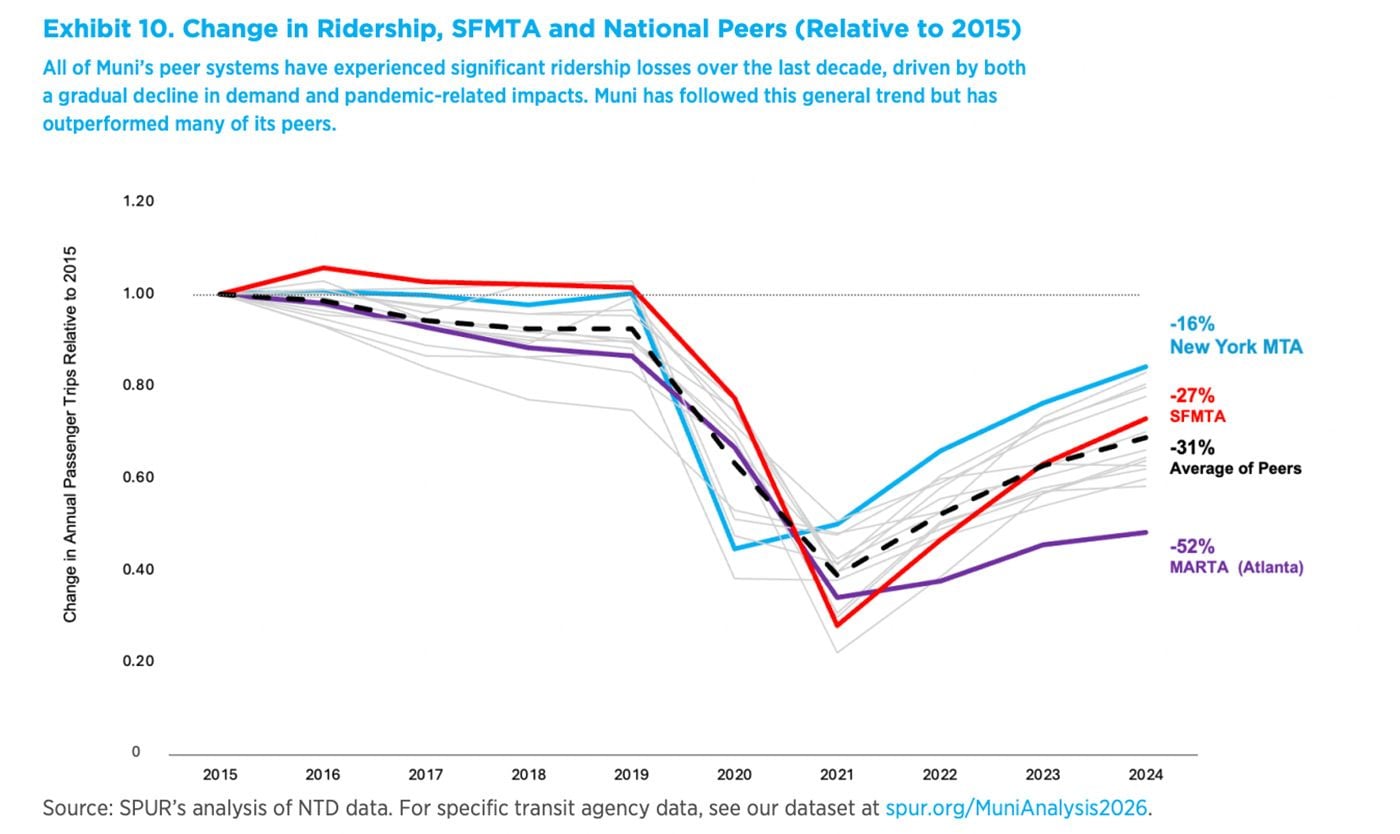
On the plus side, Muni is performing well compared to its peer transit agencies in other cities. The MARTA system in Atlanta, has seen a 51% drop in ridership since 2015 and it has barely rebounded since the pandemic. Meanwhile, the peer average drop is 31%, with Muni doing a few points better than that at 27%.
The report also cites the fact that Muni has increased efficiencies, with its cost per rider numbers well below the peer average.
"SFMTA, like all large transit agencies in the United States, has had a challenging last 10 years," writes Sebastian Petty in the SPUR report. "Despite difficult conditions across the industry, Muni has performed well, sustaining and recovering ridership and productivity faster than its peers, on average, while holding its aggregate service output constant."
Now if they could just start collecting more fares...
Previously: You May See More Muni Fare Inspectors on Buses This Year as SFMTA Vows Crackdown on Fare Evasion

