A bombshell New York Times investigation reveals details about the abuse of two girls at the hands farmworker union leader Cesar Chavez, and now Dolores Huerta, who helped found the United Farm Workers, has a bombshell of her own: Chavez assaulted her and fathered two of her children.
We learned Tuesday that the United Farm Workers union was canceling its Cesar Chavez Day celebrations this year, and that multiple localities had been canceling their own Cesar Chavez events in recent weeks. The reason was reported revelations of abuse by Chavez of young women and girls when he was president of the union, in the 1970s.
What had been brewing, we now know, was a New York Times investigation, the results of which were published Wednesday morning. Two women, Ana Murguia and Debra Rojas, both now 66, say that Chavez assaulted them when they were minors. Murguia says she was first abused by Chavez when she was 13 years old, and he had known her since she was 8.
Rojas says her abuse began when she was 12 years old, and the Times reports that when she was 15, Chavez arranged to have her accompany him, staying in a motel, during the famed 1,000 Mile March demonstration in 1975, and had intercourse with her multiple times. (Murguia says that Chavez molested her but never had intercourse with her.)
Now, Chavez's iconic co-founder of the United Farm Workers, Dolores Huerta, has broken her silence in conjunction with the Times piece. Huerta issued a statement Wednesday saying that Chavez assaulted her once, and prior to that coerced her into unwanted sex, and that both encounters had resulted in pregnancies.
"I am nearly 96 years old, and for the last 60 years have kept a secret because I believed that exposing the truth would hurt the farmworker movement I have spent my entire life fighting for," Huerta says. "I have encouraged people to always use their voice. Following the New York Times’ multi-year investigation into sexual misconduct by Cesar Chavez, I can no longer stay silent and must share my own experiences."
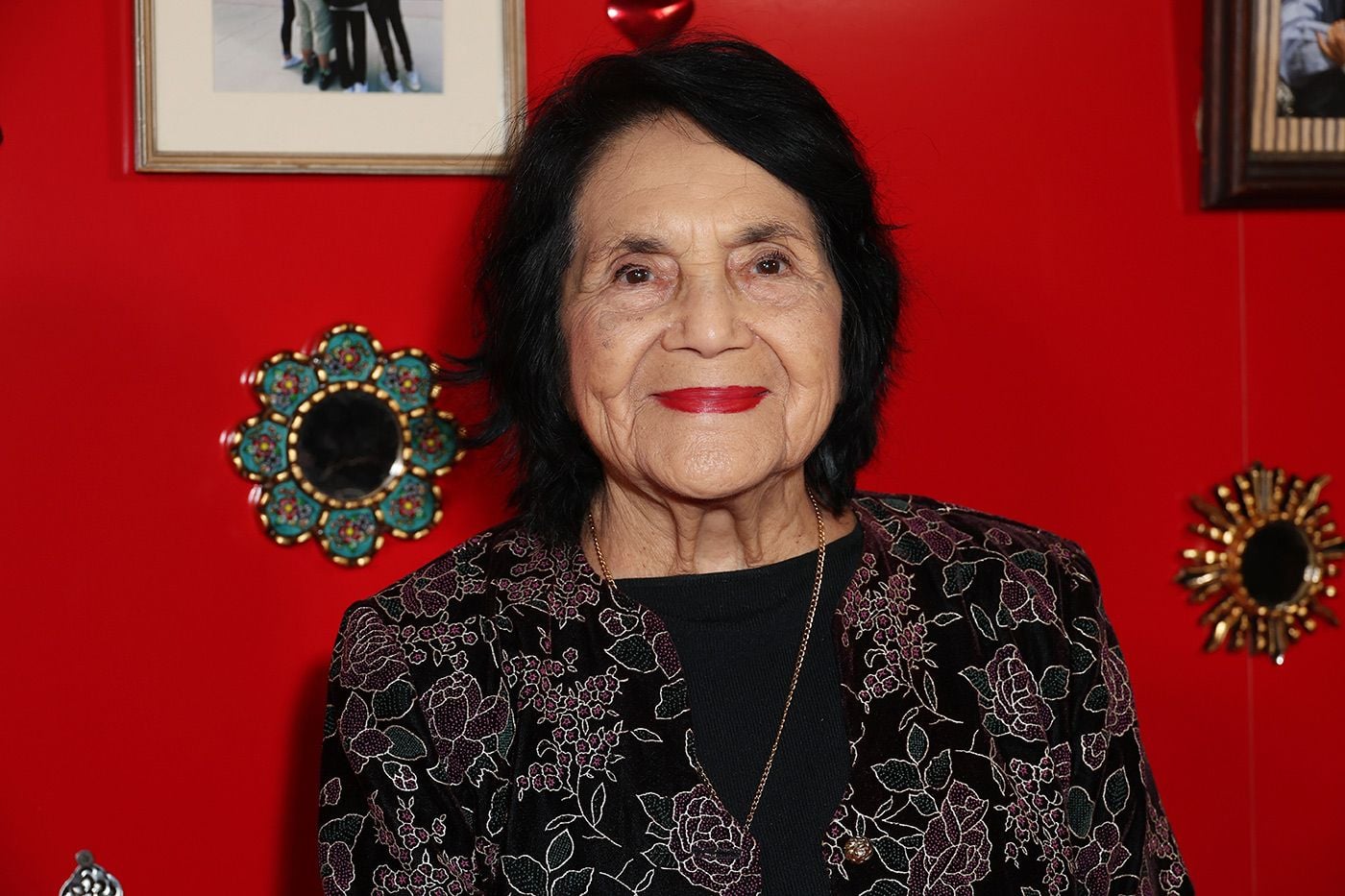
Huerta spoke to the Times as well, telling them that "One night during the winter of 1966 in Delano, Calif.", Chavez "drove her out to a secluded grape field, parked and raped her inside the vehicle." She added that she "chose not to report the assault to the police because of their hostility toward the movement, and she feared that no one within the union would believe her."
The fallout from these allegations is sure to be vast. And, as the Times notes, Huerta's story in particular "shatters what was a widely celebrated — and seemingly egalitarian — bond between two of the most influential Hispanic activists in U.S. history."
The family of Cesar Chavez, who died in 1993, issued a statement to the Times ahead of the publication of the piece, saying "These allegations are deeply painful to our family." And, they say, "As a family steeped in the values of equity and justice, we honor the voices of those who feel unheard and who report sexual misconduct."
The remainder of Huerta's statement appears below.
As a young mother in the 1960s, I experienced two separate sexual encounters with Cesar. The first time I was manipulated and pressured into having sex with him, and I didn’t feel I could say no because he was someone that I admired, my boss and the leader of the movement I had already devoted years of my life to. The second time I was forced, against my will, and in an environment where I felt trapped.
I had experienced abuse and sexual violence before, and I convinced myself these were incidents that I had to endure alone and in secret. Both sexual encounters with Cesar led to pregnancies. I chose to keep my pregnancies secret and, after the children were born, I arranged for them to be raised by other families that could give them stable lives.
Over the years, I have been fortunate to develop a deep relationship with these children, who are now close to my other children, their siblings. But even then, no one knew the full truth about how they were conceived until just a few weeks ago.
I carried this secret for as long as I did because building the movement and securing farmworker rights was my life’s work. The formation of a union was the only vehicle to accomplish and secure those rights and I wasn’t going to let Cesar or anyone else get in the way. I channeled everything I had into advocating on behalf of millions of farmworkers and others who were suffering and deserved equal rights.
I have never identified myself as a victim, but I now understand that I am a survivor — of violence, of sexual abuse, of domineering men who saw me, and other women, as property, or things to control.
I am telling my story because the New York Times has indicated that I was not the only one — there were others. Women are coming forward, sharing that they were sexually abused and assaulted by Cesar when they were girls and teenagers.
The knowledge that he hurt young girls sickens me. My heart aches for everyone who suffered alone and in silence for years. There are no words strong enough to condemn those deplorable actions that he did. Cesar’s actions do not reflect the values of our community and our movement.
The farmworker movement has always been bigger and far more important than any one individual. Cesar’s actions do not diminish the permanent improvements achieved for farmworkers with the help of thousands of people. We must continue to engage and support our community, which needs advocacy and activism now more than ever.
I will continue my commitments to workers, as well as my commitment to women’s rights, to make sure we have a voice and that our communities are treated with dignity and given the equity that they have so long been denied.
I have kept this secret long enough. My silence ends here.
Previously: Union Co-Founded By Cesar Chavez Cancels Annual Celebration of Him, Citing Allegations of Sex With Minors
Top image: American labor activist and cofounder of the United Farm Workers of America (UFW) Dolores Huerta (right) and Richard Chavez (1929 - 2011), brother of UFW cofounder Cesar Chavez, speaking at a meeting at the UFW headquarters (La Paz), Keene, California, mid 1970s. (Photo by Cathy Murphy/Getty Images)

