The battle over Gavin Newsom's stick-it-to-Republicans ballot measure, Prop 50, which would temporarily redraw California's congressional district map for the next five years, is heating up in its final month, and it is looking very expensive.
The national Republican Party is clearly worried about the potential passage of California's Prop 50, which would redraw California's congressional district maps between now and the next census, and would likely take five House seats away from Republicans, giving them to Democrats in the 2026 midterms. The measure was created in response to a move by Texas Republicans in the state legislature, who bulldozed over their Demoratic colleagues, at the behest of President Trump, and passed a redistricting measure without any such democratic process — likely handing five extra House seats to Republicans next year.
You've likely seen ads paid for by the "No on 50" campaign, which use former Governor Arnold Schwarzenegger and others talking frighteningly about the measure being anti-democratic, even though it is meant to be just a temporary counter-measure to the Republicans equally undemocratic actions.
California established a non-partisan, independent commission process for drawing congressional district maps almost two decades ago, and Prop 50 does not cancel that — as these ads suggest — it merely supercedes it for the next two national elections in 2026 and 2028, until the results of the 2030 census come in.
As Cal Matters reports, spending on Prop 50 already made it the third-most expensive ballot-measure campaign in California history as of a week ago. The "No" campaign has raised $77 million, primarily from two donors — the Republican Super PAC known as the Congressional Leadership Fund has given $42 million so far, and Charles Munger Jr. has given $33 million to the campaign. (Munger was a major donor to the original ballot measure campaign to establish the independent commission for congressional mapping.)
Former Republican Speaker of the House Kevin McCarthy also transferred $1 million from his campaign coffers to the "No" campaign.
Supporters of Prop 50 had raised $138 million as of last week, bringing the total being spent so far to $215 million. That puts this fight just behind two other recent, very expensive ballot-measure fights, the 2022 campaign for and against Prop 27 to legalize online sports betting; and 2020's fight over Prop 22 to make Uber and Lyft drivers employees.
A whopping $49 million of the "Yes" campaign funds have come from individual donors who've given $100 or less.
If you're curious just what the maps will look like if Prop 50 passes, you can see the Associated Press's interactive before-and-after tool here, or see the proposed new map below. It would take away Republican seats largely by combining coastal "blue" areas with inland "red" districts — like the new District 2, which would stretch all the way down the coast to Sonoma and Marin counties and extend all across the northern swath of the state to the Nevada border, including the city of Redding, and the Mount Shasta area.
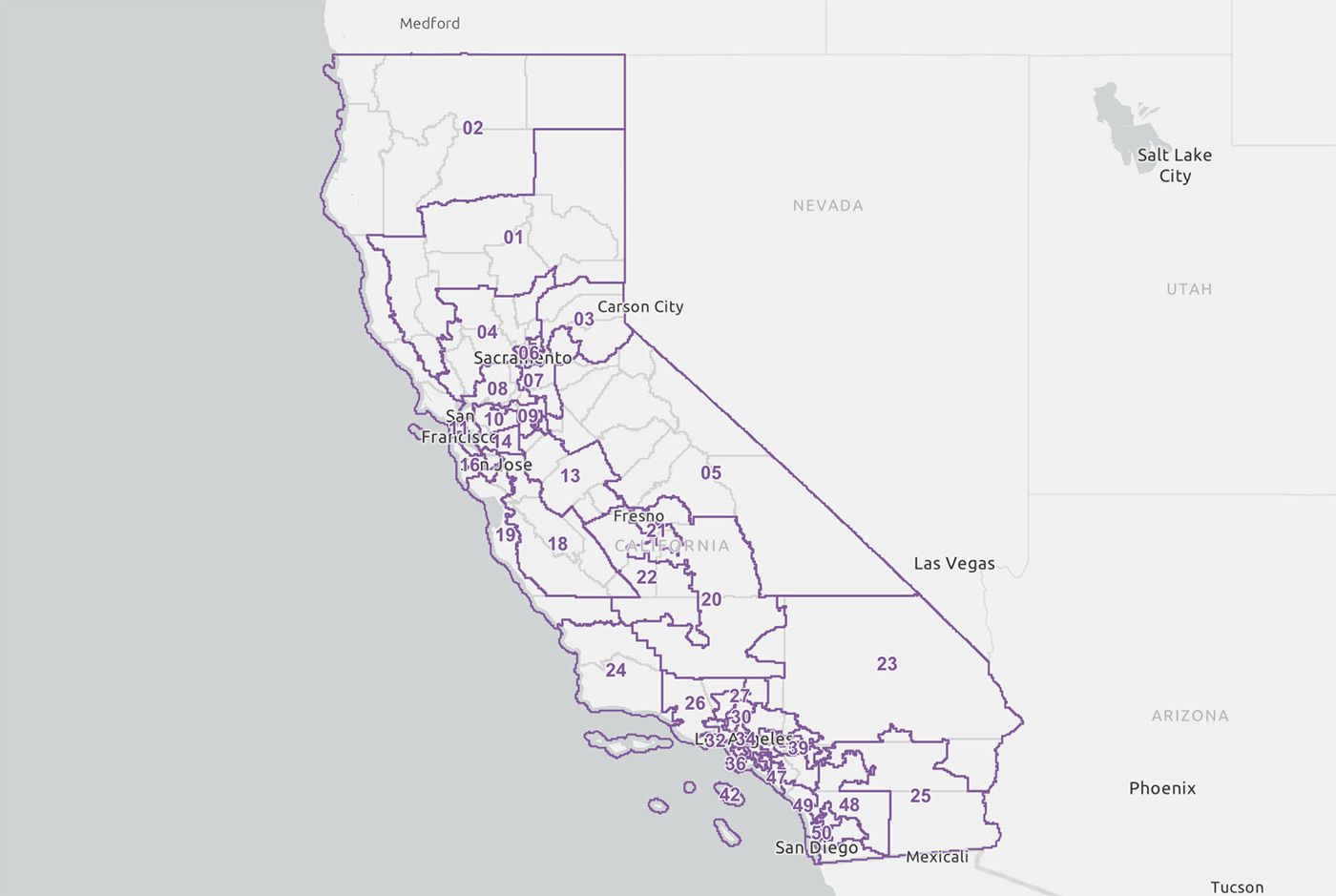
To the south, red districts around San Diego and Orange counties would disappear and be combined with heavily populated, bluer areas, leaving only District 40 as a likely Republican stronghold.
All told, nine currently red-leaning districts would become just four — Districts 5, 20, 23, and 40.
How the vote goes on Prop 50 this November is likely to have significant impacts on the governor's race next year — and it could have long-lasting impacts on the future political ambitions of Newsom as well.
We've already seen, just this week, that Democratic frontrunner for governor Katie Porter got hung up on a question from a reporter about what she'd say to Trump voters who oppose Prop 50 or who may be disenfranchised as a result of it. The testy exchange, and Porter's attempt to cut the interview short, have gone viral, particular in conservative/pro-Trump corners of Xitter.
Top image: Close-up of voter guide materials listing Proposition 50, a ballot measure in California, on a light gray surface, Lafayette, California, October 3, 2025. (Photo by Smith Collection/Gado/Getty Images)

