November 12, 2007
Touched by an Angela: La Rondine at SF Opera.
Angela Gheorghiu, the diva, made her SF Opera debut on Wednesday evening, in Puccini's La Rondine. That she made it onstage was somewhat of an accomplishment; she just had been fired from a production in Chicago for missing rehearsals. She was attending her husband, French tenor Roberto Alagna, concert at the Met, it seems. (Alagna's claim to fame has been walking off the stage at La Scala in the middle of Aida, after being booed. His cover had to jump in, still sporting jeans, to keep the opera going.) Fittingly, they were dubbed the "Bonnie and Clyde" of the opera world before these exploits. The aforementioned are only the latest peccadilloes. (Visit the links above for more of their jaw-dropping behavior.)
Now, Angela has some redeeming qualities: one could excuse her for her behavior; being diva in the truest operatic sense of the word, that's her job after all. Plus, she brings excitement to a performance well before a single note is sung, which is good in the accounting department. It does not hurt that she can display major cleavage very convincingly. And: she can sing.
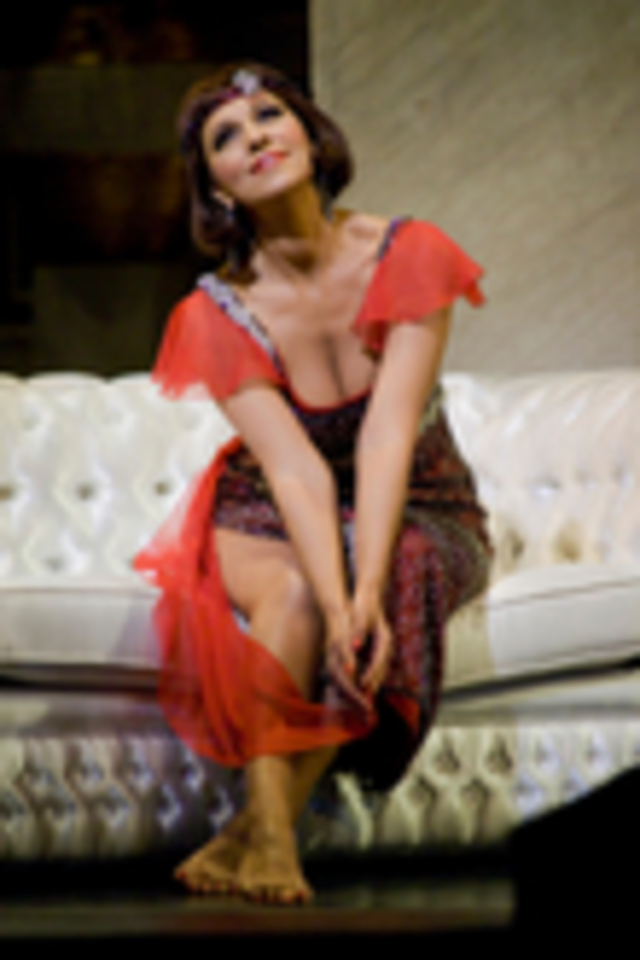
Pictures of Angela Gheorghiu, above, Anna Christy and Gerard Powers, and Misha Didyk below, by Terrence McCarthy, SF opera.
Angela's musical performance as Magda was a bright point in the La Rondine production. She's as stunning on stage as she appears on the promo material, wearing in the first Act an ankle-long evening dress slit all the way up to her thigh. Her voice is warm, silky, it evoked a caramel swirl to us, or a heavy velvet drape: a voice with texture and depth. Her acting, on the other hand, was built on a single premise: look at me. If she walks, she comes off as Naomi Campbell ona catwalk. If she takes off her shoes, she plays a coy little girl. Maybe her attention grabbing behavior off-stage predisposes us to see her forced acting as a ploy for attention, so go check for yourself. Fortunately, it does not deter from the enjoyment of her singing.
The other performers were eclipsed by Angela. The poet Prunier (Gerard Powers) has a charming tenor voice, tinted with irony, but whenever he gets a nice aria, someone decided to upstage the poor guy! He sung nicely the first part of the Doretta aria, but then Angela took it over, with much more conviction. She ended up milking the applause a tad longer than strictly necessary, her arms high in the sky, as if she had shot the winning buzzer beating three pointer. Below a recital version of that song. Listen and fall in love:
Powers rendition of the Swallow (in Italian, la rondine) aria, which gives the opera its name, was vibrant and full of delicacy, only to be followed by Ruggero's entrance (Misha Didyk, last seen in Manon), again blasted with more conviction. Still, we liked Powers better than Didyk: what Didyk gained in conviction, he gave up in smoothness. He would open his phrases abruptly, or terminate a line as if gasping for air. What happened in between was mostly nice, but the overall effect was rather harsh to us. Anna Christy does not have the unctuous soprano of Angela Gheorghiu, but her slightly more sour voice was a perfect fit for her irreverent maid character. She was perky, energetic and still musical. It does not hurt that she gets perfect comic timing. Her duets with Prunier were delightful, charming and humorous at the same time.
The set, by Nicolas Joël, got applauded by the audience at the beginning of each act. We guess they like shiny things, but we found them quite ridiculous: a Klimt-inspired art deco set looking more like Vienna than Paris, with a fake fireplace (which looked like a TV playing a fireplace DVD, it was that bad) in Magda's flat, a disco ball in the restaurant Bullier, and a French Riviera hotel which looked so much like a swimming pool, we were hoping Angela would show up in a bathing suit. No luck, as costume-wise, we get summery afternoon dresses for a spring evening: light dresses are nice to show off Angela's assets, but we don't get the message the set and costumes are trying to convey. Well, we get the Viennese influence on the operetta genre, but we really don't see the need to highlight it this way. But the bourgeois aesthetic resonated with the SF audience, so who are we to be grumpy?
We have to salute the conducting of Ion Marin. Ion was positively electrifying, ha! The opera is a comedy, and it's full of wit in the lyrics, but also in the music. And Ion not only kept his tempos varied and lively, not only switched the musical texture swiftly in the transitions, he managed to highlight some musical puns in a way that we, of all people, could get it. Here a Vivaldi quote, here a musical whistle. Even more fun, we get a quote of Tristan and Isolde merged with a citation of Madame Butterfly, all in one minute, when Magda is first consumed by love, then waits for the return of Ruggero in Act II. Usually, this stuff flies over our head, but we thank Marin for presenting it to us in an intelligible manner!
La Rondine
SF Opera War Memorial Opera House
5 more performances:
Tue. November 13, 8 pm, Fri. November 16, 8 pm, Wed. November 21, 7:30 pm, Sun. November 25, 2 pm, Thu. November 29, 7:30 pm


That's a lovely review. Interested in hearing what you think of the Eurotrash "Macbeth" production.