
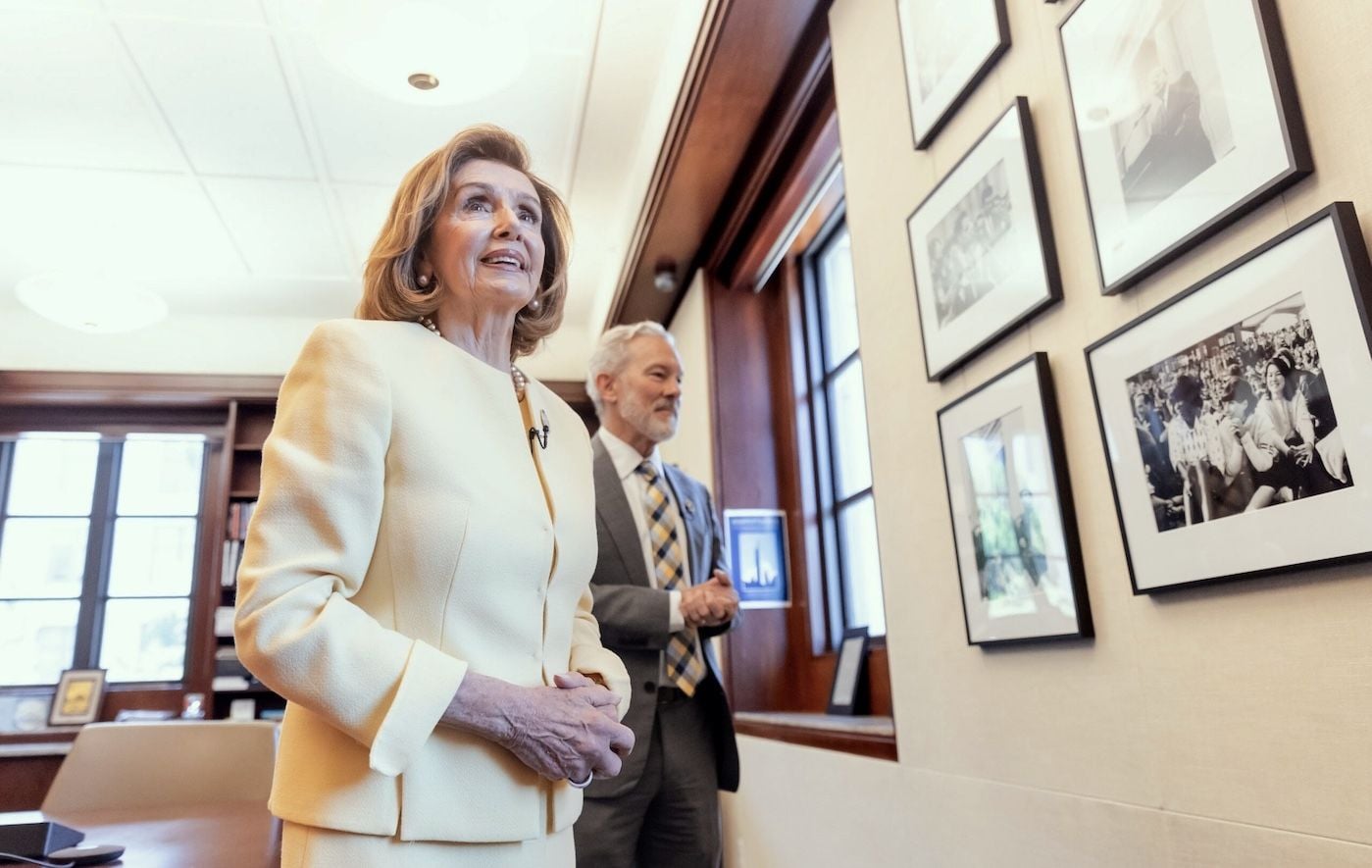
After Speaker Emerita Pelosi retires in January, she’ll be heading a new nonpartisan institute at UC Berkeley, which will serve as a hub for undergraduates interested in public leadership, as well as a think-tank for faculty exploring issues impacting democracy.
In January, the doors will officially open to the new Nancy Pelosi Institute for Representative Democracy at UC Berkeley, where the soon-to-be-retired Speaker Emerita Nancy Pelosi will co-teach a course on Congress alongside political science professor Eric Schickler, as the Chronicle reports. The institute has already raised $35 million toward its initial $50 million goal, a feat university officials largely credit to Pelosi's fundraising prowess.
The organization will reportedly serve as both a leadership pipeline for students interested in public service and a research center examining issues affecting democratic governance, including political polarization, the ethical use of AI in government, criminal justice reform, and civil rights. About 500 undergraduates a year are expected to participate, with students able to earn a certificate in public leadership regardless of their major.
UC Berkeley officials say the institute will remain strictly nonpartisan, despite Pelosi's long history as a Democratic leader and frequent criticism of President Donald Trump. According to the New York Times, the institute joins a growing number of civics and public leadership centers launching at universities nationwide, many of them in Republican-led states and often viewed as having a conservative bent.
The Times also notes that the announcement comes as UC Berkeley faces multiple investigations from the Trump administration. Pelosi, however, described her new role as "almost an emancipation from partisanship," telling the Times, "This is about civics, it's about the vision of our founders, it's about democracy."
The Chronicle reports that university officials also hope the institute will help UC Berkeley compete with Ivy League schools that have long dominated the pipeline to national leadership positions. According to the university, roughly a quarter of Berkeley's undergraduates are the first in their families to attend college and about a third come from low-income households. Chancellor Rich Lyons said the goal is to give those students the same kinds of leadership opportunities and professional connections traditionally available at elite private universities.
The program will also fund student internships and host visiting fellows and annual forums featuring prominent national and international leaders, with the goal of expanding to include faculty-led centers focused on topics such as artificial intelligence, gender and politics, and human trafficking.
“We intend to do more than simply study democracy,” Lyons said in a statement, “we are building this institute to strengthen it.”
Previously: Nancy Pelosi Says She'll Retire After 2026
Image: Brittany Hosea-Small/UC Berkeley

Join the conversation
Comments
Comments load automatically as this section approaches.