
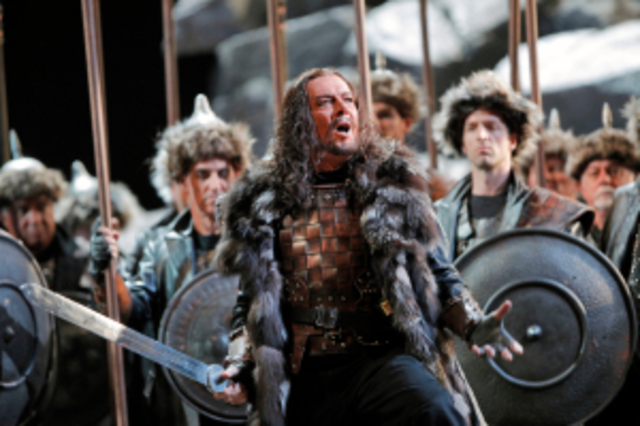
Video enhancements are all the rage on staging nowadays, and of course opera isn't exempt of the fad. Case in point: both Attila and The Magic Flute at SF Opera, which we saw on consecutive nights Friday and Saturday, prominently feature large screen with video projections. It was a tutorial in how to do it well, and how to do it poorly.
In Attila, Verdi used the Hun barbarian of the 5th century as a metaphor for the Austrian oppressor of his time, the mid-18th century. So stage director Gabriele Lavia decided to set the first act in the historic time of Attila, in a destroyed Roman amphitheater; the second act happens in Verdi's time, in a run down theater, making the Hun-Austrian symbolism explicit. But the opera ends with a third act, so the next ride in the Delorean takes us to a movie theater in the 1950s. Why, you ask? "Our choice of the movie theater was influenced by recent barbaric Italian policies: many important theaters, that were also historical sites, were demolished or refashioned and turned into modern movie theaters, " replies Lavia in an interview in the program book. Turning theaters into bowling alley, peep shows, churches, movie theaters, or gasp, parking lots: those are the real outrage, the barbaric crime against humanity. Glad it's clarified. Let's fight evil, let's bring a Shakesparian troupe back into the market street cinema already. They'll get in the VIP lounge for free if they wear their name tags.

Join the conversation
Comments
Comments load automatically as this section approaches.