Thesis: classic Italian opera represents the core tradition of the art form and success as a singer means being able to master the genre. Anti-thesis: opera is an evolving live form, and the work of contemporary composers is relevant, forget about the old dead ones. Synthesis: let’s toss a little bit of everything on the wall, old and new, domestic and foreign, we’ll see what sticks, and call it the Merola Grand Finale.
To conclude the apprenticeship program’s 50th season, the Merola program gave its grand finale concert last Saturday at the War Memorial Opera House. The singers did not present a full fledged opera, as in the previous concerts this summer, but selected arias to display what they can do best. The staging was minimal, and the costumes were black tie attire, but felt like what a formal 50 year high-school reunion in Texas would wear: expensive, full of satin, but bland, bland, bland.
To explain what was at stake: last year, Heidi Melton and Noah Stewart gave superlative performances, and were later invited into the prestigious ranks of the Adler fellows, and voila, they were both singing in the cast of the Rosenkavalier on arguably the second best opera stage in the country a couple months back. While all singers on Saturday were amazing, many in the audience were trying to figure out who was going to “make it,” who was going to be the next Thomas Hampson or the next Patricia Racette.
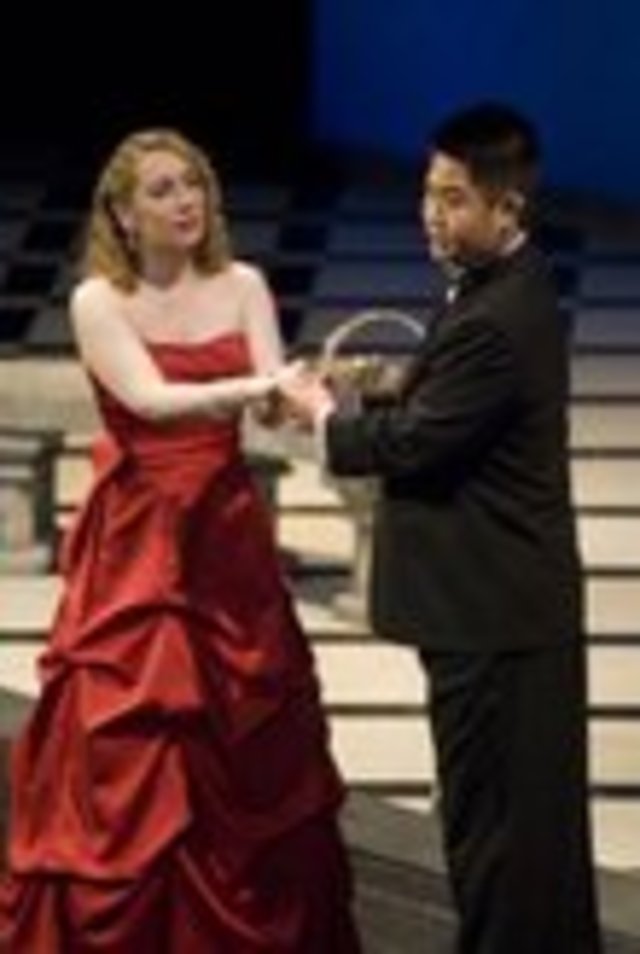
Above, Jamie-Rose Guarrine and Vince Yi; below (left to right) Ani Maldjian, Cynthia Hanna, Alek Schrader, Sam Handley (w/ scroll), Alexander Boyer, Tom Corbeil, Matthew Hanscom, Kenneth Kellog, Paul Murrihy (ponytail showing), Matthew Moore, Nathaniel Hackman, Daniela Mack (blue dress), Tamara Wapinsky (black dress). Photos by Kristen Loken/SF Opera
We’re only philistines, so we’ll be wrong, but nonetheless we would pick a few: the most mind blowing performance was also the most unexpected. Vince Yi came on stage with Jamie-Rose Guarrine. He looked a bit awkward, to be honest, far from the regal character he was giving life to. We were thinking of William Hung, for some reason we’d rather not explore. Jamie-Rose, who had sunged a lovely, delicate “C’est le Dieu de la jeunesse” earlier, was again a sweet-voiced young lady in love, as she kicked off the duet.
We had not seen Yi in the previous productions of the Merola program this year, and we were guilty of this thought: “Good they are giving this nerdy-looking kid a chance to come on the stage after all. He’ll have a memory for the rest of his life.” But soon after, he started to sing in the most crystalline counter-tenor voice, and we were floored. His duet with Jamie-Rose was The Highlight of the evening, literally two soprano voices meshing high above the staff, in an ethereal communion. Yi’s voice was a head voice, but did not feel strained or forced. We don’t know if the Adler fellows must have a counter-tenor among them at all times, but if they do, they found a natural! As far as Yi having other opportunities on the opera stage: hell yeah.
The man who stole the first part of the show was Sam Handley. We praised him in the earlier production of La Cenerentola, and he came back with a high-wattage, devilish performance of Gounod’s Le Veau d’Or aria, powerful and intense, which awed the audience, despite (or was it because?) is aria being the shortest. Being French, we’ll just say that his diction can be improved, but that’s the only fault we’ll find with the performance.
We payed attention to the diction only because Jason Plourde opened the show with the prologue from Poulenc’s Les Mamelles de Tirésias, and this baritone seems perfectly fluent (his bio says he is from Caribou, Maine, a name that means moose in French, and a city 30 miles from Quebec state). You have to kick off things off the right foot, and Plourde welcomed us with savvy, bonhomie and some jovially sung poetry.
Meredith Woodend, last seen as the new owner of the Hotel Casablanca, fixing cocktails and being light and witty, came back as the polar opposite as the Mother in an aria from Menotti’s Amahl and the Night Visitors: intense and brimming with emotions, managing to sing in a soft voice, but projecting it strongly in the whole house, she had us on the edge of our seat.
We liked the crooner-like rendition of Billy Bigelow’s Soliloquy from Rodger’s Carousel by Nathaniel Hackman. Hackman looks like he has no compunction being on stage in front of thousands of people, he exudes self-confidence and sung with the perfect amount of brash and cockiness.
Andrew Bidlack, last seen crowing that everything is bigger in Texas, now waxed elegiacs about New-York and the New-York lights. Andrew, just ask Tony where you should leave your heart, because your selection is not A-number-one, top of the list right now. Still, he has a nice tenor, full of color. Paul LaRosa was smooth, velvety and full of charm.
Rebecca Paul was another singer from the program we saw tonight for the first time, and we would have liked to see more of her. Her dramatic and thoughtful rendition of the “embroidery in childhood” aria from Peter Grimes had us wishing to see that opera again.
And Daveda Karanas offered the third high point of the evening (Yi and Handley being the other two). It’s hard to stand out, all the singers were so amazing, but she managed the feat. A big voice that fills the opera house effortlessly, she still sounded delicate and always accurate. She started a bit static, as if she was giving a recital, not acting a part, but we witnessed her acting chops in La Cenerentola anyway. Still, she could be immobile, with a voice like hers, she’ll convey the emotions of the part effectively, and she'll get people's attention.
The opera orchestra needed half of the overture to realize they were not on summer break anymore, and the limited staging was unobtrusive. The only edit we would suggest would be to cut the spoken intro of “Pain! Nothing but pain” from Weill’s Street Scene, which involved two non-singing characters and seemed to last longer than the song.


A reason for minimal staging:
We're deep in technical rehearsals for the Fall season. The floor you see there is actually the floor from Rondine.
-an opera house stagehand
Thanks for the precision. The limited staging was not a criticism: there's enough variety in the tunes and singers to sustain interest. Last year staging wittily acknowledged its simplicity by switching the position of the two elements (a bench and chair I believe) on the stage.