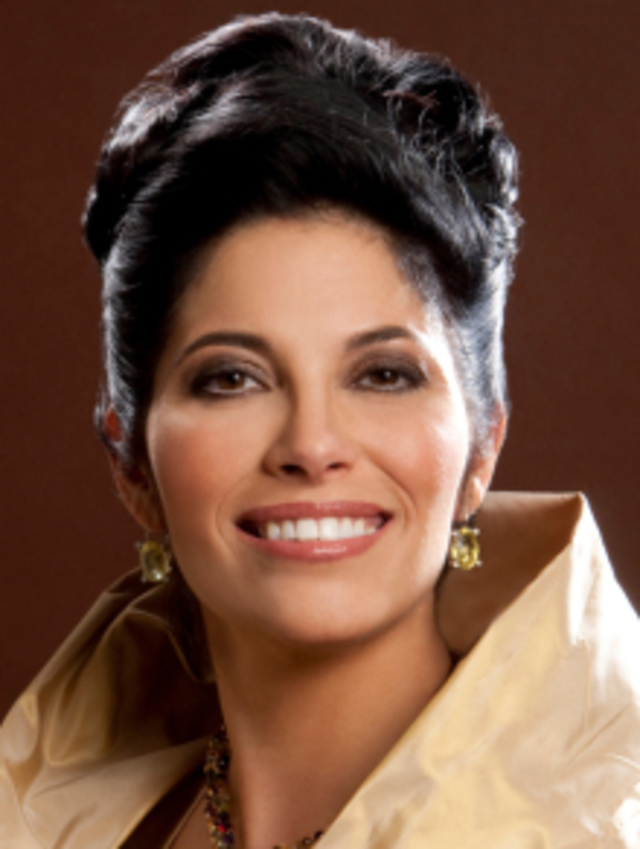
SFist Interviews: Mezzo-Soprano Vivica Genaux
Vivica Genaux
You know who else was famous for vocal agility? Castrati, that's who. Farinelli, the most famous of them all, is the picture for coloratura on Wikipedia. And Vivica has become quite a Baroque specialist and scholar, even moving to Venice to be closer to that scene. So it's only natural she will sing some of Farinelli's arias in her concerts this week, which she recorded on a Grammy-nominated CD with Rene Jacobs. Check this out to give you a flavor.
This is your debut with the Philharmonia Baroque, how did this come about?
Vivica: Originally, they asked me to come with Rene Jacobs, to do a program of Farinelli arias that we had recorded together. Unfortunately, after we had already planned to do that, Rene was not available anymore and Maestro McGegan was very sweet and said he would conduct the concert if I would still come, and so I'm coming and we'll do some Vivaldi and Rene Jacobs kindly gave us permission for us to do some Farinelli arias.
Why did he have to give his permission?
Vivica: They're all his materials. He the one who found the manuscripts. When you work with Rene, he puts so much work into all of his projects that you really have to respect his proprietorship of the material. I don't have the scores for those, so we had to ask for his permission to use the scores and he was very kind, and his ornamentation he said I could use, so I'll probably be doing some of his ornamentation on a few of the pieces.
Can you elaborate a bit on the ornamentation, why it's so important?
Vivica: Oh yes, it's intrinsic to Baroque! Generally, the Baroque aria, between 1700 and 1750-60, the aria was written in the da capo format, da capo means from the beginning. What this means is that you have an A-B-A format which means that you have an A section that you sing through, then a generally contrasting B section, and then you go back and sing the A section again. And the reason for the ornamentation is so that you are not singing the same exact music twice. Actually, it's probably the opposite: the reason that you go back, is so that each singer can do their own ornamentation and show off what they do best with their voice. So every singer, whether is Jennifer Larmore, Stephanie Blythe or myself, any mezzo-soprano you could name, we would have different ornaments for the da capo A section. And because it's supposed to show off what's the best and most effective in each person's voice. It's true in the original singers of the music as well. Farinelli was very very famous for his trills, so if you see some of the original ornamentation that has survived from the 1700s, you can see that he does a lot of trills and a lot of long held notes where he would change the color of the note in the voice. Other people have strength which would be coloratura, so they would put a lot of fast notes in the repeated A section. Everyone has different strengths and weaknesses so it's all to show off what you do best.
Rene Jacobs as a singer himself understood that very well. Also he's a musicologist, so he has done a lot of research on the style of ornamenting and one of the things that he does and that I really admire and look forward to when I work with him is to write ornamentation for everyone on every project that he does. So if you are doing an opera with him, he'll write out the ornamentation for the soprano, the mezzo, the tenor, the bass, for whoever is singing with him, he writes up the ornamentation. He tend to work with singers he knows very often, or he'll have a working session with the singer before the ornamentation so he can understand the voice and sees what they do best.
Every conductor has their own preferences as to how to ornament. Sometime you work on an opera, and you have a singer who has worked with Marc Minkowski, with Christophe Rousset, you all come in with different experience and different tools. Sometimes you have a tendency to have varied ornamention. I don't know that it is particularly daring. But when Rene writes the ornamentation with everyone, it's particularly harmonious. It just adds something to the evening for me as everyone is speaking the same musical language.
When I do my own ornamentation, because as a singer you almost have to bring your own ornamentation to look at with the maestro, to see if it's what they like or if there's something they don't agree with harmonically, I have my own ornamentation written by Jory Vinikour, who is a great harpsichordist. He is American from Chicago, but he's been living in Paris for the last 20 years or so, and works with a lot of singers on style, ornamentation, and plays for the greatest maestros in Baroque music. And he's an amazing Grammy winning harpsichordist and recording artist, he's a great guy to work with.
It ends up that every aria that you sing as a Baroque singer is tailor made for you. It becomes a haute couture experience, you go to Versace to have the gown made for you by Versace, you have a song made for you, or adapted to your measurement. It's really special.
It's true of the Rossini that you sing as well, you are supposed to ornament there too.
Vivica: In Rossini and the bel canto, it's not a strict da capo format. It's a written out format. There is some repetition in the cavatina-cabaletta form. But as you get toward the bel canto, there are these questions: did Rossini want you to ornament? There are documents from the time, by singers and musicians explaining the ornamenting style. There seems to be still a lot of resistance towards ornamenting in Rossini and other Bel Canto. Which I disagree: I think it should be ornamented. Obviously there is a slightly different style of ornament that there would be in the Baroque period.
But a lot of the original ornaments that one find by singers of the time are protested by maestros and by musicians of today. They don't think they sound authentic. But they were authentic at the time, it's our ear that has changed and does not accept the modulations and the intensity of the ornamentation that was done in that period. And the discussion with Rossini: it's true there is a citation of him, someone sung una voce poco fa for him and it was so ornamented that he said "it's beautiful, who wrote that?" Sarcastically, of course.
I think if one ornament in the style and has good taste...but again good taste is a very subjective thing. There are more people who think they are experts in the bel canto now that there are in the baroque, and I think there is more public out there that think they're expert on the bel canto repertoire than in the baroque. So in the baroque, there is much more freedom to actually experiment with what we know to be the historical tradition that there is in the bel canto. In bel canto, there is a lot of baggage that we picked up from singers in the 1900s even, when it had a renaissance in the 1940s, 50s, 60s. They put their own performance tradition then that are with us today. And you are expected to put the high note at the end of the aria, and if you don't sing the high note, you don't sing the aria, bye bye.
It was not the tradition in the original time of Rossini. The whole point of the aria wasn't the high note at the end, it did not exist. Now if you don't sing the high note at the end of the aria, they think you can't sing it. People's ears change. People ask me a lot of time after I did the Farinelli, do you think your voice resembles in any way Farinelli's? And I say: I doubt it, probably not! I have maybe some of the same facility with the voice, I have easy coloratura, I can sing fast notes very easily, but as far as the color, the timbre, the texture of the voice we'll never know what the castrati sounded like. And I add: if we knew, we might not like it today! It might not be on the marketable sound in today's world.
Because people's ears change. When Stravinsky was writing, people thought it was horrible and awful and distasteful. Now everybody loves Stravinsky. You have to wait for people's ears to change and what was wonderful one time might not be considered wonderful today, and what was scandalous and atonal at one time is now perfectly acceptable and admired.
Do you have to adapt your voice to play with period instruments? The pitch is different, already, right?
Vivica: The pitch at the baroque time depended city to city. Venice had one pitch, Ferrara had another, Napoli, Milan had another. And this you find in the baroque pieces is that many times the operas would be rewritten for different city. Both because they had a different pitch, and because they had different group of singers to work with. So the composer would rewrite arias or rewrite entire parts for different voice. That to me shows the flexibility and the tailoring that was done for the singers of this music.
Nowadays you think as what's written on the page as the bible. You cannot have any kind of interpretation, it is what it is and you can only sing it that way. It's ridiculous, it was not intended that way at all.
Regarding the pitch, even Rossini performed at 430, which is a quarter tone, a little bit more than a quarter tone lower than modern pitch. And it warms the instrument sound up a lot, it's a lot more comfortable in my voice. There was a time when I would do the last aria in Cenerentola, I would transpose it down half a step. And I lost many jobs because of that. "Oh no, you can't transpose, you have to do it as it's written." If you want me to do it as written, then you need to give me an orchestra with gut strings not with metallic strings. You put the pitch down to what it was before von Karajan lifted it up to 447 or whatever it is now. The voice is not something that you can twist a little knob and tune up higher and higher. Music was never intended to be etched in stone. It was always a malleable, flexible art form according to the artists that one was working with.
I have a lot of objections to the rigidity of the art form today outside of Baroque. It's one of the reasons I really enjoy the baroque ambiance. There I find much more flexibility, much more energy in thinking about it, rather than placement of the art. Actual working with and modeling of the clay that you're working with, both in terms of the artist and the music itself. It's more alive.
What about the specific arias you will be singing? The composers of the Farinelli arias are not very well known now, who were they?
Vivica: We haven't exactly set the program [ed: this was in September], it will be up for Maestro McGegan to decide. In Baroque music, it's often a question of time. Most of the Farinelli arias are like eleven minutes longs, so if you are looking to put fifteen minutes of vocal music on one half, and twenty on the other, by the time you have done one aria you're pretty much at the end of your quota!
I believe we'll be doing of the Farinelli repertoire an aria by Porpora. Porpora was a very important and wonderful composer for the voice as well. We'll be doing I think an aria or two by Hasse, who is my favorite composers. He was one of the top three most famous composers in the 1700s, he had a very long composing lifetime. Through the 1770s I believe he was still composing. He was up there with Handel in terms of recognition. He worked in all countries. He traveled extensively and was married to one of the top three most important singers of his time, Faustina Bordoni. Together with Senesino and Farinelli, she was one of the most famous singers of the Baroque period. He writes amazing pieces,amazing music for the voice. He was also a singer when he was younger and had his training in Italy as a composer.
It's interesting for me, we won't be doing it on this program, but I do several programs where I compare the music of Handel and Hasse, and in fact there is a CD out with the music of Handel and Hasse, because both composers are of Germanic origin, trained in Italy and it's incredible to me how they develop so differently. Handel maintains a Teutonic style, maybe also because of his long experience in London. Hasse just dissolves in the Italian style and becomes one of the top Italiancomposers that ever existed. Mozart was a huge fan of Hasse's music.
We'll do one aria I believe written by Farinelli's brother, Riccardo Broschi, which is a huge feat of coloratura, and it's a great aria, I love singing it, and it's kinda become my calling card as someone said.
The Vivaldi was something I had heard it many years ago when it came out, in Cecilia Bartoli's Vivaldi album. I always loved Vivaldi. I used to play the violin and remember playing Vivaldi's music on the violin and always really liking the style of it. I had never found voice music from Vivaldi that was right for my voice. There was a soprano aria that were published at the same time with Cecilia Bartoli CD, but that was too high for me. This was a proposition that I got from Virgin EMI recording company to make a recording of Vivaldi arias with Fabio Biondi with the Pyrotechnics program, which is all the Vivaldi we have recorded on the CD together. So in SF, we'll be doing a couple of the Vivaldi pieces of the Pyrotechnics,/em> album.
Have you had any projects in the modern repertoire?
Vivica: I haven't, it would be interesting, I'd like to. I did do a lot of contemporary music in School in college at Indiana University, I was part of contemporary vocal ensemble, which I really enjoyed. It was counting to save your life, it was hysterical, we had a lot of fun. In Baroque, you have to work harder to make a finish product with the ornamentation. You practically have to learn two arias per each aria to learn the ornamented version as well. It takes a little bit more effort. The people who do the baroque music are those who are vocally capable of doing the Baroque music, it takes a good technique, they are the people who are capable and the people who want to dedicate the extra energy and time. The same is true with contemporary music, it's the same scene. Because it takes more time to learn it than it does when it's a standard classical opera, Where you already now the musical language, the harmonic progression, you know what you expect, you have the recording, you have many more expectations and preconception of the piece.
In contemporary music, it gives you again the freedom of working with the composer, of having a piece written for your measurements. It is fascinating to me. The thing that disturbs me is that more often than not, you are dealing with composers that are more trained on keyboard, computer programs now, synthesizers, and they do not really understand the technique of the voice and the tessatura and the mechanics of the human voice, as much as the composer did in the 1700s, 1800s, even the 1900s, Puccini was super. You find yourself imitating an instrument more than exploring the natural capacity of the voice.


