Quantcast

SFist Interviews: Composer John Adams

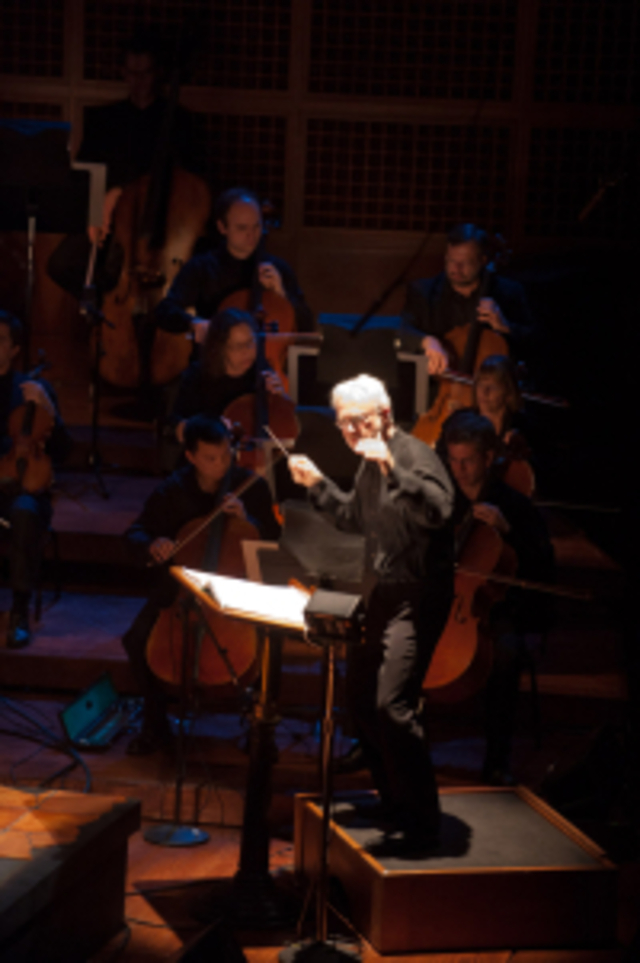
JohnAdamsConducts_ElNino_SFSbyKristenLoken.jpg
John Adams conducting his oratorio El Niño on Thursday evening (all photo credits: SF Symphony/Kristen Loken)
Berkeley composer John Adams's oratorio El Niño had its US premiere at Davies Symphony Hall ten years ago next month. The reviews were unanimously enthusiastic. El Niño, like Handel's Messiah, is a musical setting of the Nativity. Sellars and Adams compiled the texts from some more eclectic sources though, adding South American poetry and apocryphal gospels to the mix, and we'll let Adams himself tell the story. The man composes wicked music, and the man blogs.

Ten years later, we get a chance to check out if it's still as potent. Soprano Dawn Upshaw returns, she of the amazing voice and the genius grant. Original conductor Kent Nagano has given his baton to the composer himself. Adams will also conduct his Shaker's Loop on Sunday 12/12 in a chamber concert, and MTT will record Harmonielehre next week.

A blogging, conducting, composing machine, who has reached iconic status especially since his opera Dr Atomic exploded, we just had to interview him. And he kindly took our phone call on Wednesday evening, just before the last dress rehearsal. The show runs two more times, tonight and tomorrow.

Peter Sellars participated in selecting the texts, but he also came up with videos and dancers for his stage setting of the original production. How much of this is kept in this production?

SFS_ElNinobyKristenLoken.jpg
The SF Symphony staging of El Niño
John Adams: No, this is a production by a different director, Kevin Newbury, and it's very simple. All the singers just got into town on Sunday. It's something that had to be done quite quickly, although they still had twenty hours of staging rehearsal, which is pretty amazing. It's very simple and very eloquent. And I like the way that it's worked right into the stage. The orchestra is there, the set is thrust right smack down the middle of the stage. The orchestra is split in two halves, with all the action between the two halves. It makes conducting really complex.

You will be conducting the piece. When studying the score as a conductor, do you ever curse at the composer? Do you think about the conductor when you compose?

John Adams: Part of the composing process is imaging how something is going to work. How you're going to make the machine sync and all the gears mesh. I could not imagine being a composer if I were not a performer. I know there are quite a few composers who don't perform, but for me I always think as a performer while composing.

As a conductor, do you approach your own score like those of any other composer?

John Adams: I know what you mean. Sometimes, things will come together in a magical way and it will produce an effect. It's usually an expressive effect, but sometimes it's a color effect, that is much stronger than I ever expected it would be, and that's always a thrill. Sometimes if I have a really really great performer, a truly great conductor or violinist or what, they may just bring out something in the music that I did not realize was there, and it's always a revelation.

You mentioned at the time that the song which opens the 2nd part "Pues mi Dios" was a "compositional mistake", yet one which worked out well. Could you elaborate?

John Adams: I did not speak Spanish very well when I made this piece. I'm much better at Spanish now. Pues, it's a word in English, you'd say 'since'. "Since" I'm talking to you..."since" I have to go home. We put it in very quickly. Pues is like that. I started the aria with a big long melisma on Pues, a big leap on the word Pues, thereby accentuating it in a way that runs counter to the way Spanish people speak. So I consider it an error in prosody. You know, composers do that, even in their own language. I think my goal in setting text is to make the text flow exactly as it flows when it's spoken.

We heard that you had some difficulty finding the rights for the text you wanted to set to music. How much of the composition process is depending on these external, non-musical circumstances?

John Adams: I don't remember that being the case. Maybe it happened, but I've forgotten. I had a lot of trouble getting the copyrights for the apocrypha, the almost fairy tales that were written around the time of the gospels, but they are not official gospels. I had trouble getting licensing to the translations. It wasn't that people did not want it set, but the publisher was very hard to find, it was a Christian press somewhere in the Midwest, and I actually did get them.

How much are the circumstances around the text shaping your vision as a composer? Would we get a different piece if you could not get the copyrights?

John Adams: In the case of a piece like this, the text generates the musical ideas. I would not have started any of these pieces, any of the arias without the text. It's frequently the case that while I compose the piece, my publisher is trying to get the licensing. And it's scary because if there ever were a situation were an office says "no, I don't want my text set to music," I'd have to just start all over again. There is no way I can keep the music and plug in a different text.

What I really want to say is: when I write vocal music, the text is the generating force. I respond very deeply to a piece of poetry. And the musical ideas, the harmonies and the rhythms is a result of my response to the text.

Do you view this oratorio differently now that you have written other staged vocal works like A Flowering Tree and Dr. Atomic?

John Adams: Over Thanksgiving, my children who are now in their mid-20s, they came back for Thanksgiving, they live in NY. And they wanted to watch home videos of when they were really little. So the evening of Thanksgiving we just sat and watched these basically silly videos. And I was astonished at how young I was. This is twenty years ago, I don't have gray hair, I look like a young man. And then I realized that was the year I wrote The Death of Klinghoffer. To me, it still feels like a very mature work of music. I don't think of it as the work of a young man, an immature composer. It's a wonderful thing that art can reach a stage of maturity that does not necessarily correspond to the chronological age of the composer.

There are pieces of mine that are thirty years old that satisfy me very much. Sometimes there are pieces I write now that i don't think is good. That's not always the case, in some ways I feel what I'm doing now is more musically sophisticated and interesting. All along through my career, there have been strong pieces. And weak ones as well. It's nice to follow the growth of them.

I think El Niño is a very complete piece. For me, it's very imaginative. It's a wonderful story, the way Peter Sellars made the narrative by using this selection of poetry and the verses form the Bible. I'm amazed what I did! I don't mean to be patting myself on the back, I'm just so pleased I made the musical solutions I did in this piece.

DawnUpshaw_Countertenors_ElNino_SFSby KristenLoken.jpg
Dawn Upshaw singing El Niño on Thursday evening.
Dawn Upshaw was at the premiere, Jessica has been a recurring singer of your work. Do you show loyalty to your singers?

John Adams: Dawn Upshaw is one of the great singers alive. In the world of singing, so many people just do grand opera, they get locked in this stereotype of the diva. But Dawn has been so unique, she's been like Glenn Gould, she's gone on her own creative journey. Which has taken her to all sort of things, of course the Górecki symphony, her work with Osvaldo Golijov, other contemporary composers, Kaija Saariaho. I haven't worked with Dawn for over a year. When she came and I heard her just warming up in the dressing room, I was reminded of what an astonishing artist she is. She still has this incredibly beautiful voice with absolutely perfect diction. But also she is an amazingly passionate emotional artist.

Loyalty is not the right word, loyalty might imply you might stick with somebody whether they're great or not. And I consider myself just incredibly lucky that I have performers this wonderful. I have artists who know and love my music and want to perform it. In some case, they become specialists at it, like the violinist Leila Josefowicz.

We read that SF Opera will do Nixon in China soon.

I've heard that they're planning to do it sometimes in the future. David Gockley told me about his desire to produce it. Beyond that, I don't know any more details.

Contact the author of this article or email tips@sfist.com with further questions, comments or tips.

Comments [rss]