Britten's Serenade for Tenor, Horn and String with the NCCO
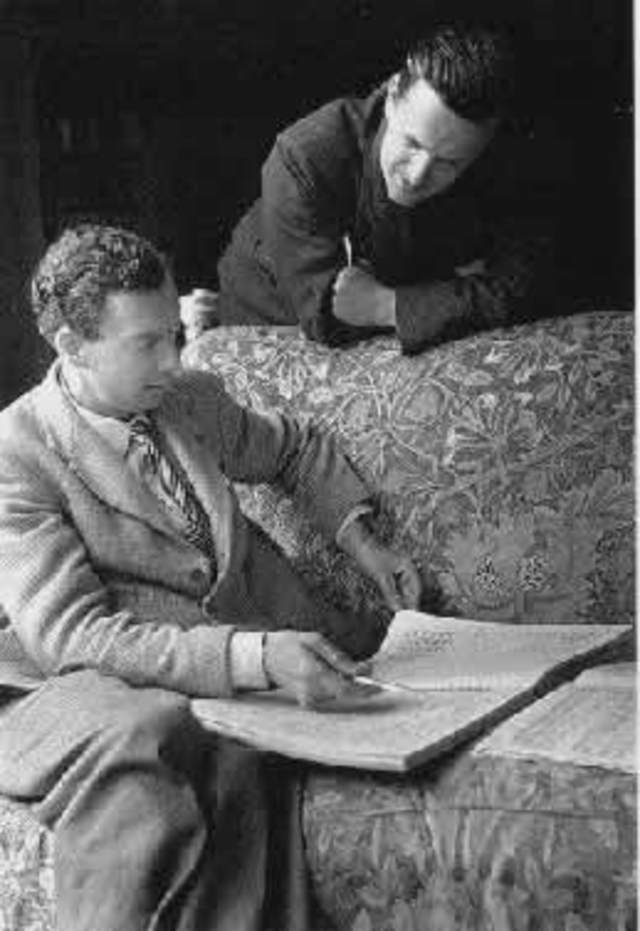
Benjamin Britten and Peter Pears
But most importantly, during the trip in June'39, Britten and his traveling companion, the tenor Peter Pears, started the love affair that lasted forty years until Britten passed away, in 1976. There is a hotel room in Grand Rapids, MI, that is a place of pilgrimage for gay musicians, where they supposedly consummated their union. Pears wrote later: "I shall never forget a certain night in Grand Rapids — Ich liebe dich, io t’amo, jeg elske dyg(?), je t’aime, in fact, my little white-thighed beauty, I’m terribly in love with you." How mushy. Little white-thighed beauty? But Britten was a Brit, of course his legs were white.
As the Prop 8 trial currently unfolds, one could look up at Britten and Pears as an example of a high profile gay union that did nothing to weaken the "institution of marriage," but actually incubated some of the most magnificent music of the century. Of course, 'marriage' is inappropriate a word: homosexuality was altogether prohibited in England at the time. Still, in a letter to Pears in 1943, Britten writes to a traveling Pears: think of all the other married couples who are separated for everso much longer! When Britten died, almost ten years after the repeal of the buggery laws, the Queen sent condolences to Pears under the thinly veiled guise of sharing sympathy with 'a representative of all who had worked with Lord Britten.' Oh, the hypocrisy.
This prohibition of homosexuality is partly responsible for Britten's monument of the 20th century music, the opera Peter Grimes, whose conception started two years into the Britten-Pears relationship. It's during the US trip that George Crabbe's poem, The Borough, was pointed out to Britten, and became the inspiration for the opera. The libretto departs from the poem in making Grimes not a murderer, but an outsider, alienated from the life of his fishing village which rejects him, as Britten's homosexuality had isolated him growing up in the conservative seaside.
In between the first early Grimes sketches and the completion of the opera in 1945, Britten wrote a Serenade for Strings, Horn and Tenor. He had been sick (he had recurring bouts of depression) and was convalescing at home and wrote Pears in March 1943 that he felt well enough "to write things for you, -better than nothing." In a letter two weeks later, he announced, using his working title for the Serenade: I've practically completed a new work (6 Nocturnes) for Peter and a lovely young horn player Dennis Brain, & strings...It is not important stuff, but quite pleasant, I think."
The Serenade for Strings will be performed by the New Century Chamber Orchestra tomorrow through Sunday, with local Bay Area tenor Brian Thorsett in the role of Peter Pears. A graduate of the Merola program, Brian is intimately familiar with the origin of the work; he even has performed recitals that involved reading excerpts from the private letters between Britten and Pears, interwoven with specifically mentioned songs.
In this piece written for his lover, Britten sets to music what Edward Sackville-West, who helped selecting the six poems and to whom the piece is dedicated, described as a nocturnal elegy which contained "the worm in the heart of the rose, the sense of sin in the heart of man." So Prop. 8 proponent can rejoice: societies hating on the gay produce people with stunted and conflicted emotions and where one's love for a partner is imbued with a sense of sin. But those emotions can still blossom into beautiful music. That's small consolation for the rest of us.
