SFist Interviews: Curler Lyle Sieg
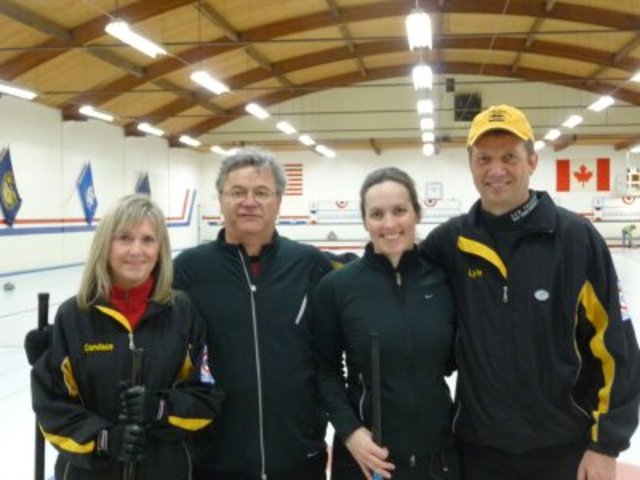
Mountain Pacific Region 2010 Mixed National Curling Representatives Team California(Skip: Lyle Sieg ,Third: Gabrielle Coleman, Second: Barry Ivy, Lead:Candace Seip)
by Amy Crocker
For obvious reasons, San Francisco isn’t steeped in the culture of curling as much as cities in say Minnesota or Wisconsin. This obscure frozen sport enters our radar every four years and for most people that’s enough.
But believe it or not, San Francisco Bay Area Curling Club has been operating for more than 50 years and is one of the oldest clubs on the west coast. It will be sending a mixed team to the national championships this March.
Lyle Sieg, who will play “skip” on this team (the last player to shoot), has been curling since boyhood in Canada, where he competed regionally, then provincially, then nationally - making the championships in the early 80’s. But while he could practice on a frozen lake during his lunch break in Canada, it takes more determination to curl in California.
We spoke with Sieg about California curling, physics, and his Olympic picks.
SFist: About how many curlers are in San Francisco?
Lyle Sieg: After the Salt Lake City Olympics in 2002, our club grew from 20 people to 40. We went back down to 30 or so and then we’ve maintained 80 members since [Turin in 2006]. We are hoping to double that [after Vancouver].
SF: Why do you think the sport will grow in the bay area?
LS: I think it goes back to a little bit of the engineering. I’m an engineer myself, not that you have to be an engineer to enjoy this game, I think engineers enjoy it because of the aspects of physics and competition and thinking and strategy. Tying them all together makes the game very appealing and certainly has helped us in our region - all the people from Silicon Valley and various universities here.
SF: If you just want to curl recreationally, what do you need to start?
LS: You need ice, and that has to be provided by an arena, and you need curling rocks - that’s probably the toughest thing to find. You need 16 for a game and they’re roughly $500 a piece. Used version might be a little cheaper than that. Some of the clubs have picked up rocks over the years. Some of the arenas are buying sets to get things started.
SF: Once you have the equipment is it pretty straightforward?
LS: Its like going to the driving range: you can hit the ball right away, but can you hit the ball straight or far? Probably not. You can throw a rock in a matter of few minutes whether you can throw it accurately takes a few weeks of practice.
SF: You've described curling as being like chess. Could you explain that a little further?
LS: Curling is a thinking person’s game. When you first learn the game you’re trying to just get shots and get a rock in place. Once you master that skill on a pretty regular basis, then you start challenging yourself. Where are you putting it on the ice? Are going to put a guard in front of it? You start developing layers to the game. Each step of the game is a new tactic. You can play this game for 25 to 30 years and still find new things and that’s the way chess is.
SF: Besides the mental sweat, what physical shape do you need to be in to play?
LS: Keep you knees in good shape and you have to have good strength in your legs to pull out and balance yourself. I do a lot of leg squats. Sweeping is a very much a strong cardio vascular workout. You do workout and run and get in shape so you can sweep for the 25 seconds that you have to. You see lots of people tiring out at the end. You need the extra effort. It’s all about sprint sweeping for those 25 seconds. And then you get a break while the other team shoots.
SF: Could you explain the strategy of sweeping?
LS: It’s warming the ice and maybe melting it just a little bit - enough to reduce friction of the rock on the ice, allowing it to slide farther. If you’re not really strong you don’t have to sweep that hard, it’s just you’re more effective if you do.
SF: How did San Francisco 49er Vernon Davis, the honorary captain of U.S. Olympic men’s curling team, become involved with the sport?
I guess he’d seen it and was interested in checking it out. So we taught him how to throw and he actually put one in the house on the second stone that he ever delivered. So, 126 feet away, he hit the target on his second shot ever. He might have got lucky but we’ll give him props to for being an athlete and paying attention.
SF: Any picks for the Olympics?
LS: It’s hard to bet against Canada on the men’s side. And the women, I think the U.S. will be very close, I think China will be tough, so, U.S.A., Canada, China or Sweden on the women’s side. On the men’s side Canada Scotland and Norway.
For information on curling clinics and Olympics related events, visit bayareacurling.com/olympics.
