The Ensemble Parallele's Wozzeck
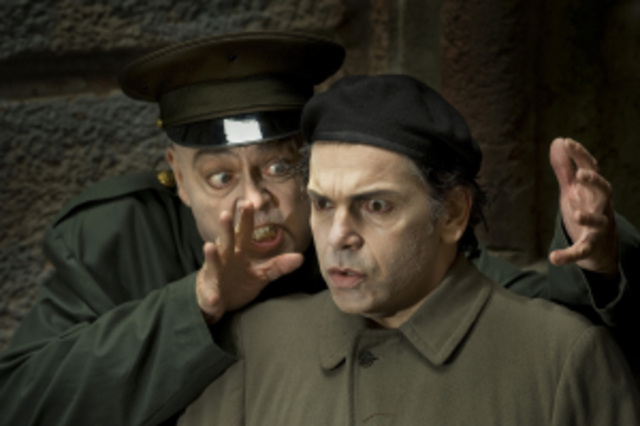
John Duykers and Boriz Knezevic in Ensemble Parallele's production of Wozzeck. Photo credit: Steve DiBartolomeo
Despite Berg's efforts, you'll be swept off your feet by the piece that revolutionized 20th century opera. It is performed, in John Rea's chamber re-orchestration, by the Ensemble Parallele this Saturday night at the Yerba Buena Center for the Arts (there's also a Sunday 1/31 matinee). It's a strong cast, with Bojan Knezevic as the title role, John Duykers (last seen here) as the captain, and Ensemble Parallele's music director Nicole Paiement at the baton. Nicole is also on the faculty and head of the New Music Ensembles at the SF Conservatory of Music, and kindly took our phone call.
You are blending different media in the stage setting?
Ensemble Parallele founder and music director Nicole Paiement.
At the end of the opera, Wozzeck drowns and we made a movie under water in a swimming pool of Wozzeck drowning. It's very impressive. In the opera, there is a great epilog where Berg recalls all the themes of the opera and make them more human, it's a four minute commentary, and we see the expressionist movie. It's sad and beautiful, it's very moving.
The piece goes "inside Wozzeck's mind." Berg being Viennese in the early 20th century, was he inspired by Freud??
Maybe a little. Berg started to question himself a lot on this topics with Freud's ideas. It is inspired from this movement that was starting at the time. It is really one of the aspects of the opera. It's the first modern opera, mostly because of this new point of view. Often the main character kills his lover and then himself, it's a story that repeats itself, but the point of view is different. The emotional abuse, that's new.
What's lost/gained in the score from the original in the re-orchestration?
This re-orchestration was created in 1995 for the Nouvel Ensemble Moderne de Montreal. I had seen the premiere in Montreal, it has inspired me a lot. It is one of my goals to bring contemporary chamber opera to the San Francisco bay area. This opera in particular deals a lot with intimacy. It was written by Berg for over hundred musicians, it's a big orchestra, and it's difficult to give a sense of intimacy with this kind of production. The re-orchestration makes everything more intimate. Of course, with thirty musicians, it's still hard to get the balance right, I'm still writing orchestra notes.
What are orchestra notes?
I'm taking the score, I'm looking at each line, and I write: 2nd Oboe, the crescendo starts from pianissimo to mezzo-piano instead of mezzo-forte to piano, so that we have the right balance with the singers. And after rehearsal, I do that for each instrument.
Berg wrote 15 scenes, and in between there is a brief musical interlude to switch the sets, the play moves a lot. For the scenes with singers, Berg does not use the whole 103 musicians, it's very rare. It's only in the interludes that he uses all of them. So it's a good opera to re-orchestrate to smaller scale, there is almost no lost in the colors of the orchestra, almost never. John Rea used timbral combination; for instance, by playing a contra-bassoon with a trombone, we hear the sound of the tuba, even though there's no tuba in the pit. When you study instrumentation, you can combine instruments to create a new color, and Rea did that very well. There are as many colors, but fewer musicians. So it's harder for the musicians. If you have three trumpets in the orchestra, one can get a rest, it's not always the same trumpet playing. Here, there's only one trumpet, playing for 100 minutes. They have to develop stamina to perform!
You are affiliated with the Conservatory, but those are not students.
Oh no, the Ensemble Parallele is a professional ensemble. It is resident at the conservatory, but it only means we can rehearse there. A lot of musicians are from the SF Opera orchestra, some are very active in the contemporary music scene. Our concert master, Roy Malan, is also concert master of the SF Ballet.
The Ensemble Parallele is filling an aspect of arts which does not exist otherwise: there are no other ensemble that performs contemporary opera. It started as an instrumental ensemble, but has shifted to doing more operas. We produce one opera every year, and then some performances outside of the bay. We went to Korea for instance.
What's cooking for next year?
We have not unveiled what we'll do next year. In 2010, we'll do the premiere of a re-orchestration of the Great Gatsby. Jacques Desjardins will do the chamber orchestra version of the John Harbison score. They know each other, and Harbison is on board with him doing it. In 2013, we have commissioned an opera on the life of Gesualdo. Gesualdo was an Italian composer from the Renaissance and he had a particularly eventful life [Ed: to say the least...You should check out that wiki page], and we use aspects of Renaissance music into the modern music of the score. For next year, we're deciding between three projects.
Nicole is Québécoise, and this conversation has been translated from the French
