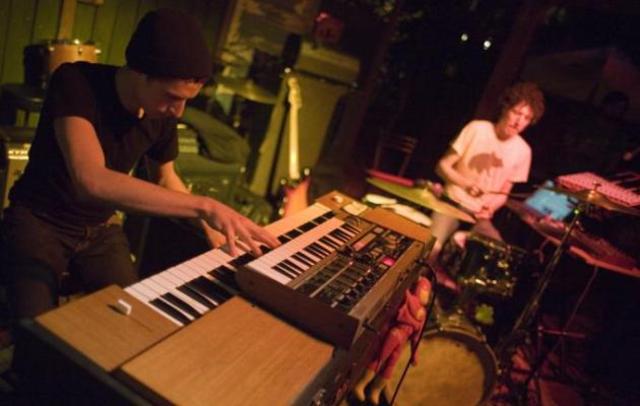
SFist Interviews: Lymbyc Systym
by Kevin Meenan of Epicsauce
Prior to their show at Café du Nord a couple weeks back, we had a chance to catch up with sibling duo Lymbyc Systym's Jared Bell via phone, and we had a lengthy discussion about the instrumental act's recording process, the benefits and drawbacks of their geographic barrier, the sans-vocals approach, their plethora of early influences and much more.
Kevin: When listening to your recent effort Shutter Release and 2007’s Love Your Abuser it is easy to forget that you guys are at the core a duo. The sound is incredibly rich and layered, and it is clear that there is much more going on than synth and drums. Can you give us any insight as to what is happening musically in the studio?
Jared Bell: The basic premise is that I play keyboards and my brother Mike plays drums, along with the programmed beats. And live, it is basically like that. But on the record, we both sort of do a bunch of things. There are a plethora of instruments - banjos, guitars, all sorts of little keyboards and toys, old and new. We also have some friends play on the album -- a couple different string players and a couple horn players. I could probably go way more in depth here, and make this a really long answer.
We just really spend a lot of time on stuff. We made demos of all the tracks, and spent a week at our friend’s studio recording the basic drum tracks along with the basic guitar and keyboard stuff. We sort of fiddled around with the album for a year and half after that, adding stuff gradually. So all the string and horn parts and a lot of the electronic stuff was all kind of written after to accompany the basic gist of the album. The vibraphone and stuff -- we just sort of kept adding a lot.
How many tracks are you generally working with on each song?
It varies from song to song. Some of the bigger songs can end up having eighty tracks or something like that. But we often will add a lot, and then takeaway. The idea for us isn’t just to add as much shit as possible -- ideally every track has something of value. So we definitely edit afterwards.
I imagine it is quite the challenge to replicate this density in the live setting, when it is just you, Mike and a laptop. How exactly does this all break down?
So live, the computer basically runs sequences, the electronic portion of the beats and some backing tracks. But we basically try to do the opposite of what we do in the studio, and make the gist of the song as compact as possible. So if you took away the computer entirely, what my brother and I are playing sounds just like the song -- we try to just kind of rock out, and use the computer to supplement and fill in the space. What we don't want is a moment where we are just sitting there and you hear a trumpet part in the background and think, “where is that trumpet on the stage?” We try to make the computer work as the hidden third member without being “a laptop band” live.
I saw that you had Slow Six's band-leader Christropher Tignor join you on some recent shows, adding live strings to the equation. Was this a major change, and is it something we can look forward to seeing again?
It was a little change, but it is not that far of a stretch. The reason we started adding Christopher is because our newest record is so orchestrated - it’s our most dense album. And melodically it is really hard to replicate without having the computer play stuff for us, which we really don’t want to do.
We try to consolidate as much as possible. Maybe combine two or three drum things into one drum part, combine two melodies into one -- sequence the bass or something like that if we need to. But for the new songs, it’s just really hard to do that. Some of them really need two to three people live to pull off like they are on the album. So we started trying out playing with Christopher, and worked out parts for those songs we always wish we had someone else to play on.
So a lot has been written about your band's geographic barrier -- I understand that you live in Brooklyn, and Mike in Austin. How does this shape the writing and recording process?
Well that’s right, although my brother just moved to New York, so we both live there now. But the album was written and recorded with this setup.
When we made the demos for the album, one of us would work on something and send some tracks over the Internet, or maybe talk about something basic over the phone. We would just sort of add to that, back and forth. And that’s how we got the basic demos. Then we met up together to record in the studio -- like I was saying, record that basic foundation. Basically, the actual song writing process was done almost entirely separately, but the entire recording was done -- 90% or so -- with us in the same room.
You know even before, back in 2007 when we did Love Your Abuser and both lived in Phoenix, this was the way we would write - we sort of trade-off. Like Mike would work on a section, then he would walk away, and I would come and work on it for four hours or something and then maybe I would walk away. So we were already used to that process.
So we generally write separately, and once we are together recording it we can easily tweak and adjust things and be like “oh this doesn’t work" or "this does work.”
Are there any major drawbacks to the approach?
I mean, it just takes longer. Just to play something together, we have to upload it and send it over the internet. We used to jam a little more to work out ideas, but now everything is a little more cerebral, I guess more composed. We are very precise about everything we are doing, which I like.
If anything, I think the song writing process has become very streamlined and systematic, but in an organic way. Not systematic as in we have a set thing we are going to do -- everything is open and we are still really experimental -- but it's kind of like, we can each be in our own realm. So it’s very easy to have our own creative space -- work on something and sort of get feedback separately. Where as in the same room you can sort of step on toes.
A couple years back you guys did a remix for One AM Radio. Have you thought about doing more remix projects like this, or getting into pure production for other artists?
Yes and no. It’s definitely something we are interested in. With One AM Radio, he did a remix for us, and we did one for him to promote a tour we were doing. It was really fun to do, and ideally it would be awesome if we were able to do more, and hopefully we will at some point. We get offers from time to time, but its really hard because most of the things we like and want to do -- we don’t have money, no one has money. It’s really hard to get a budget for any of those things.
We also are pretty meticulous about the things we make, and have so little time. Its just really hard to find a solid month or three weeks to just truly work on a remix. But we definitely have had people ask us to do them, and we want to do more. We basically have been touring like machines for the past several years but have been taking it easier this past year, mostly just working on the record. So we might have some more time now and hopefully will get to do more remixes soon.
Your sound is often compared to -- among others -- that of Four Tet and your former tour-mates, The Album Leaf. Were these types of acts big influences when the project was first conceived, or did the initial inspiration come from elsewhere?
Growing up together, we shared musical influences for the longest time. I think one of our first big influences -- aside from all the typical things, like Radiohead, Bjork or the Beatles or something like that -- was on the electronic side. Squarepusher, Aphex Twin -- stuff like that. And later, definitely Four Tet, but I don’t think we even knew about him when we first started messing around with the electronic stuff.
But we also have -- especially Mike and me to a slightly lesser degree -- sort of a jazz background. So we were really influenced by Ornette Coleman and John Coltrane, and like Eric Dolphy -- kind of out there free jazz stuff, which you can tell is sort of an influence for someone like Four Tet as well.
So we started with this jazz and electronic basis, and later discovered the Album Leaf, Sigur Ros and especially Tortoise -- Tortoise was probably the first of those types of bands that we found out about, and they were a really big influence. I mean, we have been influenced by a lot of things. But I think I would say Squarepusher, Aphex Twin and Four Tet -- on the electronic side at least, these are the three biggest influences.
One band I forgot to mention that was a huge influence on us, especially at the time, was Mice Parade. I don’t know if you are familiar with them, but they were sort of a turning point band for us, that got us thinking about music.
Read the rest of the interview at Epicsauce.
