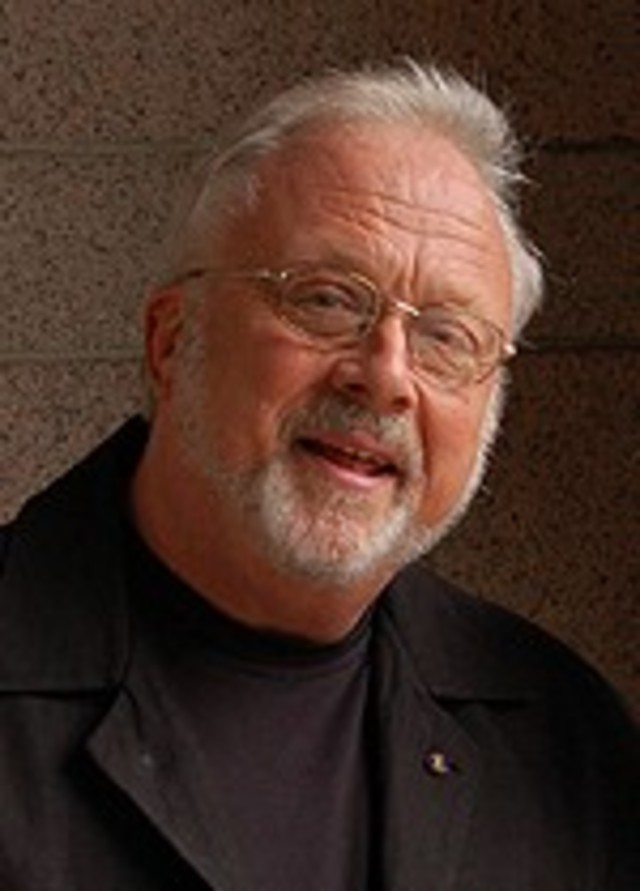
SFist Interviews Composer William Bolcom
Composer William Bolcom
Bolcom won multiple Grammies, a Pulitzer, the National Medal of Arts and teaches composition at the University of Michigan in Ann Arbor, where we reached him at his home. We chatted about his partnership with NCCO fiery Nadja Salerno-Sonnenberg, about his upcoming world premiere with her next spring, about the "Bolcom Meets Strauss" program this week and about the French composers he studied with, Darius Milhaud and Olivier Messiaen. And while Bolcom is as American as apple pie, born in Seattle, earning a doctorate from Stanford, he floored us by conducting half of this interview, with the same charming volubility, in an impeccable French acquired during his studies at the Conservatoire de Paris.
How did you engage in a partnership with the NCCO?
To start with, in the mid-nineties, I wrote a sonata for Nadja Salerno-Sonnenberg, who leads the NCCO. We had a very good time, it was a sonata for violin and piano and I was commissioned to write it for her. We actually premiered it together, it's number three of my four violin sonatas, and it's been done fairly often. Actually right here in Ann Arbor, a couple of people will be doing it at the end of the month. It's been recorded several times, and so on. It's a piece I much enjoyed doing. I was very interested in writing for Nadja, she has a very strong, fiery personality. She's very identifiable when she plays, which is not always true talking about other violinists. They tend to be rather interchangeable, but Nadja, you know right away: it's her. Which is one of the reasons I enjoyed working with her, and we had a great time. And I guess she was happy about commissioning something else. I'm hoping she will be playing the solo part. I had the idea of a piece for string orchestra, which is the core of the New Century.
I've worked before with the string orchestras. One of them is the Stuttgart, Germany, orchestra, when it was handled by Dennis Russell-Davies, a very old friend of mine and a wonderful conductor, with whom I've worked for years and years, actually from the 60s on, and he did all my three operas. Dennis conducted them all for the Lyric Opera of Chicago. I enjoyed working with Nadja before, and when they asked for a piece, I thought "how terrific, I'll write a piece for Nadja and the strings." That's how that whole piece came about.
I certainly had the idea of a very lyrical piece. There is 19th century form called "romanza," which is not necessarily a form, but kind of a mood. Many of the great classical composers wrote them, and I wanted to do something in that tradition.
So you have the piece already mapped out?
Not only the piece is written, it has been engraved, I approved the score. Once I knew what I going to do, it came rather quickly.
This week's piece is titled Serenata Notturna for Oboe & String. Why the Italian title?
This piece I wrote for the oboist Richard Woodhams. He is the principal oboist in the Philadelphia orchestra and one of world's greatest oboists. So I wrote it for him and for the Guarneri Quartet, a famous quartet who just did their last year of touring a year or two ago. There's also a version for String Orchestra, and that will be the premiere of that version with the New Century.
The Serenata Notturna and the Romanza: they have one thing in common, they very much invoke the early 19th century romantic atmosphere. In recent years, I've fallen into that style. That's probably why the Italian name. Actually, there's a Serenata Notturna by Mozart (which is not the same thing as eine kleine Nachtmusik). A night serenade, the whole idea of nocturnes, that is something that is quite common in early 19th century. John Field, an English composer took that idea, and then Chopin wrote his nocturnes. It's very classical, early 19th century. Both the Romanza and the Seranata Nocturna have a classical, early 19th century feel about it. Why? Because I felt like doing it!
The concert is headlined: Bolcom meets Strauss.
Richard Strauss won't be able to show up, he died in 1948.
Is this a musical meeting of sort. Is there a reason for the pairing?
I did not know that. Why not? There are lot of wonderful pieces by Strauss. The chamber music, besides the big operas, the big orchestra pieces, there are a lot of very large chamber orchestra pieces. I don't know which one, I have seen the program, but I've forgotten.
It's Metamorphosen.
Oh yeah, that one is all strings. That is a very dark one, he wrote it toward the end of his life. This was a lament for what had happened to Germany. He wrote it in the forties. During the whole Hitler era, he was in Germany, somehow protected, but very unhappy about the situation. I think he did what he could to help people out, but he did not dare to go against the regime. He saw what happened to his country, what had happened to Austria, what had happened to whole German people, which had become rather horrifying. So the Metarmophosen is a very sad funeral march, although it's also much more lyrical. It alludes to the slow movement of Beethoven's 5th symphony, the funeral march for the death of a hero. That gets quoted at the end of the piece. It's a very sad piece, what happened to the destruction of a culture, really.
That darkness echoes with your nocturnal piece?
Maybe they chose the program because that one is dark, and mine is light. Mine is light and pretty and maybe it is a good contrast. Mine is full of tunes. It's a classical night piece, but not a dark piece. There are a couple passages that are a little dramatic, but most of it really is, and was meant to be, purely to enjoy. Metamorphosen is kind of a heart-breaker, you can see this man is very ambivalent about his life. It's a powerful piece, it's a little scary at first. It's like he's saying goodbye to his whole culture. That's the way I read it when I first heard it. I was struck by that. He was aware of the situation, and I don't know how he felt about his own complicity with it. It's a hard thing to know how to deal with. I'm sure Strauss was quite sad at the end of his life.
You studied composition with Darius Milhaud, whose music is full of humor, and Messiaen, who's way more austere.
Messiaen was terrible that way. He was a wonderful man, but I had a funny time with him. I have a funny story about him. [at this point, Bolcom asks us if we're French, and starts speaking in an amazingly beautiful, perfect French which he learned during his study at the Paris Conservatory and has kept in excellent shape since. From this point on, you are reading a translation of his French]
I was in his class at the Conservatory, which was every week, three times three hours. We were there basically the whole day. One day, he played piano with his wife, well not his wife yet, his wife was still alive in an asylum somewhere, but his next wife, Yvonne Loriot. For someone who loved birds so much, it's funny he married someone named Loriot [Oriole in English]. So they were playing a big piece for two pianos, Visions de l'Amen. And Messiaen said, with gravitas: "there are three divine species in the world, there are angels, there are saints, and there are birds. The angels are the highest form of Virtue. The saints are the best of the men. The birds, I love them because they are so small.
Milhaud and Messiaen have very different music. How much could you tell about their music from their personalities?
It's a great mystery. There are always cases where there is no connection between someone's personality and what he produces. There are cases where a great composer is also a bad person, like Wagner. I don't know if you read Louis-Ferdinand Celine, Le Voyage au bout de la Nuit (Journey to the end of the night). It's extraordinary, but he was a Nazi, an anti-Semitic person, he helped the Nazis in Paris. And at the same time he was a physician. But it's a great book. How do you solve such a problem?
You started composing in the 50s...[and he interrupted us here before we could actually ask our question].
Oh, that's what's written about me in the Grove dictionary. When I was young, I dabbled in many styles. There are aspects of dodecaphonism that I still find useful. In the US and in Europe, we felt the need to break things up after WWII. The past was the root of all the evil that we visited on this world. We all made silly things, horrible things, there are no exception. What to do? So we blamed romanticism, we blamed classical music, we blamed Wagner for the Nazis. The idea was to find a music without history, without a past, to start over from scratch, as in Edith Piaf's song. And we were very taken by this idea.
I was raised in Washington State in the US, so I was not touched by this until I went to Europe. Then, there was Pierre Boulez, Stockhausen, and Berio, I found this fascinating and very fresh. The alternative, back then, when Stravinsky gave a concert at the Conservatoire in 1948 with his neo-classical music, he was booed, there were demonstrations against him. It had been arranged, I believe, by Boulez and Stockhausen. The point is that back then, neo-classicism was dead. We had to go in another direction.
The best way to negate history was to find a system like dodecaphonism. There are useful things in this system, as in any system. There are always influences of mathematics in music from almost every cultures.
In the 50s, one needed a lot of courage to not write in that style. There was a lot of pressure from the other students. In Milhaud's class, there were Bouletists, there was a bit of everything. He cherished independent people. I was in a sense independent, but I was fascinated by the potential of all these musics. In the later years of my life, I moved away from that style.
Will you be here for the performances?
I will be there for the premiere in May, and the very same week, I made a melody for string quartet and baritone, which will be performed at Stanford, where I got my doctorate in '64. So I'll definitely be there.
