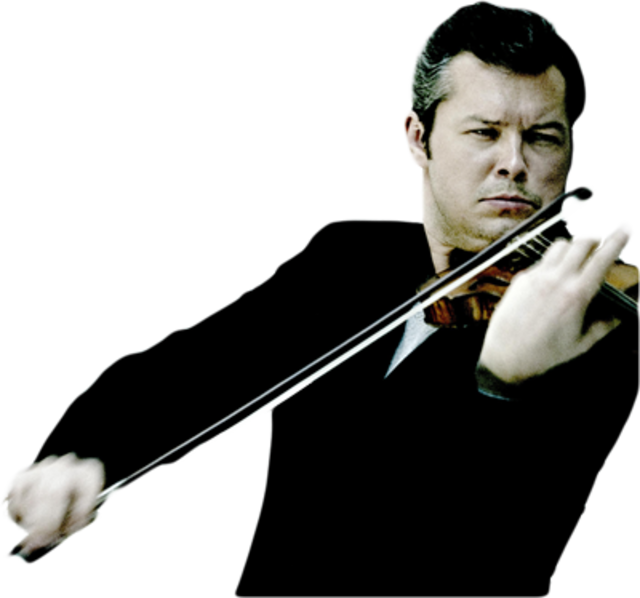
Vadim Repin and his 1736 "Von Szerdahely" Guarnerius violin (photo credit DG).
Looking forward to the pairing, who came in from the Cold as one of the highlights of the season, we spoke with virtuosic violinist Vadim Repim, 38, who hails from Siberia, and is now settled in Geneva, where he indulges in his love of skiing.
What do you like about the Sibelius violin concerto?
Sibelius, it is one of my favorite concertos to play. It's a phenomenal work for violin. It is extremely passionate, virtuosic, and at the same time, it's written both in one way compact and in the other way, grand. So it's a perfect combination for being something epic and at the same time, personal and tender as well.
The 3rd movement has been described as a "polonaise for polar bears." What do that mean?
I've heard that before. When I play this, I have one imagery in my mind, but I think for the listener, every one tries to find their own opinion about this thing. It's a little bit controversial, this finale. On one side, it's a polonaise, extremely running forward, and at the same time it's extremely steady and heavy. It is quite difficult to dance with it, but it is in fact a dance. To find a balance between those to aspects is difficult. The character of this movement is very much a specificity of this concerto, it's a unique finale, extremely broad, and also extremely passionate.
So what images do you have, if not bears?
It's impossible just to be guided by the images. You put the structure of the finale, you see the classical form of it. Then you try to overcome all the difficulties to find the character. Once you are on stage, it can provoke quite a few different images performing it, depending on the day, depending on how you feel, even depending on the second movement, how it went.
This concerto was first recorded by Heifetz, for whom you have a great admiration. Do you have other role models?
Heifetz is the king of violin for many violinists, and for me as well. I feel very much attached to his playing, and I love listening to his recording. He is one of the key figures of the violin history. As I get older, I get less provocatively critical. I actually enjoy different players very much from this generation and other and so on. For me, it's more about the music in general.
When it comes to criticizing, I concentrate more on my own playing, for being critical. Listening to other, I try to enjoy most of it.
Anyone from the current generation whom you like?
Just about everybody. It's difficult to say, I don't want to offend anybody. People like [Leonidas] Kavakos,or Gil Shaham, I have a big admiration for them, they are wonderful players.
Heifetz's Guarnerius violin is now in the hand of Sasha Barantschik, who is from St Petersbourg. You are from Siberia, do you know each other despite the cross-country divide?
I have known him very well for years now. Russia, is very unusual in that respect. For example, the language does not change for 10,000 km, it's the same language and everybody can understand each other perfectly and it's very much mixed. It is a country very attached to the language and culture. You don't have in Italy a Northern and Southern with different languages, or like in China. In Russia, it's very much the same. The cultural life was quite easy and quite reach everywhere.
Osma Vänskä is a Finn, as Sibelius. Does he have a special affinity for the composer?
I've never performed with him before. It's going to be the first time for me. He is THE Sibelius interpreter. He devoted most of his life to the music of Sibelius. He recorded just about everything about what he wrote. I'm looking very much forward to having a dialogue with him, both off stage and on stage and hopefully we will create some interesting conversation with the orchestra.
It's quite impressive that on Sunday you play Bruch in Melbourne, Australia and Wednesday Brahms a world apart in Helsinki, Finland. Is your schedule always that hectic?
It's quite tough. We are planning our season way in advance, three years ahead. You try to plan your travel properly. Then closer to the date, some interesting things may come up and in the end, it's up to you to make this crazy decision, yes or no.
Usually, I put myself far from that kind of travels. But the Australian tour came much later, when I had agreed on Helskinki. I would not be professional if I canceled Helsinki, and I wanted very much to take part in this LPO tour with Jurowski, who is one of my dear friend and one of the conductors that I respect the most. So it was musically a very interesting perspective. So in the end, I pulled myself up, and said: I would do that for once this year.
So it's not the normality, it's only when something musically interesting comes up that I may think yes or no.
Your latest CD is a set of trios with Lang-Lang (and Mischa Maisky). Lang-Lang hardly ever plays chamber music, how did it go?
We had a great time, he is very open personality and he is very nice to get along with. Off stage and with the instrument, he's very sensitive. I think with Mischa, we had a wonderful time together, and in the recording, one can feel it.
You were a young prodigy. How do you get a child to practice?
It's a hard thing to answer. For me it was quite natural. I was bugging my mother so she would buy me toys that would make a lot of noise. Because of this, she brought me to music school. No one is a musician in my family. She chose one school in the middle in the city and brought me there and told the teacher I had a natural interest for music. The violin came by chance, because everything else was taken. I loved to play plastic toys that made music. And violin was something very special, it became my favorite toy.
One thing one have to natural wish to do so. One thing is a musical education as part of the culture of a person, this is vital. Every child must go through the fundamentals of musical culture, must know the classical music, the basics. But to do it professionally, it must be really a combination in between devotion of the parents and nature of interest of the child as well.
Do you do yoga?
It is very difficult, for me the subject of yoga. Yoga is very spiritual and very important. It is on one side directing a personality towards a perfect balance. But speaking again about music, it is a different kind of balance, it is about exaggerating ups and downs. It's quite different, it's closer to crazyness rather than perfect balance. So I don't know how to combine those two things. I know many great artists seriously take yoga. For me, either I did not find the way for myself, or I don't have the right experience yet. I prefer skiing to relax myself.


Good job and interesting interview.