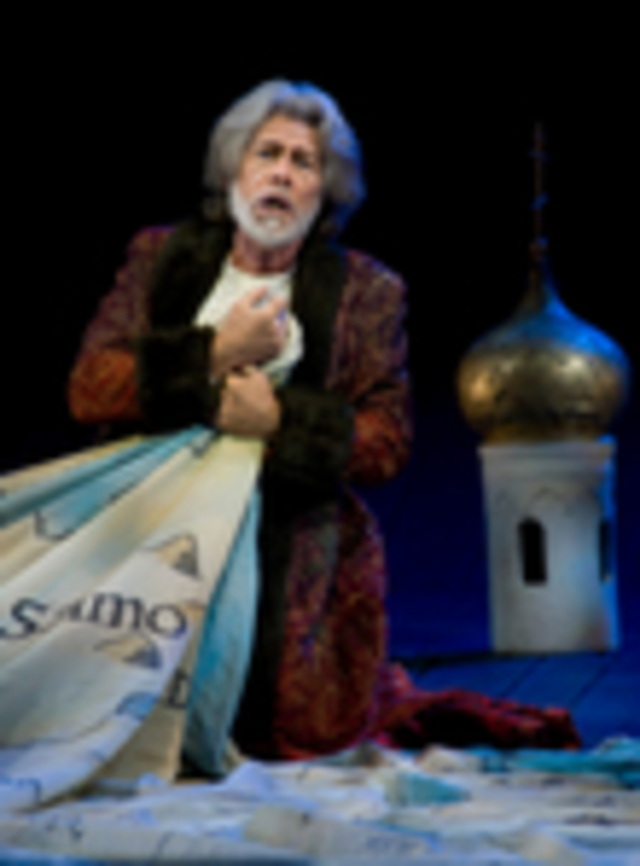
Boris Godunov at SF Opera

Modest Mussorgsky's Boris Godunov keeps with the un-official theme of the SF Opera's Fall season: Presidenting is hard work. Well, Godunov is not presidenting as much as Tsaring, but he comes on the tail of Idomeneo, who has to sacrifice his son to avoid his city's destruction by a giant monster, and Simon Boccanegra who has to fend all these nasty homicidal traitors.
It's hard work, as Boris Godunov became Tsar after assassinating Dimitri, the rightful heir to the throne, when Dimitri was seven, and has pangs of guilt when a young monk starts believing he is in fact Dimitri, and starts inciting riots. It's also hard work for Mussorgsky, who has to put together a sweepingly broad story that spans decades and yet still focuses on the deep emotions of the Tsar. It's hard work for the director, who has to stage this story, which unfolds on a scale which ranges from the grand and magnificent down to the very intimate. Yet, it's easy work for us, the audience: this production totally succeeds in putting it all together.
Pictures by SF Opera/Terrence McCarthy. Above, Samuel Ramey, below Vitalij Kowaljow and Vsevolod Grivnov, and Andrew Bidlack.
We are still smitten with Vitalij Kowaljow, who returns as an old wise monk: he has the same gravitas, and the same effortlessness as in Boccanegra. Samuel Ramey, who celebrates his thirtieth year on the stage of the SF Opera, gives his all, diving on the floor like a nimble Jerry Rice. He actually wears padding too. Not bad for a sixty-six years old. He falls because he is oppressed by guilt: Innocence is but a football thrown too far. He has a vibrato that wobbles a bit too wide, but makes up for it with his fierce intensity. He fares much better in the more intimate second half of the opera.
John Uhlenhopp paints a viscous Prince Shuisky. Vsevolod Grivnov (Gregori, the Pretender Dimitri) is quite cute; his volume control is a bit irregular, but when on, has a bright passionate tenor. We were slightly worried by the on-stage presence of Adler Fellow Andrew Bidlack, silently hugging an onion-bulb-shaped mock-up of an orthodox church across the stage from the overture on, all through the opera. He's listed last in order of appearance in the program, but, but, but,... he was first! Then it all fell into place, as he sung (indeed, last to open his mouth) the simpleton aria, magnificently. He is singing truth to power, and does it wonderfully. There's a darth of women roles in this work, but in their small parts, Catherine Cook (the innkeeper) oozes sensuality and Ji Young Yang (Boris's daughter) youthfulness.
The chorus, prepared by Ian Robertson, again is resplendent, even though conductor Vassily Sinaisky let's a bit too loose on the trumpets in the Coronation scene. That's a minor ding, as he goes an excellent job with the convoluted textures Mussorgsky tosses at him: the overture comes across dark and ominous; the second scene, orchestrated mostly for brass and percussion, majestuous; the comic relief of the inn scene, perfectly humorous (helped by pitch perfect comic timing from the cast). He manages the spectacular as well as the human elements of the score.
The set, despite being quite bare, is resourceful enough: it's basically a big wooden slanted floor, and a back wall of the same material. There is actually no room to put in anything on top of it, what with the large headcount of the multiple choirs (there's the kid's chorus coming in as well). Yet, it is inventive enough to differentiate between the Kremlin, an inn, the Duma, or a monk's cell, with trap doors turning into pedestals, screens coming up and down, and an effective use of lighting (by Duane Schuler). Kudos to Stein Winge for the production, Göran Wassberg for the set design, and Julia Pevzner for the direction.
Boris Godunov
6 more performances, starting tonight at 7:30 pm, Sun Nov 2 2008 2 pm, Tue Nov 4 2008 8 pm, Fri Nov 7 2008 8 pm, Wed Nov 12 2008 7:30 pm, Sat Nov 15 2008 8 pm
