About SFist

SFist is a website about San Francisco.

Editor: Brock Keeling
Publisher: Gothamist

About | Advertising | Archive | Contact | Job Board | Mobile | RSS | Staff

Categories
Favorites
Contribute

Latest tip:

Someone was shot on 24th at San Bruno this evening, near Jack's Bar. Police responded. Victim was [more]


Latest link:


Latest Photo:


Recent Comments
Blogroll
Subscribe
Use an RSS reader to stay up to date with the latest news and posts from SFist.

June 18, 2008

Lucia di Lammermoor

lucia1.jpgLucia di Lammermoor, it's the story of doomed love between two members of rival clans. Gosh, we wonder where we saw that before! Oh yeah, there:
Romeo: Lady, by yonder blessed moon I swear, That tips with silver all these fruit-tree tops,-
Juliet: O, swear not by the moon, th'inconstant moon, That monthly changed in her circled orb, Lest that thy love prove likewise variable.

Get that moon metaphor out my face, says Juliet, and we totally understand the wisdom of it. A huge creamy moon hovers over most of the sets of Lucia di Lammermoor, a production designed by Graham Vick, which had its premiere last night at the SF Opera, and which you can see for free at the ball park this Friday; it's a big round placid disk, which moves slowly above the singers. It appears at the entrance of Lucia, on a barren plain with low purple-ish bushes and a single, wind-bent tree which makes a silouhette trying to reach for the moon. Oooh, symbolism! At this point, we know the moon will be back for The Mad Scene, the high point of Lucia. See? The full moon as the cause for temporary insanity, you know, dogs howling at the moon, girls getting cranky. The world lunatic derives from luna, moon in latin. We were warned that it's a common trope amongst Lucia set designers. What we did not expect: that we'd find a full moon again over the roofs of San Francisco, as we were going home on Valencia street. We're pretty sure it winked at us.

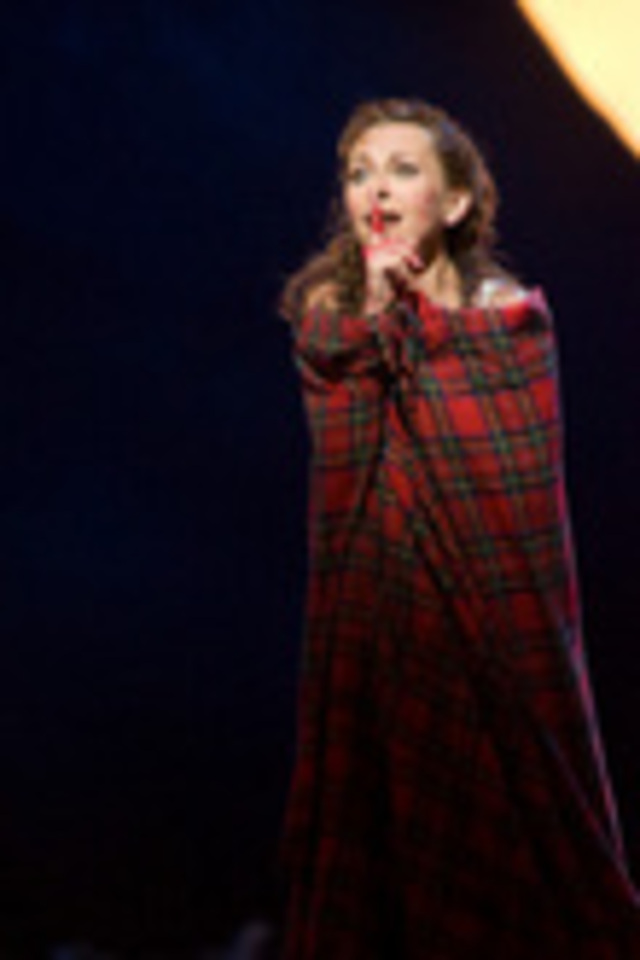
Photo credits: Terrence McCarthy/SF Opera. Above, Natalie Dessay, below Gabriele Viviani, then Giuseppe Filianoti

Lucia and her lover, Edgardo do not possess Juliet's wisdom, and with the moon as their only witness, they exchange vows of everlasting love. Both of them will soon doubt, by way of treachery from Lucia's brother Enrico, that their partner's love was likewise variable.

lucia2.jpgTo offset the roundness of the omnipresent moon, the set is framed by partitions which open horizontally and vertically, not unlike the aperture mechanism of a camera. The partitions provide a sharp, linear edge and divide the stage into an organic back section (where love happens, even though it's rather sterile with the leafless trees and the measly shrubs) and a hard-angled front (where lies and deception take place).

In a way, the symbolism heavy settings intellectualize the performance, and at first, it's hard to react to it viscerally. Some of the effects of the partitions opening up on a different sets were quite surprising and effective, and we do appreciate the mechanics of it. But the audience could not help giggling when the screens opened up horizontally in the lower tier to show only the heads of the choir (excellent, btw) at some point. Some gambits work, some don't.

Actually, the stuff that failed mostly happened in the first act: we'll list the unintentional ironies of the Captain Hook costume (what is he doing in sixteenth century Scotland?), and we had seen so much Scottish plaid in Act I that we actually were disappointed not to notice any kilts. Until Act III, where our prayers were answered! Still in Act I, the plaid became the instrument of a tug of war, when Edgardo threaten to kill Lucia's brother, who begs him not to. "I could honor my vow of revenge," sings he, pulling on the plaid; "no, yield to my love", says she, pulling the other way. Note to stage directors: ping-ponging with fabrics makes your actors look silly. Just before, we saw a spunky Lucia sauntering like a baby goat while Alisa, her companion, asks: "what makes you so anxious?" We do skip when we're worried too! We do cartwheels when we're concerned. And Matthew O'Neill, the first singer on stage, barely audible, did not exactly ignite a fire. We had seen the former Adler fellow in finer voice.

After the first act though, we got used to the conceits of the production, the weaker supporting cast receded in the wings, and we grew to enjoy the show. Even Oren Gradus as the priest Raimondo, who was rather anonymous in the early proceedings, finds redemption in the later part, with a magnificent, touching "Dalle stanze, ove Lucia." The superb cast of principals made it easy. Enrico (Gabriele Viviani) had the physical and vocal heft to intimidate Lucia. For some reason we can't explain (ok, we can explain it: unrequited provocation from the stage director), Enrico acts with his sister in a weirdly incestuous manner. Not enough to not be impressed by the overall performance.

Edgardo (Giuseppe Filianoti) has to deal with a wig that was left behind by the Guns'n'roses. Who knew they visited the War Memorial Opera House? He won't let his hair distract him from a focused performance, clear of diction, and emotionally potent. His voice meshes with Natalie Dessay's in the most lovely manner and there is more tenderness in their duet than in the awkward hurried kiss with which he bids her good-bye in Act I.

lucia3.jpgYou can tell Dessay has played Lucia many times, she owns the role. Her portrait is so richly characterized. She is in full control, and finds all the right nuances. She ranges from crazy full throated melismas to intimate, delicate sotto voce. Her voice is bright and powerful, but vulnerable and fragile at the same time. The opera of course culminates with Lucia's mad scene, and Dessay's descent into madness is a thing to behold. Her eyes wide open, she smiles as if she's gone off the deep end, disheveled, yet fully present. She exchanges melodic lines with a verrophone, an instrument with a ghostly, glassy sound (the original score calls for a glass harmonica, and the verrophone is a more modern update on the instrument which sounds louder) for an eerie, spooky effect. In Act I, she tells being haunted by the ghost of her mother, and in the mad scene, she convinces us she's dialoguing with it. Nuts, she's nuts.

The verrophone cadenza and the ornamentation were worked in concert with conductor Jean-Yves Ossonce, who did a fantastic job throughout. The overture was appropriately ponderous, yet with enough freedom for a clarinet riff to sound almost jazzy (some oboe sounded out of balance in a few spots though). He paced the pieces wonderfully, and found varied tempi even within the arias, taking an aria's mood from contemplative all the way to hectic. The performance of the verrophone (Alexander Marguerre) and the harp (Olga Ortenberg Rakitchenkov) were particularly noteworthy.

Lucia di Lammermoor
War Memorial Opera House
Shows:
Fri Jun 20 2008 8 pm
Mon Jun 23 2008 7:30 pm
Thu Jun 26 2008 7:30 pm
Sun Jun 29 2008 2 pm
Wed Jul 2 2008 7:30 pm
Sat Jul 5 2008 8 pm


Email This Entry


Advertisement: SFist Continues Below!

Post a comment (Comment Policy)

2003-2008 Gothamist LLC. All rights reserved. Terms of Use & Privacy Policy. We use MovableType.