About SFist

SFist is a website about San Francisco.

Editor: Brock Keeling
Publisher: Gothamist

About | Advertising | Archive | Contact | Job Board | Mobile | RSS | Staff

Categories
Favorites
Contribute

Latest tip:

Way to go, Ed Jew <a href="http://www.kcbs.com/pages/3117269.php?contentType=4&contentId=28 [more]


Latest link:


Latest Photo:


Recent Comments
Blogroll
Subscribe
Use an RSS reader to stay up to date with the latest news and posts from SFist.

June 12, 2008

SF Opera's Rheingold

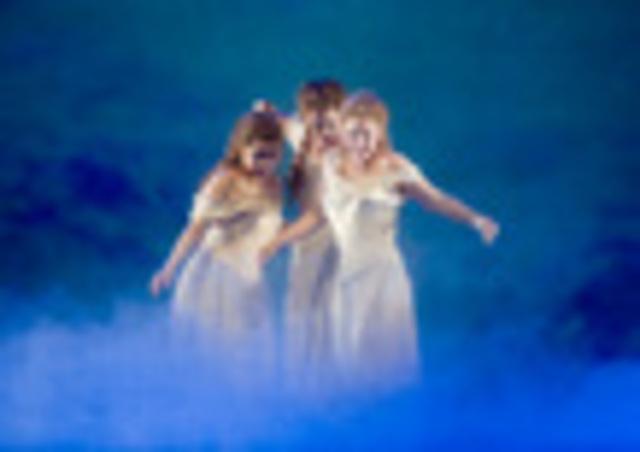
rheinmaidens.jpgWagner's Ring, which opened its new and awaited SF Opera production last week with das Rheingold, made the Gods human, if you will. Francesca Zambello, though, went one step further: he made them American. Zambello decided to stage Wagner's tetralogy, which will unfold over the next few seasons, as an American Ring. (The cycle is produced with the Washington National Opera, who got a headstart earlier a few years prior. Read the review of the other coast's Rheingold here.)

But! You can't predict whether this production will work, if the American angle will infuse the operatic sequence a juicy underlying story. Das Rheingold is a prequel of sorts. And insofar as opera goes, it's on the short side (two-and-a-half hours with no intermission). What's more, it's very male dominated, which isn't a plus in this case, and ultimately devoid of the passionate-love theme that sears the rest of the series.

In the end, the American setting is only an accessory to the music, which, we should note, was performed superlatively.

Above, the Rhinemaidens (Catherine Cangiano, Lauren McNeese and Buffy Baggott); below Fricka and Wotan (Jennifer Larmore and Mark Delavan); and Günther Groissböck and Andrea Silvestrelli (the giants Fafner and Fasolt) with Tamara Wapinsky (Freia). Photo credit: Terrence McCarthy, SF Opera

Part of what made the resetting in turn of the century America fall short of the mark is that we still have in our mind the recent production of Stravinsky's Rake's Progress, which used the same Go West! gimmick (and similar movie projections on a giant screen to fill up the set). Where the American setting added a new dimension in the Robert Lepage's production, here it seems to be too literal a reading. Alberich is a troll who steals the gold under the watch of the maids of the Rhine. He becomes a gold miner, dredging the river with his pan. The god Wotan is the ruthless and unscrupulous leader of a dysfunctional family: he now wears the outfit of a mafiosi. Loge, trying to extricate himself and others from tricky situations using his, comes off like an shrewd attorney. The two giants who build the fortress: they are skyscraper construction workers.

wotanandfricka.jpgFor these principal characters, the mapping does narrowly make sense. But in some cases, it ends up being artificial and distracting: we always imagined Donner's hammer to be something powerful and terrifying. If you insist on sticking to the Family theme, Robert De Niro's baseball bat as Al Capone, that would be a scary mjolnir. Here it turns out to be a wimpy croquet mallet, and Donner looks more ready to play bocce ball on the lawn in the Hamptons than defend Wotan from giant monsters.

Eventually, we found the American perspective sterile and reductive (but hey, we're French). Everything is brought down from the mythological level to a caricatured level. The elements which transcend the god-mortal relationship, blurred by Wagner, here disappear. Whereas one could argue that Wagner elevated man to the level of the gods by making the gods human, here, everything stays firmly grounded. Alberich would take the gold in his miner guise no matter what, that what 49ers do! Whereas Wagner has him forsake love to attain power, quite a different trajectory! It's Fasolt's love for Freia which dooms him: the ring's dilemma is love or power, but not both. He cannot renounce either, and ends up dead. Here, (even though the ring is used as the last item to hide Freia from his view) it becomes a dispute on greed and who between him and Fafner* will get the ransom they extracted from Wotan. More American a reading, for sure. yet, the decors (Michael Yeargan) were very eye pleasing, especially the watery first scene, the Indiana Jones-y forge scene, or the cute entrance of the Giants being lifted down from the sky on a steel I-beam. Plus we are a sucker for special effects, and Alberich's disappearing trick is impressive (Patrick Martin is listed as Illusionist, so he must be responsible).

giantsandfreia.jpgOk, so if we step away from the philosophical differences, we came out of the opera house quite happy: the cast and orchestra overwhelmingly sounded exceptionally well. Maestro Runnicles imparted a steady sense of pace on the music (again, it's two-and-a-half hours of continuous music, no break for the orchestra, which plays interludes during scene changes). The overture starts with a low muddle of bass strings (Runnicles did not take his customary bow and just jumped in), a deep, smoky, drone-y rumble which oh-so-slowly opens up, and the screen was covered with out of focus movies of space travel, or was it some lava lamp screen saver? What's more American than an acid trip? Of course Runnicles wove deep currents in the stream of the orchestra: it's the music of the Rhine, he's due for some flowing metaphors! But he did it deftly, so that the music really breathed. Wagner's actually returns to the overture's theme a few times, in particular in Scene 2 to the lyrics "wherever life ebbs and flows." So the music better ebb and flow,there's no way around it, and Runnicles got it down pat. He would pump the volume up a bit during the interludes to hide the noisy hammering of the decor change, but otherwise gave his singers room to shine.

Shine they did: we're looking forward to more Mark Delavan as Wotan, whose performance was very strong. He has the voice of a trombone, and sounds of burnished brass. He'll be back for more, and that's a strong casting, despite a slightly mechanical acting. Richard Paul Fink's Alberich follows the more dramatic trajectory, and Fink imparted the more varied emotions to his character: lusty troll at the beginning, bragging brightly in Scene 3, softer and prounder when describing his magic helmet, the tarnhelm which allows him to change shape, more plaintive as a captive, then vicious in casting his curse. The Giants, Günther Groissböck and in particular Andrea Silvestrelli, in witty costumes that make them actual giants, and the brightly toned Stefan Margita as Loge, were excellent as well. The sultry Rhinemaidens were sexy as hell. We won't acknowledge all the fine singers, but we'll salute new Adler fellow Tamara Wapinsky's debut on the main stage.


*Not to confuse with Fafnir, another mythological character who should, no, must!, be the subject of an opera.

Only 4 more performances!
das Rheingold
SF Opera, War Memorial Opera House
Box Office: (415) 864-3330
Sat Jun 14 2008 8 pm
Thu Jun 19 2008 7:30 pm
Sun Jun 22 2008 2 pm
Sat Jun 28 2008 8 pm


Email This Entry


Advertisement: SFist Continues Below!

Post a comment (Comment Policy)

2003-2008 Gothamist LLC. All rights reserved. Terms of Use & Privacy Policy. We use MovableType.