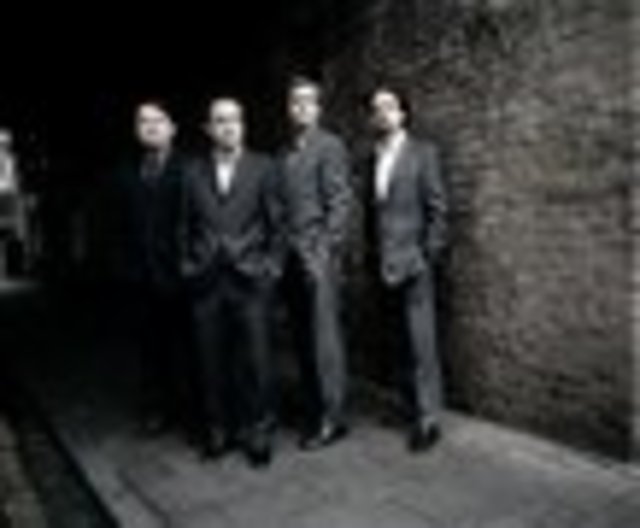
Emerson String Quartet.

emerson.jpgWe caught Phil Setzer, the violinist for the Emerson String Quartet, being driven down between performances in Santa Barbara and Orange County. We hope it was in a stretch limo, as these guys have won eight Grammy awards and critical acclaim everywhere they go. They are the only chamber music group to ever win a best classical album grammy, and they even got two. So they better travel like the rock stars they are. They'll be up here on Sunday for a performance at Herbst Theater presented by SF Performances. They'll play the integral of Brahms string quartets, or, as we like to say, tunes from their latest CD.

We missed some of what he said, coverage was spotty up in the hills north of LA and once Phil starts talking, he's hard to stop. He just won't let a disconnected call hold up a conversation. He is a great violinist, but he's a born teacher as well, and he is not stingy with explanations about the music. We had such a great time listening to him and there's so much interesting stuff in what he told us that we put it all below the jump, almost unedited. The answer to the first question is essential reading in music history 101, ok?

Picture of the Emerson String Quartet (from left to right, Phil Setzer, Eugene Drucker, Lawrence Dutton, David Finckel) by Mitch Jenkins

You are basically playing your latest CD. Could you whet our appetite for the program?

Phil Setzer: This program is one of the programs we’re doing in relation to the release of the CD, we're playing the Brahms string quartets, and we’re also playing the Brahms piano quintet in Orange County with Leon Fleischer.

Brahms was very much under the shadow of Beethoven. He was supposed to be the next Beethoven. But he was very intimidated by Beethoven, in particular in two, no, three areas: the piano sonata, the string quartet and the symphony. Brahms wrote 23 string quartets, and he discarded 20! All of his early attempts to write a string quartet were destroyed. The first two are the op. 51, and the third is op 67, which means he wrote them when he was already middle aged.

The string quartets show the influence of Beethoven in many ways. The first one is in the key of C minor, which is a tonality that Beethoven favored: the first piano concerto, the 5th symphony, the string quartet in C minor...

The Choral Fantasy...

Phil Setzer: The Choral Fantasy is in C minor too? So when Brahms writes his first quartet is in C minor, and his first symphony in C major but with significant parts in C minor, he is paying tribute to Beethoven.

The A minor quartet is paying to homage to Beethoven as well. It has more of a lyrical aspect to the music than is predominant in the C minor quartet, it is moving away from the influence of Beethoven. Brahms is finding his own influence and his own style. He features the viola more.

As for the last quartet, the op 67 a few years later, we see Brahms writing a piece that, like Beethoven, looks forward and backwards at the same time. It pays tribute to Mozart too, in particular the hunting calls of the Mozart “hunt quartet” (Mozart did not give it that name, but people name it that way because it echoes the calls of the hunt). Brahms inserts those calls in his quartet. Mozart’s quartet is also in B flat major, by the way. Brahms is paying homage to Mozart, but he also writes for the last movement a set of variation like Beethoven would do, based on a simple neo-classical kind of theme, on a rather sweet, innocent theme.

In a way, the B flat quartet is more Mozart than Beethoven, but it’s like Brahms paying tribute to Beethoven paying tribute to Mozart. There’s definitely a lineage, handed down from Haydn to Mozart to Beethoven to Brahms. Brahms is taking the torch from Beethoven and carries it into the romantic era.

These pieces are clearly romantic work, but Brahms’s structure and design never completely leave the classical period. That’s what’s wonderful about Brahms.

The song-like aspect of Brahms in the slow movement of the 3rd quartet, here he surpasses Beethoven in writing beautiful long melodies in a delicious way. It’s something Brahms carries from the classical period and finds his own voice as a song writer.

It’s interesting to hear the 3 quartets, they are not often played in one concert, it’s difficult to do that. Historically they are such important pieces and had such difficult birth for Brahms, it’s interesting to experience what he was struggling with and what he was able to achieve. Also, hearing his whole output for string quartets in one concert gives a historical perspective to it.

In the last quartet Op.67, the viola plays an even more prominent role carrying the main theme in the 3rd movement and in the 4th movement. You really see Brahms coming more and more enamored with the viola, which you see later in his life with the Viola Sonatas and the two songs for voice, viola and piano. Brahms is clearly falling in love with the viola.


It’s the 30th anniversary for the Emerson Quartet, that's pretty amazing, isn't it?

Phil Setzer: It’s the 31st season, and it’s been the same four members for 28 years. In two years, it will be 30 years with the same 4 people; perhaps it’s even more amazing. But in two years, we’ll celebrate privately, we won’t force that celebration upon our audience!

Like any relationship, there are some tensions, but we found a way to work together in a very efficient fashion. We spend a lot of time together. We always have a couple hours of rehearsal before concert, we record a lot, we are about to sign a new contract with DG.
What’s interesting about this group is that each of us is different, you wonder how we can make it happen together. But that keeps it fun. It’s not like we’re made out of the same mold.

That being said, we all admire the same people from the past or people that we work with, so the influences on us are similar and that is something we definitely agree on. We all admire the same masters, we all worship at the same shrines. Each of us has a good sense of humor, and we don’t take ourselves seriously, we take the music seriously, but we don’t take ourselves seriously past a certain point. We’re really trying to honor what the composer wanted, rather than promote ourselves through the music.

What do you guys do outside of the Quartet, do you have solo careers?

Phil Setzer: Everbody does different things. Eugene [Drucker, the other violinist] has just published a novel about a non-Jewish violinist during the Holocaust and being caught in the conflict, he’s had a lot of success and the book is doing extremely well

David [Finckel, the cellist] is the music director for the Music Society of Lincoln center with his wife, Wan Hu and they create the music@Menlo festival in Menlo Park.

Lawrence [Dutton, viola] plays in a string trio and they play probably 20 concerts a year in that formation

The Quartet teaches at Stony Brook university, we teach chamber music. And I’m there on the faculty as well as a violin professor. But the Quartet is the main focus in our lives, it takes priority.

It’s good to have other things, if there was only the Quartet, there would be more chances for tension to arise. There are other things and it’s nice when we come to the Quartet.

We haven’t seen you perform yet, but we saw a picture in the NY Times, and you guys are standing up. What happened?

Phil Setzer: We’ve been standing for 5 years now. We started doing that with an all Haydn program, we thought it would allow the first violin to be more virtuosic. We started standing for our 25 anniversary and the response of the audience was so great, and the sound was great too, so we kept doing it. It gives us more freedom, we’re not stuck in a chair. Plus, it sounds better to be away from the floor, with none of that early sound reflection. When we play with a pianist, we’ll sit, it’s difficult to communicate otherwise.

With David, we put him on a platform, so that the cello can be at the same level. It’s very natural to us. And now, some younger quartets are trying this as well.


You guys are regular visitors to the city, any favorite places, any SF stories?

Phil Setzer: We’ve had a long tradition of paying in the bay area, we’ve played almost every year at Stanford from the beginning of our career, we played several times in Berkeley, several times in SF. It’s an area where we feel very comfortable, we feel we have an audience when we walk off the stage that can recognize us.

Some places hire you and feel they should have always different people coming. I think it’s a mistake, it’s better to nurture the relationship between an audience and the group by coming regularly. I have close friends in Oakland, in San Francisco, it’s like a 2nd family. It’s definitely our home on the other coast.

Thank you so much!

Email This Entry


Post a comment (Comment Policy)

Tips

About SFist

SFist is a website about San Francisco.

Editor: Brock Keeling
Publisher: Gothamist

Contribute

Latest Tip:

Elihu Hernandez is running for Board of Supervisors in District 6 and he is having his campaign kick
[more]

Latest Photo:

Recent Comments

Subscribe

Use an RSS reader to stay up to date with the latest news and posts from SFist.

All Our RSS