Who better to compose an opera on the repetitive forces which govern human nature than Philip Glass! There is no better match to write about the immutability of the human soul, as the theme begs for an insistent ostinato in a minor key, of course. His score is one of the strong points of Appomattox, which had its premiere on Friday night: it is distinctly Glass-ian, but integrates elements and influence contemporary to the civil war. There is a substrate of minor third pedals and a restrained palette of rhythmic motifs in the orchestra, but this is the scaffolding which sustains a surprising variety of colors and sounds. The leading men have singing patterns which are close to speech, but Glass lets his hair down with the women, providing superb arias to moments of intimacy, or pettiness, or even, in the case of Mary Custis Lee, ugliness.
The most powerful moments are written for the chorus: the aforementioned opening women choir, for instance. But Glass also recycles We’re tenting tonight, a song of the era, to intense dramatic effect. Even more dramatic is the Marching Song of the 1st of Arkansas. It is the anthem of a black Union regiment, sung in its original melody with Glass’ arrangement to it. This is the climax of the opera, as the military victory and the dreams of black emancipation coalesce here, only to go their separate ways in the second Act.
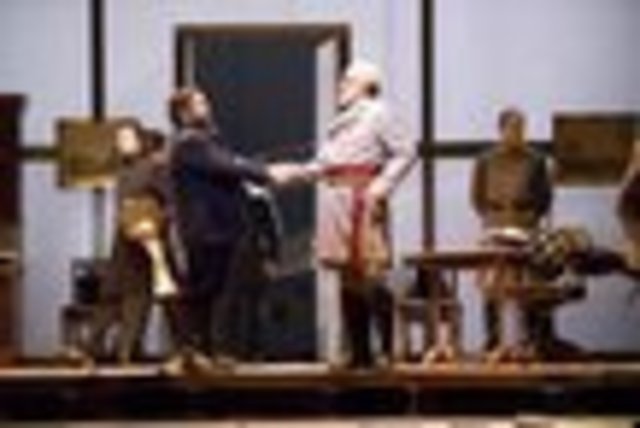
Pictures by Terrence McCarthy, SF Opera. Andrew Shore (left) and Dwayne Croft above, Noah Stewart below
Appomattox’s first performance was so marred by imperfections they should have hung a fresh paint sign on it, but it nonetheless offered glimpses of a beautiful, compelling opera. The opera takes place in April, 1865, as two generals, Ulysses Grant and Robert Lee attempt to outflank each other, Grant trying to conclude the war, Lee hoping to find a breach in the Union lines to keep it going another year.
Well, we know how that worked, and composer Philip Glass and librettist Christopher Hampton do not introduce any revisionist twist. Actually, it is so historically accurate that it feels sometimes like a history class, complete with maps of the troupes movements and a detailed biography of Ulysses Grant. The element of surprise, denied to us by being faithful to history, is provided by a glimpse into the personal life of the protagonists, and especially the women around them.
As historical figures, Grant and Lee are fascinating personalities. As opera characters, there are pretty single dimensional, with similar emotions and rather flat melodic lines. We like epiphanies! The only character as a matter of fact which undergoes a radical transformation is T. Morris Chester, in a stage stealing performance by Noah Stewart, singing with gut wrenching passion. He is an African-American journalist, a true historical figure, who was writing enthusiastic dispatches from the fall of Richmond, sitting in the speaker’s chair in the confederate capitol building, in Act I. In Act II, he comes back disillusioned: while slavery was abolished, violence against black people had not stopped. The reconciliation brokered in Appomatox, the generous terms of surrender in order to facilitate the after-war, did not include black people. Chester’s great hope had been betrayed.
This is a pretty pessimistic outlook. Even more pessimistic is the emphasis on the impossibility for human nature to change. Except for Chester, characters do not evolve, and the opera runs in a circle, book ended by the same opening aria, sung by a woman chorus of “War is sorrowful.” It is a pretty cliché construction, so we have to believe Hampton and Glass believe quite strongly in the message of stasis and condemnation to repetition to put it out there so explicitly. The opera builds an aria around Lincoln’s statement: "What has occurred in this case, must ever recur in similar cases. Human-nature will not change."
They make the point in Act II by inserting events a few years later, and 100 years after the signature of the surrender where hate, violence and racism still hold forth. There is some truth that Appomattox did not end racism, but the implication that nothing can change is a bit too depressing to us. The intrusion of violence after the end of the War is unfortunate indeed, but it’s not exactly as if status quo was preserved. Call us naive, but we’d like to think some progress has been achieved.
The women end up with the nicest arias, in particular Rhoslyn Jones (Julia Grant), haunted by the pain and suffering, and Heidi Melton (Mary Todd Lincoln), who has an incandescent premonition of the assassination of her husband, Abe. All the girls, and Noah Stewart and Jeremy Galyon as Abraham Lincoln are Adler fellows, that’s a rich training program.
Andrew Shore is Ulysses Grant, and Dwayne Croft is Lee. Shore manages to impart a bit more life to his part, despite blundering badly through his “reading of Gen. Lee’s letter” aria. He definitely is the more committed actor. But why didn’t just write the lyrics on the letter he was reading? That would be too simple.
The alternative would be to rehearse the thing a few more times, as Gen. Grant was not the only one caught unprepared: his aide-de-camp jumped the start of a previous line, or a trumpet line was off from the freed slaves choir it accompanied. Maybe conductor Dennis Russell Davies, otherwise providing a steady, deliberate beat, should give better cues, this is not music that conducts itself. They’ll have it worked out for the next performance, you won’t get entertained by those.
A word on the stage setting: period costumes and accessories, but harsh metal and white lightings. We could not make really sense of the sets, where a supernumerary pushes a shopping cart full of body parts (to an underground Frankenstein factory, we assume?) or dead horses rise from the ground to hang on the ceiling. Alloy, what have they done to you? Ok: hanging stuff up on nooses was a hobby at the time, that’s symbolism, we get it. But the rigor mortis’ed horses were too campy to elicit anything but laughter. Still, the setting and the few mishaps mostly did not distract from a brilliant opera.
Appomattox
San Francisco Opera, War Memorial Opera House
6 performances remaining: Wed. October 10, 7:30pm, Sun. October 14, 8pm, Tue. October 16, 8 pm, Thu. October 18, 7:30 pm, Sat. October 20, 8 pm, Wed. October 24, 7:30 pm.
Box office: 864-3330


Interesting how I agree with all of your observations, and yet came away hating the whole thing.
Methinks the dead horses at the end were meant to symbolize lynchings of blacks.
I'm sorry you did not like it Cate. Was looking at the reviews today, and maybe the Merc agrees with you: http://www.mercurynews.com/columns/ci_7112542
I did not know nothing about the civil war, so all the exposition stuff was interesting to me, but I understand you could find it too teachy.
Cement Brunette: most definitely.
>>Who better to compose an opera on the repetitive forces which govern human nature than Philip Glass!
Someone whose work is capable of keeping me awake?
i didn't like the opera either. i wish glass had written about something else honestly. the opera was just a little underwhelming in general, though it tries to be powerful at times (and sometimes succeeds).
i knew a couple people in the chorus, and they were awesome.
and i swear that i saw the journalist singer (who was the best singer) at Cafe Flore this past weekend.