SFist Julie checked out the "Great Men of Genius" show in Berkeley -- and she thinks you should too!
We have some bad news for you. Unless you see all four of Mike Daisey's "Great Men of Genius" monologues (and see them IN ORDER), you might miss the point.
While none of the promotional materials made this clear to us, GMOG is NOT in fact one man acting as four different "geniuses" -- Bertolt Brecht, P.T. Barnum, Nicola Tesla, and L. Ron Hubbard -- in four 75-minute monologues -- à la that guy who performed at our high school dressed as Abraham Lincoln and talked about the Gettysburg Address.
Rather, this is one five-hour monologue, broken up into four segments, wherein the true genius of the piece, Mike Daisey, interweaves vignettes from his life with the excerpted life stories of those famous men. He paints for us not only pictures of who these men were, but also of himself, and, by association, how the productivity and madness of genius can be expressed in our own lives.
And did we say he's funny? Daisey is freaking funny. And smart. By the second monologue, we were resolving to read more about historic figures, to similarly learn their anecdotes and become just that much more interesting.
Honestly, we were hardly excited at the prospect of five hours of theater on Sunday. Actually, more like six if you count the 15 minute intermissions, not to mention the two hours between matinee and evening shows (during which we highly recommend you dine at Downtown restaurant just up the street. If nothing else, eat the fried, anchovy-stuffed olives... once... in... your... life).
We called nearly everyone we knew to go with us to this show. Come on. Free tickets? No one bit. Biographical monologues? No thanks. We begged our editors to let us just see one monologue and generalize to the other three. No dice. Our husband had to be dragged, and even then, we could only in good conscience subject him to half the day (he chose the 7 p.m. show), but as we filled him in over dinner on what he had missed from the beginning, he regretted his decision.
Now, if you must choose only one, which one should you see? We'll give you our vote: Barnum. Although the Tesla story is a close second. And that's because we really like these things (in no particular order): freaks, burlesque, clever public relations strategies, and major international governments who build giant Death Rays.
So, back to our odyssey. In the first few minutes of Brecht, Daisey had us in the palm of his meaty hand, tickling our bellies. (Our scribbled notes in the darkness say this: "Fucking HILARIOUS.") He explains how Brecht changed his name from Bertold to Bertolt (the German equivalent of changing Michael to Michaelk), wrote his own manifestoes on how to be Brecht-IAN, slept with scores of women despite his apparent lack of good looks, and is responsible to this day to much of the bad art we see in theaters. Daisey comments, "No one wants to make bad art, and yet it happens. Again, and again, and again."
As Daisey unfolds the life of this first genius, who "believed that art could change the world," and who was in fact the subject of Daisey's thesis in college, he surprises us with flashbacks of his own college-era exploits, including one explosive political-art act that led school administrators to organize a public hearing and demand that he apologize to the entire student body and faculty. In alternating scenes we are also invited into his longtime collaborative relationship and marriage to his director, Jean Michele Gregory.
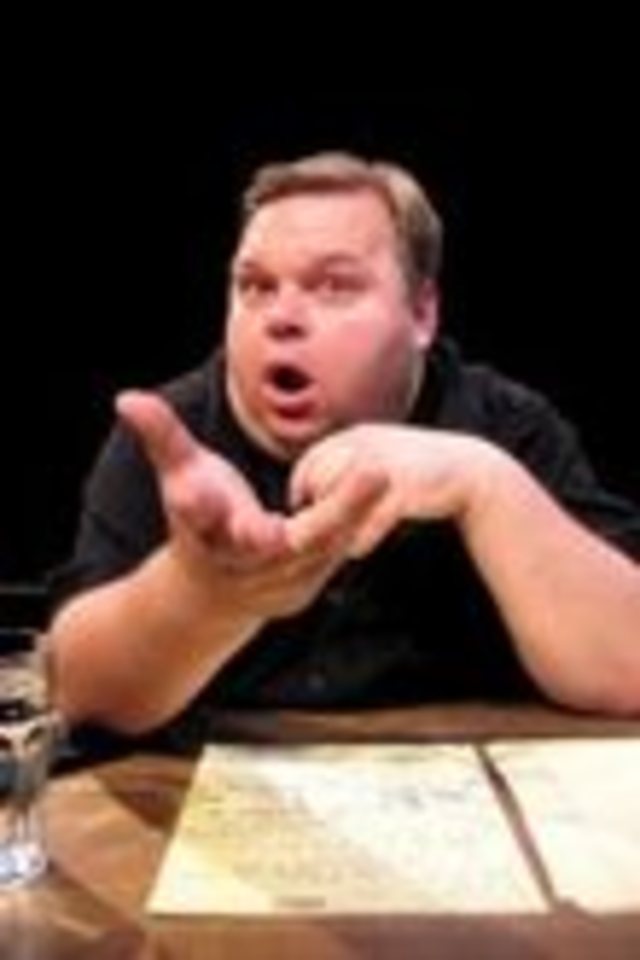
Throughout all four monologues, Daisey sits on a wooden chair, at a wooden table, with his notes on lined yellow paper, a glass of water, and a black kerchief for brow mopping. He's dressed all in black. Lighting changes are minimal. He is a cross between Louis Black and Andy Richter, or the love child of Spalding Gray and Micheal McShane. When he makes certain points, his chin pushes up into his stout face and he looks not unlike a very sweet bulldog.
A modern-day tale of nouveau burlesque at a bachelorette party creates the perfect foil for the virtuosity of P.T. Barnum. Daisey's complicated relationship with his naval war hero grandfather offers dark echoes to the exploits of Commodore L. Ron Hubbard and his mystery ship of Scientology. Daisey's grammar school obsession with nuclear winter contextualizes the cold-war era manifestations of some of Tesla's "madder" experiments.
The opportunity to juxtapose not only Daisey's life with the geniuses, but also to view the geniuses in relation to each other, creates even more dimension. Each man's efforts or lack of efforts at interacting with the public or publicizing their works, each man's conflicts with the American government, even each man's cultivation of a coterie of humans (or animals), all of these stories grow larger in their similarities to each other. The ultimate result is a vivid and detailed portrait of the nature of megalomania and success.
Because Daisey works from an outline, performances will vary somewhat. He has the freedom to improvise, which is part of what keeps the show energetic. However, on Sunday, he seemed to get a little loose in the latter half, often repeating phrases, and even stuttering a bit, where the first half had felt more solid. But these are minor complaints as overall the five-hour plus journey was brilliantly executed.
We say, stock up on trail mix, coffee, chocolate, and get tickets for one of the remaining Sunday marathons before this unique theatrical experience sells out.
Great Men of Genius
Brecht: Wednesdays, 8 p.m.
Barnum: Thursdays, 8 p.m.
Tesla: Fridays, 8 p.m.
Hubbard: Saturdays, 8 p.m.
Marathons:
Brecht and Barnum: Sundays, 2 p.m.
Tesla and Hubbard: Sundays, 7 p.m.
Tickets: One genius $30, Two Geniuses, $50, all Four Geniuses $75.
Box Office: (510) 647-2949, www.berkeleyrep.org


Post a comment (Comment Policy)