About SFist

SFist is a website about San Francisco.

Editor: Brock Keeling
Publisher: Gothamist

About | Advertising | Archive | Contact | Job Board | Mobile | RSS | Staff

Categories
Favorites
Contribute

Latest tip:

http://s [more]


Latest link:


Latest Photo:


Recent Comments
Blogroll
Subscribe
Use an RSS reader to stay up to date with the latest news and posts from SFist.

May 8, 2007

Shipwreck'd At Ocean Beach

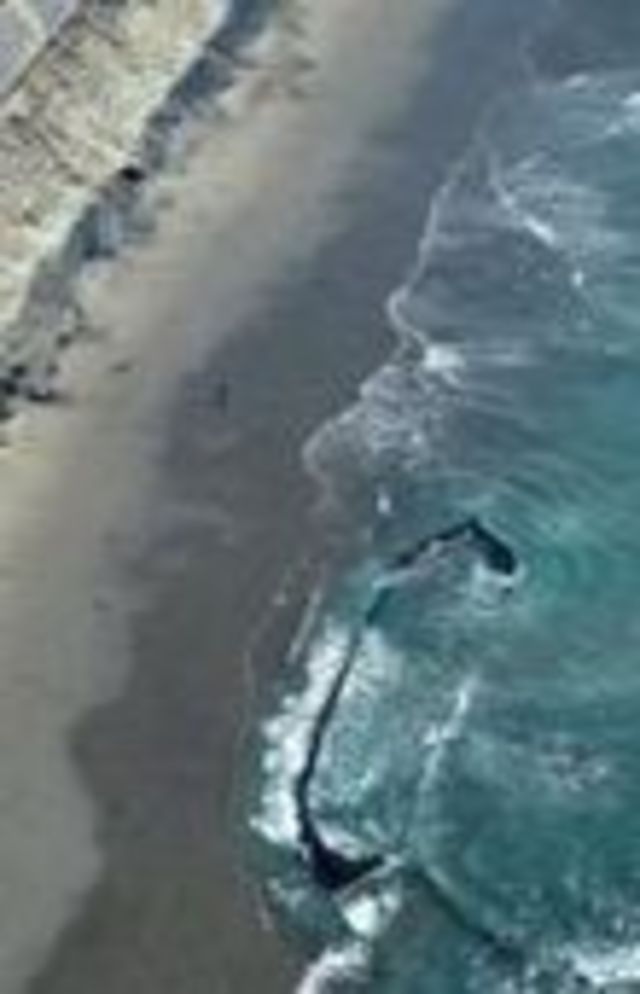
GOGA-KIPH-007.jpgEvery now and then, when the sand moves, you can see the remnants of shipwrecks on the shore of Ocean Beach -- and yesterday, folks enjoying the warm weather at low tide caught a glimpse of the remains of the King Philip clipper ship. A pirate ship? A tragic capsizing? What's the word?

Well, the King Philip sailed in the mid 1800s, and primarily carried guano or lumber. On its final voyage, it (she? Is the ship a she if it's/she's named after a male?) sailed to the Golden Gate to assist another ship in distress, but drifted loose of its/her anchor and ended up capsizing in Ocean Beach. All the sailors escaped safely.

The King Philip is usually underneath the sand, but was revealed once before in the 1980 El Nino. It's still visible as of the running of the story, but may get buried under the tide any moment now. So go check it out!

There are over 100 shipwrecks in the waters off the San Francisco Bay Area coast, including the Tennessee, a Gold Rush steamboat that sank in 1853 near Marin City, the Reporter, a schooner that sank in 1876 and whose remains are intermingled under 5 feet of sand with the King Philip on Ocean Beach, and the City of Rio de Janiero, which sank in 1901 off Point Diablo.

Picture of the King Philip ship from the National Park Service website.


Email This Entry


Advertisement: SFist Continues Below!

Comments (5)

We've digitized the official National Park Service guide to shipwrecks -- you can download it here.


Nice work on that document - from it:

In 1982 a resident of San Francisco's western shore notified GGNRA park staff that
the remains of a wooden vessel were exposed at the foot of Ortega Street on Ocean
Beach. Investigation of the site in 1982 provided no results; only 3 inches of frame
ends and a stem post were visible. Winter beach erosion in early 1983 exposed
more of the bow and stern structure, however. The exposed remains were mapped
in March 1983 by a team led by Delgado and Mayer that included volunteers Greg
Brown, Rebecca LaFontaine, Robert Bennett, and Raymond Aker. Detailed
measured drawings of the vessel's scantily exposed bow and stern were prepared,
and the vessel was identified by size and location as the 1856 medium clipper King
Philip, wrecked at the site in 1878. Timber samples taken in 1983 helped confirm
the identification of the vessel, which was probed with a water-jet lance. The team
encountered shingle, some apparent ballast, and the buried port and starboard
portions of the hull midships. As a result of the probing, it was determined that
from 40 to 50 percent of King Philip's intact hull lay buried on the beach.

The vessel remains were buried by summer beach accretion in 1983 but were
exposed again, this time to a greater extent, in April and May of 1984, allowing for
diver access to the bow and the sternpost, which still held the gudgeons and
dumb-chalders for the rudder. The entire outline of the hull was exposed, and
documentation of the wreck's upper portions proceeded photographically and
through measured drawings. A magnetometer survey of the hull and wreck area
indicated a considerable buried mass of wreckage near King Philip's bow. In
addition, intrusive wire rigging, a lead soil pipe, small bobstays with deadeyes and
hemp rigging still attached, and Douglas fir timbers with iron drifts indicated that a
second wreck lay adjacent to and partially inside King Philip. The second vessel
was determined to be the 1875 schooner Reporter, wrecked at the same site in 1902.

The remains of King Philip have not been sufficiently exposed since 1984 to allow
further documentation. A preliminary site report was prepared in 1985 and
published in Historical Archaeology Special Publication No. 4, Proceedings of the
16th Annual Conference on Underwater Archaeology held in Boston, Massachusetts,
in 1985. The wrecks of King Philip and Reporter were nominated to the National
Register of Historic Places in late 1985; the sites were placed in the National
Register at a national level of significance on May 11, 1986. King Philip's
substantially intact remains comprise the only known remains of an American
medium clipper ship, and are the most intact known remains of any wooden
shipwreck on the California coast.


Are you sure this isn't to promote Pirates of the Carribean 3?


I've been getting hits to my post about shipwrecks so i thought I'd just post it here.

There are 2 cool resources:
- the maritime museum in the Argonaut Hotel in Fisherman's Wharf. It's on Jefferson @ Hyde. They have a very cool video of bar pilots, and a big map of all of the shipwrecks in the "potato patch" outside the golden gate.
- the historical plaque at Front & Embarcadero that shows sunken ships in the vicinity.


the link is:

"recap of north beach newspaper & shipwrecks"

Anyways, it seems very random but it's interesting. Great article!

 
Post a comment (Comment Policy)

2003-2008 Gothamist LLC. All rights reserved. Terms of Use & Privacy Policy. We use MovableType.