About SFist

SFist is a website about San Francisco.

Editor: Brock Keeling
Publisher: Gothamist

About | Advertising | Archive | Contact | Job Board | Mobile | RSS | Staff

Categories
Favorites
Contribute

Latest tip:

Great story about how the original Peet's in the East Bay outlasted its Starbucks neighbor: [more]


Latest link:


Latest Photo:


Recent Comments
Blogroll
Subscribe
Use an RSS reader to stay up to date with the latest news and posts from SFist.

November 28, 2006

SFist in the Kitchen: Risotto

We remember the late 90's when every food magazine offered the definitive risotto technique. Writers trudged to Italian villages to learn how rural matrons made this popular dish. Even as newbie foodies, we rolled our eyes at these accounts. Why make it sound so treacherous?

We have a tried and true technique, learned not at the side of a Piemontese peasant woman but through observation and common sense. Risotto is a stress-free dish that's perfect for a quick meal on a winter night. It's nothing more than rice, liquid, dairy, and optional add-ins. The only trick is to use a short-grained Italian rice such as arborio or carnaroli. These special rices absorb a large amount of liquid and sport a starchy endosperm that will add creaminess to the final product.

risotto_making1.jpg
Photos by Melissa Schneider

First, bring some liquid to a simmer in a pot. A lot of that liquid will end up in the rice grains, so you want something with flavor. We often use stock, but we've used wine, the liquid left after rehydrating dried mushrooms, and so forth. Even a rind of Parmiggiano-Reggiano simmered for twenty minutes in a pot of water will create a rich taste. We use three to four cups of liquid per cup of rice to account for evaporation, and about one cup of rice for a main course for two people.

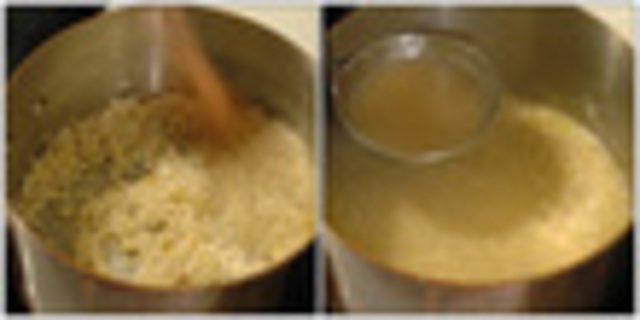
In a separate pot, sauté garlic, onions, or shallots in butter or oil. Add your rice and stir to toast the grains and coat them with fat. After a minute or two, you'll be able to lean over the pot and hear a slight whistling noise from the rice kernels. This is the sound of moisture in the kernels escaping as steam, but don't fret; you'll replace that moisture with your cooking liquid.

risotto_making2.jpg
Once your rice starts singing, add a couple ladles of liquid. It will hiss and sputter in a satisfying way. Cook over medium heat so the pot stays at a gentle simmer and keep just enough liquid in the pot for the rice to swim a bit as you stir.

Because you'll stir the whole time. We've heard "experts" suggest that you only stir in one direction, but we think that's nonsense. You're stirring to break up that starchy coating on the rice grain, which will in turn thicken the liquid. Stir and add liquid as needed.

In about 15-20 minutes, the rice will be tender with a firm core. Let the liquid reduce, and add dairy for a burst of richness. We often use Parmiggiano-Reggiano, but cream is another popular choice. Season to taste, and serve immediately on warm plates; as the risotto sits and cools, the starch molecules harden and form a globby mess. (If you end up with leftover risotto, leave it in the refrigerator overnight, and form the hardened risotto into balls. Dredge in flour, buttermilk, and flour again, and then deep-fry.)

Our basic technique covers every risotto we've ever made, but the fun and diversity of this dish comes from the other ingredients you include. Add them into the pot based on their cooking times. When we made a butternut squash-chestnut risotto two weeks ago, we added the raw squash cubes and peeled nuts at the beginning so that they'd have time to cook in the hot liquid (we used more liquid as well). But when we made a turkey-sage risotto with Thanksgiving leftovers, we added the cold, diced turkey near the end to reheat it, and added the sage at the last second so it wouldn't cook too much and lose flavor.

Roasted garlic-rosemary risotto is popular in the SFist test kitchen. We roast two heads of garlic, and squeeze the cloves into the rice at the beginning of the cooking, so that the garlic gets puréed into the rice. We add the finely chopped rosemary near the end, because as a woodier herb it takes a little longer to soften.

The creamy quality of risotto wants a complex, acidic wine to cut through the fat on your tongue. Choose a pinot noir if you want a red wine, or a Vouvray or Riesling if you want a white wine.

Got some favorite risotto combinations? Let us know in the comments.


Email This Entry


Advertisement: SFist Continues Below!

Comments (17)

Risotto is a classic blank canvas for wild mushrooms. Some shellfish risottos can be sinfully delicious (lobster, crab), but moderation is key.


That reminds me of a lobster risotto that Melissa and I ate at Capo in Santa Monica. We learned that one of the regulars will arrange layovers in Los Angeles, just so that he can send someone to get some of the risotto. I could see why.

And yes, wild mushrooms are great in risotto.


not be nitpicky, but photos need white balancing.


I entirely agree that risotto is "stress free". And besides mushrooms, bacon is always a tasty addition. My own recipe for Risotto, with Bacon, Asparagus, and Shitake Mushrooms.

(note: fixed the link. dfs)


Hey J, hate to break it to you, but these are the colors of our risotto: yellowy brown. It's not a bright white rice recipe. Though not pretty, it is very tasty.


Where is the white wine? Try adding about a cup dry white wine as the first addition of liquid and then go with stock. The wine helps balance out the dish.
Also, finish with EVO and butter, yum.
Take some leftover cooked squash, honey and a quality blue cheese for a different twist.


Thanks for fixing the link, Derrick.


while there are as many ways to cook risotto as there are people who cook it, i have to wonder... where is the butter finish? where is the white wine?

adding the rice to a saute of onions will not actually toast the grains as much as it will soften them. they can be introduced to the pan together, but if the onions are cooked first, the moisture they release will inhibit any browning of the rice. and if the rice is not toasted before the introduction of the stock/wine, it will not be a "true" risotto...

also, while shown in the picture, the importance of a wooden spoon should be noted. metal spoons will alter the color of the mixture.


Right on kainoa! No metal spoons, heavy bottom pan is key too.


Bikinchef and Kainoa,

I don't think I've ever finished with butter, but I'll give it a try (I usually just use cheese, which has often seemed rich enough). I mixed vermouth and stock for the turkey-sage risotto. Thanks for the tip.

Luke,
I'm all for bacon in risotto. Melissa wants me to recreate a bacon and egg risotto that we ate at Craft in New York (with the egg yolk serving the same role as the butter that bikinchef and kainoa suggested, except that the diner got to break it up).


I love risotto but it is one dish that I've never tried. I tend to be an impatient cook and want something fast and easy. I look at the recipe and see all of that stirring and absorption of liquid and usually end up making something faster. You have inpired me to give it a try. Is it your main course or do you serve it as a side dish with meat?


Nice article, it's a good introduction. I'm with Kainoa that adding white wine adds a lot of complexity to the taste of the dish. After the glazing the grains in the sauteed onions (try fennel too), turn up the heat and pour in a glass of wine (before the stock). Let it evaporate and then smell the rice. It'll be heavenly. Then continue with the stock as usual.

Another trick is to add the dairy (I use parmeggiano) after taking the pot from the heat, then cover and let the rice absorb the dairy flavors for a minute orso with the lid on top.

Thanks for the article,

--nico


Linda,

Like pasta, risotto in Italy is generally consumed by itself as a separate course that precedes the main course. At least for purists, neither pasta nor risotto are served as "side dishes". Neither dish should wait for diners; as a matter of fact, it's vice versa. Diners should wait for pasta or risotto and eat it as soon as it has been prepared.

Of course, most Americans care little about such matters (and commit numerous other atrocities like cutting long pasta, noodles swimming in sauce), so feel free to do whatever you want with risotto. If you want to serve it as a side dish, go ahead.


TinMan,

you are right in your comments, although the one risotto exception is Risotto Milanese which is a saffron-based risotto (it's red!). Traditionally, it is eaten with osso buco (braised veal shanks).


Another classic northern Italian risotto is made with fresh spinach. It's delicious and very green :-)


I have never made risotto before and you have inspired me to try. But first, I have a few questions.

1) When you say that when that you added the raw butternut squash and peeled chestnuts at the beginning, when exactly do you mean? How much more liquid did you add? Did you still use onions before and Parmesan or cream afterwards (if so, how much)?

2) What kind of oil did you use to saute the garlic, onions, or shallots? How much of the garlic/onions/shallots did you use?

3) How do you roast the garlic so that you can squeeze it out?


M,

I'm glad the article inspired you.

I added the squash and chestnuts after the first addition of liquid. That way, they had plenty of time to cook in the stock/wine. I probably had to use a cup more than normal of liquid. I still added onion (about half of one yellow onion) and Parmesan (probably about 3/4 cup grated cheese).

I used regular olive oil for sauteeing the onions.

Best way to roast garlic: Put the heads of garlic into a square of aluminum foil. It should be loose around the heads, but should be sealed around them. Put in a 425 oven for 30-40 minutes, until soft.

Hope that helps!

 
Post a comment (Comment Policy)

2003-2008 Gothamist LLC. All rights reserved. We use MovableType.